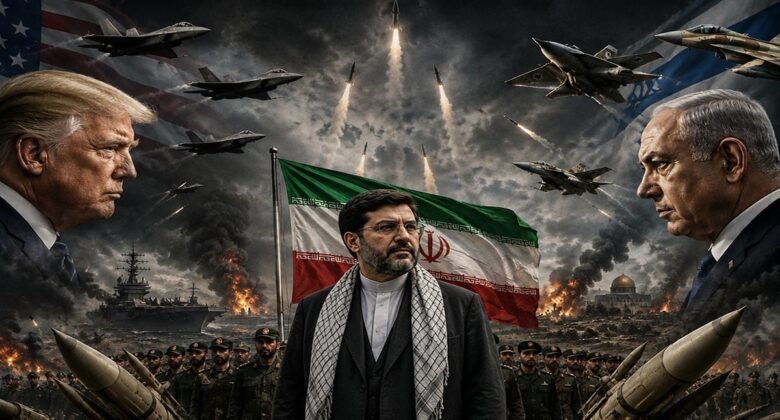
Vishwakhabram: US-Israel used all their strength, but still how is Iran standing firm in the field?
Despite more than 100 days of continuous bombing by America and Israel, the death of top military commanders, hit to oil income and structural destruction, how has Iran still not come to its knees? This is the question that has shocked the entire world. The question is arising that what is the power that is still keeping Tehran stable? The world wants to know how a country, whose economy had been suffering the burden of sanctions and isolation for years, is able to meet the needs of its citizens and soldiers even after such deep wounds of war?
Let us tell you that according to the estimates of the United Nations, the war has caused a loss of about three hundred forty seven billion dollars to Iran and its economy may shrink by more than six percent this year. Hospitals, schools, gas fields, steel plants and even residential areas have been destroyed in the attacks. Thousands of people died and the lives of lakhs of families were shattered. Despite this, Iran’s system has not completely collapsed. This has become the biggest concern for western countries.
Actually Iran is not an ordinary economy. It has learned to live through decades of war, economic blockades and international sanctions. The harsh sanctions imposed by the US after its exit from the nuclear deal had already pushed Iran towards becoming self-reliant. This is the reason why even when the oil trade was attacked today, Iran was not completely broken.
The biggest blow came when Iran closed the Strait of Hormuz following a joint attack by the US and Israel in February. It was believed that this would break the global oil market as well as the back of Iran itself, because close to the world. One-fifth of the oil trade passes through this route. But here Iran’s years-old preparations came in handy. Just before the war, Tehran had accumulated huge revenues by rapidly increasing oil exports. This stock has now become a protective shield for him.
Iran did not rely only on oil. He had created a network of shell companies and secret fleets through which his oil exports continued. Many ships turn off their indicators at sea and transfer oil to other ships in mid-ocean so that they cannot be monitored. This entire strategy has evolved over the years while fighting sanctions.
Tehran played another big gamble. The Iranian government imposed strict restrictions on imports of many essential products, such as agriculture, steel, and petrochemicals, but also increased exports from sectors that were not dependent on the Strait of Hormuz. There was a sudden boom in rail trade with Pakistan, Afghanistan and Central Asia. Northern ports, previously primarily used for trade with Russia, were also activated. This strategy saved Iran from complete isolation.
If seen, an old economic thinking is also working behind all this. In 2013, Iran’s then supreme leader Ayatollah Ali Khamenei implemented the policy of economic deterrence. Its objective was to strengthen domestic production by reducing dependence on foreign imports. Due to heavy duties, foreign goods started disappearing from the market and local industries gained space. Today the same policy is proving to be a shield for Iran in times of war.
However, this does not mean that the Iranian people are living a comfortable life. The situation is very difficult. According to the International Monetary Fund The Iranian economy could suffer its worst decline in decades this year. Inflation has reached above 77 percent and the Iranian currency Rial is continuously registering a historic decline. Everyday items have become out of reach of common people. Even eggs, rice and potatoes have become expensive. People are forced to abandon meat and chicken and adopt cheaper alternatives like soybean.
According to reports, the situation has become so bad that it is now becoming difficult to pay for simple services like books and taxi rides. Due to cash crunch, families have become dependent on borrowing. Unemployment has also increased rapidly. According to Iran’s Ministry of Labor and Social Welfare, at least one million jobs have been lost since the US-Iran tensions began. The United Nations Development Program estimates that about 41 million people could fall below the international poverty line.
Not only this, even before the war the condition of Iran was not very good. US sanctions had almost exhausted the supply of foreign currency. Due to shortage of dollars, imports became expensive and the burden of inflation on the public increased. There were large-scale demonstrations in the country against the fall of the rial, which also led to strict action. The Iranian government replaced the central bank chief, launched cash assistance schemes and raised salaries of government employees, but the public could not get relief.
On the other hand, another interesting turn among such news came when the Iranian Embassy in India completely rejected the media reports in which it was being said that there was a severe shortage of essential commodities in Iran. The embassy claimed that the government, under the leadership of President Massoud Pejeshkian, had completed the supply system. The situation has remained stable and there is no crisis of any essential commodity in the country. Besides, some foreign media were also accused of spreading biased news.
The biggest question here now is whether the economic crisis can lead to regime change in Iran? Analysts believe that public dissatisfaction is definitely increasing, but the danger of change of power is limited at present. The reason for this is the strong control of the Islamic Revolutionary Guard and the rise of anti-America and Israel sentiments. The war has rallied a large section of the public behind the government.
Still, the future does not look easy. Iran will need huge investments to rebuild its collapsed infrastructure. There is strong talk in western countries that billions of dollars of international investment can be brought for reconstruction. But the question still remains whether despite sanctions, war and economic devastation, Iran will be able to survive further with its stubbornness and policy of resistance, or will the coming days prove to be the toughest test for it.
-Neeraj Kumar Dubey