
Editorial: India’s innovation challenge remains
Though India has emerged as one of the world’s largest producers of scientific publications and patent filings, it continues to lag behind in research spending relative to the size of its economy. One of the reasons for this poor performance, compared with other major economies, is that has traditionally been the exclusive domain of the public sector since independence, and the private industry was largely insulated from innovation. However, a positive shift is happening now. The latest report by the Department of Science and Technology on India’s research profile reveals a major milestone. For the first time in the country’s history, private industry’s share of the Gross Expenditure on Research and Development (GERD) stood at 51.8% in 2023-24, overtaking the combined spending of the central and State governments. This significant jump from 45.5% in 2021-22 is a welcome development. According to the Economic Survey 2025-26, India’s GERD stands at roughly 0.64% of — a figure that has been virtually stagnant for more than a decade and is dwarfed by those of Israel (5%), South Korea (4.8–4.9%), the United States (3.5%), Japan (3.3%), and China (2.4%). The R&D spending hovered in the range of 0.6% to 0.85% for nearly 20 years despite India’s economy growing several-fold. The optics of private industry crossing the 50% threshold are encouraging, and they do bring India structurally closer to advanced economies where business enterprise typically funds 70–80% of national R&D.
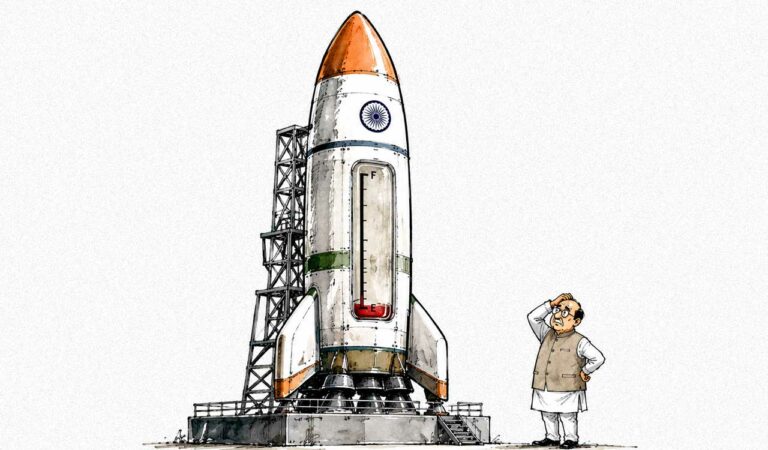
While the private sector’s rising R&D share is a positive and necessary correction to India’s historically state-dominated research funding model, it is by itself not sufficient to close the technology gap with the countries it wants to compete with. India crossing the 50% mark in private contribution while spending less than 1% of GDP on R&D is a very different achievement from the US or China doing so while spending 2.5-3.5% of GDP. Understandably, private R&D follows sectors that promise near-term commercial returns: generic and specialty IT services and software products, automotive components and EVs, and consumer-facing digital technologies. These sectors are undoubtedly important for boosting exports and generating employment, but they are not fully aligned with the areas most consequential for India’s strategic autonomy and long-term economic security: semiconductor fabrication, advanced materials, critical minerals processing, and aerospace systems, foundational AI models, and clean energy storage. A large share of private R&D is concentrated in a narrow set of sectors. Decades of a protected, import-substituting economy, followed by a services- and IT-outsourcing-led growth model, meant Indian firms could compete and profit without deep in-house research — unlike Korean or Chinese firms, which were pushed by export-oriented industrial policy. Also, public research institutions and private industry have historically operated in separate silos, with limited co-funded research or faculty-industry mobility, unlike the tightly integrated innovation ecosystems of the US or Germany.