
Fight the Government, Not the Common Man
The new trend in Indian politics is to disrupt parliamentary proceedings, take to the streets, and claim to be the saviours of democracy. While peaceful protest is a fundamental right, it is subject to reasonable restrictions under the Constitution and must be exercised in accordance with the law.
An increasingly visible trend is for political leaders to describe people holding high constitutional offices as “traitors”, “cowards” and “bullies”, while alleging that the situation in the country is worse than it was during the Emergency. Many of those who draw such comparisons were not even born when the Emergency was imposed. They would do well to study what happened during those dark days before making such sweeping claims.
During the Emergency, which lasted from June 1975 to March 1977, two important legal instruments associated with the detention of political opponents were MISA (the Maintenance of Internal Security Act, 1971) and the Defence of India Rules, 1971, framed under the Defence of India Act. The latter were also associated with restrictions imposed during the period.
The misuse of preventive detention and the curtailment of civil liberties during the Emergency remain important lessons for Indian democracy. The Ministry of Home Affairs’ 1977–78 report records that many people were detained under MISA or imprisoned under the Defence and Internal Security of India Rules for political reasons.
People were detained for their political affiliations and beliefs, and many remained imprisoned for long periods. In several cases, their families suffered financially because the detained persons were the sole breadwinners. The period also witnessed severe restrictions on civil liberties and press freedom. These are historical facts that should not be forgotten.
The legal position today is different, although preventive detention has not disappeared from India’s legal framework. The Constitution permits preventive detention subject to specified safeguards, and certain laws continue to provide for it. It would therefore be inaccurate to claim that no comparable legal powers exist today. The essential distinction is that such powers must be exercised within the framework of the and the applicable law.
Today, political activists can openly criticise the government and its leaders, sometimes using highly offensive language. For instance, Abhijeet Dipke and his associates have reportedly used the word “coward” to describe the Prime Minister. If such remarks do not attract legal action, that should not automatically be interpreted as evidence of governmental weakness or selective tolerance. The relevant questions are whether any law has been violated and whether the authorities have grounds to act. Criticism, however sharp, is not by itself proof of an offence.
Protests can be an effective means of exposing the omissions and commissions of a government. But they should not be allowed to become a pretext for disrupting public life indefinitely. The right to protest must be balanced with the rights of other citizens to move freely, work, access essential services and go about their daily lives. No one, whether a parliamentarian, political activist or ordinary citizen, is above the law.
Congress MP Karamvir Singh Boudh, speaking about the INDIA bloc’s planned march, said the protest was intended to safeguard the Constitution and seek judicial intervention on issues raised by the Opposition. The objective may be stated, but the method deserves scrutiny. How is judicial intervention to be sought? Certainly, a march to the Supreme Court is not a substitute for the established judicial process, particularly when the Chief Justice of India has reportedly said that anyone wishing to approach the court can file a petition.
Boudh said, “The Chief Justice is the guardian of the Constitution, and the Supreme Court is considered to be under his authority. It is his duty, along with the Supreme Court, to look into any instance where the Constitution is being disregarded, or actions are being taken against its provisions.”
But has the court refused to examine the issues raised by the Opposition? The SIR matter is already before the Supreme Court. If the Opposition believes that electoral procedures or constitutional provisions have been violated, it can place its arguments and evidence before the court. Why not allow the judicial process to take its course rather than turn the issue into another street confrontation?
The point is not that political parties should surrender their right to protest or that governments should be shielded from criticism. Rather, democratic opposition must combine political mobilisation with respect for institutions, established procedures and the rights of fellow citizens.
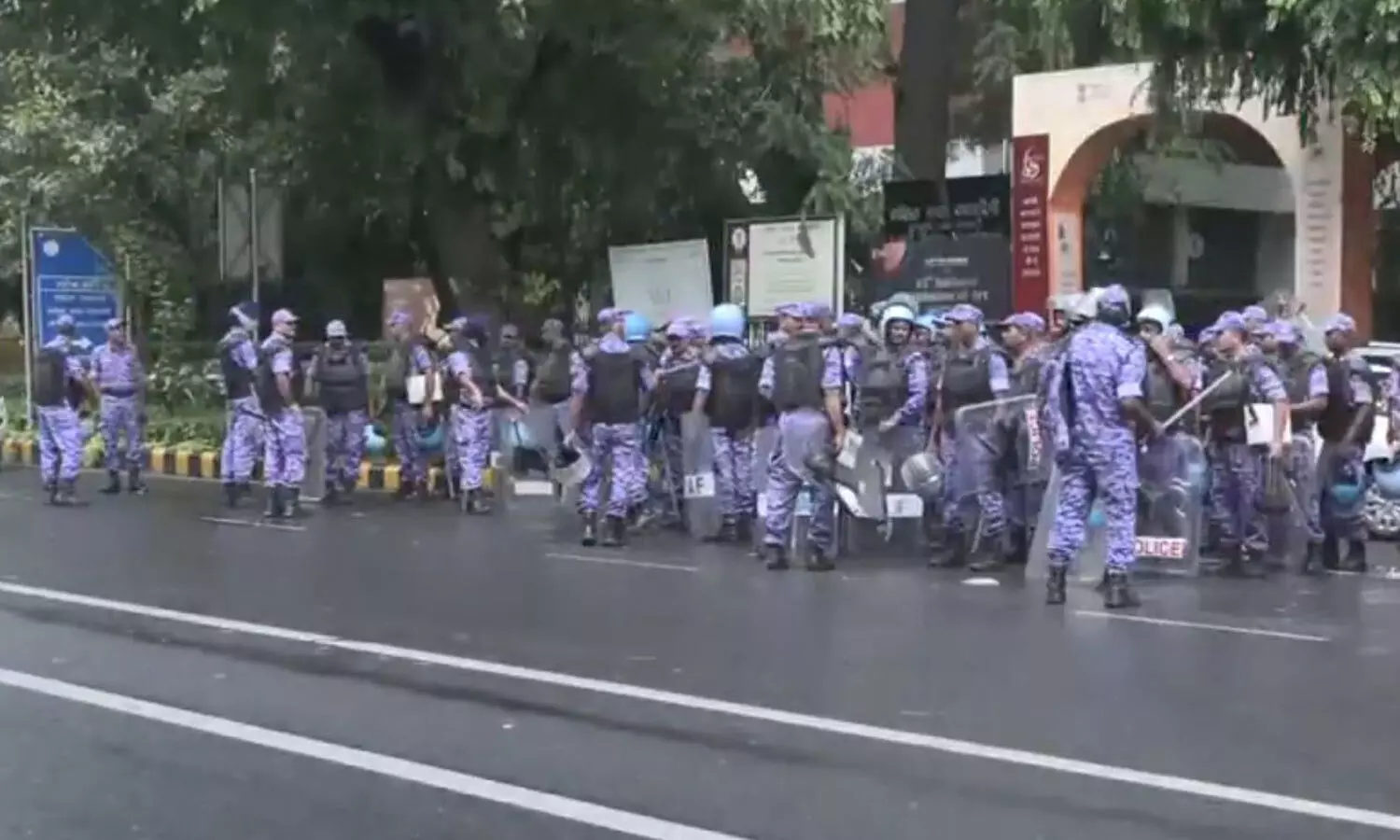
In their pursuit of political advantage, parties often overlook the impact of their actions on ordinary people. Delhi provides a telling example. Ahead of the Opposition’s planned demonstration, the Delhi Traffic Police issued an advisory warning that diversions and restrictions could affect around 30 locations, depending on the prevailing situation.
Several major roads and intersections were expected to be affected, including the Dhaula Kuan flyover, Jhandewalan, Patel Chowk, Panchkuian, Connaught Place, Mandi House, Lodhi Road flyover, Bhikaji Cama Place and Moti Bagh flyover.
Other stretches where commuters could face restrictions or delays included Jantar Mantar Road, Ashoka Road, Sansad Marg and Tolstoy Marg.
Commuters were advised to plan their journeys in advance and allow extra time, particularly when travelling through central Delhi. People heading to railway stations, inter-state bus terminals and the airport were also advised to account for possible delays and avoid unnecessary travel through affected areas.
Security arrangements and traffic restrictions may be necessary to maintain public order during a major demonstration. The concern, however, is whether political parties adequately consider the inconvenience their protests impose on thousands of people who have no direct stake in the political dispute.
Democracy is not strengthened merely by the number of people brought onto the streets, the slogans raised or the roads blocked. It is strengthened when governments are held accountable through evidence, debate, peaceful protest and lawful institutional processes.
Political parties have every right to expose government failures. But they must also recognise that the common citizen should not have to pay the price for their political battles. Expose the government, question constitutional authorities where necessary, and pursue justice through lawful means—but do not turn ordinary people’s daily lives into collateral damage.