
Explainer: How the ‘first bird’ leapt into the sky and soared above the dinosaurs
Archaeopteryx is an icon of evolution and is often called the first bird. Scientists have long debated just how it took off from the ground but a recent study published by my colleagues and I has brought new insights to the mystery.
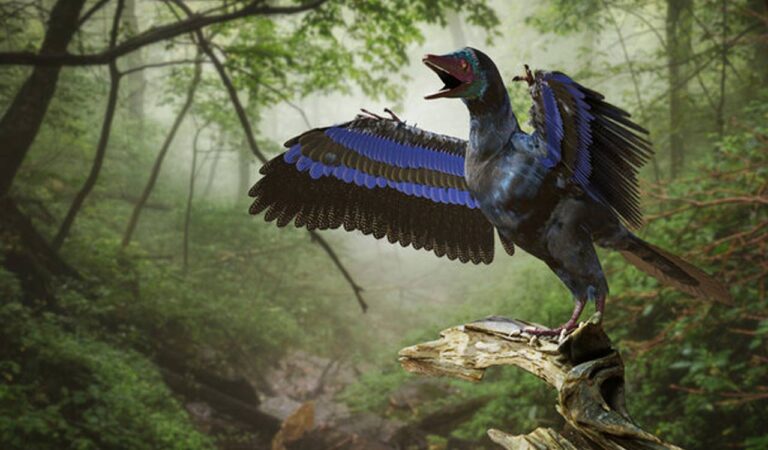
Our study compared Archaeopteryx with the anatomy of modern birds, and our findings suggest it generated the force needed to take off by taking several jumps forwards.
Archaeopteryx, a fossil uncovered from the Jurassic rocks of Germany, dates back 150 million years. It was covered in feathers and it had wings. But it retained a number of distinctly dinosaur features such as a long bony tail, claws on separate fingers and teeth in a beakless jaw.
Charles Darwin predicted, in the first edition of On the Origin of Species published in 1859, that fossils would later be found linking major groups of animals. A year after publication a feather, and within two years, an entire skeleton of Archaeopteryx had been discovered, showing clear links between birds and the dinosaurs. Archaeopteryx is one of those transitional forms that links one group to another.
The “first bird” was not perfectly developed, as birds have evolved to be today. We would not expect them to be. It had relatively weak flight muscles, with no keeled sternum for strong muscle attachment, and could not have raised its wings above the horizontal.
Rather than call it the first bird, it is better to describe it as the earliest branching species, yet known, on the lineage of birds after the whole bird group split from non-avian dinosaurs some time more than 150 million years ago.
Scientists worked on the flying cousins of dinosaurs — the pterosaurs and also a peculiar (although now one among several known) four-winged, feathered and flying dinosaur called Microraptor. However, pterosaurs are not dinosaurs and Microraptor is a dinosaur closer to Velociraptor (small meat-eating dinosaurs) than to birds.
There have been a number of suggested mechanisms for the evolution of flight and takeoff, quite literally from the ground up, or the trees down, to flapping while running to climb a slope. The problem is that these are difficult to test experimentally. So we turned instead to the best example of takeoff there is: birds themselves.
A number of birds were filmed and scientists saw that they all showed the same sort of pre-takeoff behaviour. Two leg jumping. The wings appeared to do little in getting the bird off the ground, and this opened up some possibilities for research into the earliest of birds.
The ancestors of birds, the theropod dinosaurs, had powerful legs. They could definitely jump, and jumping could provide an important evolutionary advantage. Being able to get out of the way of a hunter, and maybe adding in a flap of your feathered arms to extend your leap, might just save your life.
The first bit of this research was developing a means to see how much force the hindlimbs of birds generate in getting off the ground. All birds used their legs in takeoff.
And with detailed kinematics, all of the forces and moments generated by the muscles around the hindlimb joints, the model was fitted to Archaeopteryx and looked to see if the first bird could get into the air in a similar way to modern birds.
Archaeopteryx is by definition 150 million years behind the “leaps” of modern birds, and couldn’t take off as observed modern birds do when startled, explosively, with a single jump and then add flapping into the sky. Archaeopteryx couldn’t do that and couldn’t rely on its wings for powerful flaps. So like birds today, when taking off more leisurely, scientists demonstrated that Archaeopteryx could have got into the air with two leg leaps. Archaeopteryx could have used three jumps increasing in velocity, and once airborne its flapping wings could have maintained a flight speed of 7 metres per second.
However, if Archaeopteryx had added in a flap, it would have got to that speed – jump-flap-jump – with just two leaps. And all this without the highly evolved and flight-adapted anatomy of pigeons, crows, hawks and even chickens.
In the future we may find a fossil that is still a bird rather than a non-avian dinosaur, but is less, well, “birdy” than Archaeopteryx, and then that would become the earliest branching taxon. But we haven’t yet. So Archaeopteryx still sits on its perch as the first bird that we know of.