
Opinion: The deepening distance of water beneath the earth—Telangana’s vanishing groundwater
By Chitikena Kiran Kumar
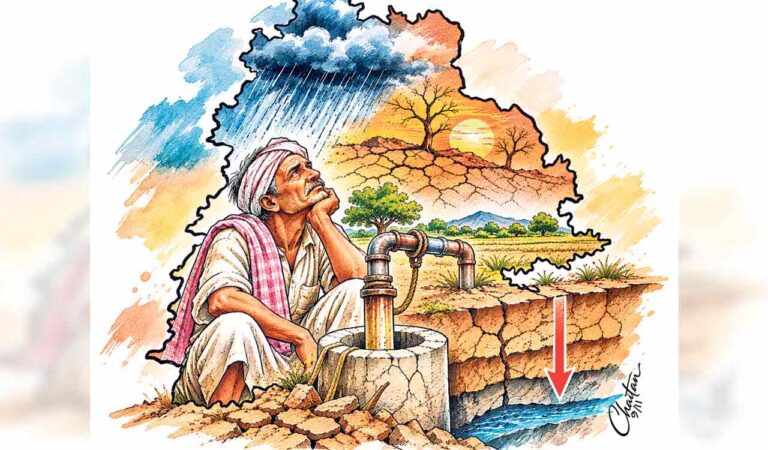
Telangana is now confronting a silent but far-reaching . In 554 of the State’s 621 mandals, groundwater levels have declined, turning what was once viewed as a seasonal concern into a long-term challenge affecting farmers, rural households and urban residents alike. This is not merely a matter of statistics; it reflects drying borewells, withering crops and families forced to walk longer distances for drinking water. Though groundwater remains invisible to the eye, it continues to sustain rural life, agriculture and urban water supply across the State.
Groundwater is a form of wealth that cannot be seen directly. When it rains, water percolates through the soil and is stored over time between layers of rock and sand. This stored water eventually finds its way into wells and borewells. When rainfall declines, these reserves diminish. At the same time, for irrigation, drinking water and industrial purposes disturbs the natural balance beneath the earth. According to the October report of the Telangana Groundwater Department, the State’s average water table now stands at 7.77 metres below ground level. A decline of two metres compared with the previous October is a matter of serious concern.
No Ordinary Warning
The figures make it clear that the crisis is not confined to one region. Compared with the ten-year October average, the area where groundwater is found at depths exceeding 20 metres has expanded from 478 square kilometres to 2,040 square kilometres. In other words, the extent of this problem has increased more than fourfold over the past decade. A decline in groundwater levels across 89 per cent of the mandals is not an ordinary warning; it indicates that the lifeblood beneath the soil is gradually weakening.
The situation in Hyderabad is particularly worrying. In , the average groundwater level has fallen by 7.17 metres in a single year. In Hyderabad district, the average depth has been recorded at 10.62 metres, compared with 6.12 metres last year, a decline of 4.50 metres. Rapid urban expansion, the disappearance of natural areas and excessive water consumption have together worsened the problem. Water scarcity in a city is not merely a concern for a few localities; it affects the entire urban living ecosystem.
One of the principal reasons for this decline is the rainfall deficit during the current monsoon season. Between June 1 and October 31, Telangana normally receives 831 millimetres of rainfall, but only 628 millimetres were recorded this year, resulting in a rainfall deficit of 24 per cent. Of the State’s 33 districts, only one received normal rainfall, while 22 experienced a deficit. Jogulamba Gadwal recorded the highest deficit at 50 per cent, followed by Narayanpet at 44 per cent, and Nagarkurnool and Nalgonda at 42 per cent each. Although deficient rainfall may not have an immediately visible impact, its effects gradually become evident in wells, tanks and agricultural fields.
The impact has been particularly severe in the western and southern districts. Suryapet recorded the highest annual decline of 6.05 metres, followed by Vikarabad at 5.39 metres, Narayanpet at 5.25 metres, Mahabubnagar at 5.01 metres and Medchal-Malkajgiri at 4.99 metres. The present groundwater depth stands at 12.80 metres in Medchal-Malkajgiri, 12.44 metres in Medak and 11.90 metres in Rangareddy. These figures are not mere measurements; they represent failed borewells, loans taken out for irrigation and the weakening economic security of farming families.
During the BRS regime, Mission Kakatiya not only helped conserve water but also created awareness among rural communities about the importance of protecting tanks. Such infrastructure requires continuous maintenance and renewal
With surface water sources becoming inadequate, farmers are increasingly dependent on borewells. When an old borewell dries up, many are compelled to deepen it, while others drill new ones. What begins as an individual necessity gradually becomes a burden on the entire region. When water is already scarce, further extraction pushes the water table even deeper, creating the need for increasingly deep borewells. This vicious cycle weakens farmers economically and damages the environmental balance of villages.
BRS’ Initiatives
During the previous government’s tenure, several initiatives were taken to arrest the decline of groundwater, and some of them laid a strong foundation for the State’s water system. , in particular, played an important role in reviving thousands of . Desilting tanks, strengthening bunds, clearing irrigation channels and enhancing storage capacity were undertaken on a large scale. Watershed development, recharge pits, check dams, rock-fill dams and rainwater conservation measures in villages also helped channel rainwater into the soil.
The revival of tanks contributed to in surrounding areas and reduced pressure on borewells to some extent. These programmes not only helped conserve water but also created awareness among rural communities about the importance of protecting tanks. However, the present situation shows that even such infrastructure requires continuous maintenance and renewal, particularly in years of severely deficient rainfall.
Similar problems are visible in other parts of the country and the world. In the Marathwada region of Maharashtra, drying wells and water supply through tankers have become common during drought years. In the desert regions of Rajasthan, takes place very slowly. In California, in the United States, excessive use of groundwater for agriculture has even led to land subsidence in certain areas. In several Middle Eastern countries, rapid depletion of groundwater has intensified the link between agriculture, drinking water and migration. These examples show that water scarcity is not a problem limited to one State; it is a global challenge of survival.
Conserving Water
Small local measures can be as effective as large projects in protecting groundwater. Cleaning tanks, ponds and streams; ensuring that rainwater remains in fields and villages long enough to percolate into the soil; harvesting rainwater from rooftops; and improving through vegetation and tree roots are all important steps. Crop selection, too, must be guided by water availability. Instead of water-intensive crops, farmers can opt for crops suited to local conditions that require less water. Drip irrigation, judicious water use in paddy fields and disciplined consumption can help safeguard water resources for the future.
Conserving water is not the responsibility of the government alone. Turning off unused taps in every household, digging a recharge pit in every field and protecting a tank in every village can together bring about a major change. If there is no water beneath the earth, no number of buildings above it or projects announced in its name can make life sustainable. Groundwater is the lifeline that sustains our future; protecting it is the responsibility of our generation.
The path charted earlier through tank restoration, watershed development and structures must now be pursued consistently. A tank desilted once will accumulate silt again over time, and a recharge pit constructed once will cease to function effectively without regular maintenance. Therefore, water conservation must not remain an annual project; it must become an enduring practice in every village. Protecting groundwater is not merely an administrative duty; it is a moral obligation to future generations.
(The author is a poet, writer and columnist. He is also a member of the International Benevolent Research Forum)