
Rajnath stresses on defence self-reliance, global cooperation
Jaipur: Hosted by the Indian Air Force (IAF) from September 26 to October 12, the multinational air exercise brought together air forces from seven Friendly Foreign Countries (FFCs), including Australia, Bangladesh, France, Germany, Sri Lanka, the United Arab Emirates and the United States of America along with 32 observer nations.
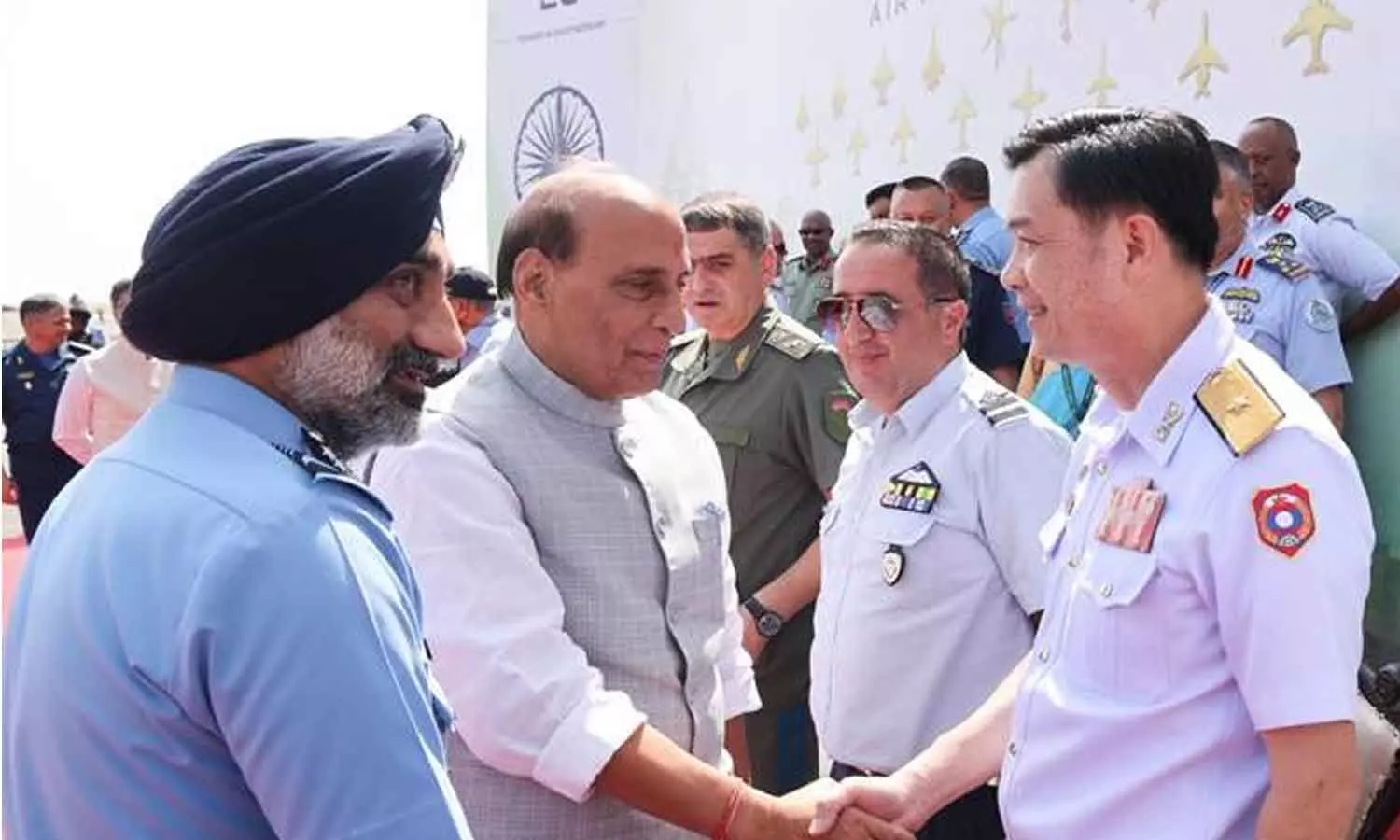
Congratulating the IAF and all organisations and personnel involved in the successful conduct of the exercise ‘Tarang Shakti’ at Jodhpur Air Force Station, the Defence Minister Rajnath Singh on Saturday welcomed the participating nations and appreciated their contribution to strengthening professional understanding and operational cooperation.
The Defence Minister noted that the presence of participating air forces had added significant value to the exercise and expressed hope that the contingents would return with valuable professional insights and a deeper understanding of India’s capabilities and perspectives.
Rajnath Singh highlighted the importance of self-reliance in defence, technological innovation and international partnerships in addressing the evolving challenges of modern warfare.
He noted that warfare now extended beyond land, sea and air to include space, cyberspace, the electromagnetic spectrum and the information domain.
He also underscored the growing role of drones, unmanned systems, artificial intelligence, electronic warfare and long-range precision weapons in shaping military operations. Future military strength, he said, would depend increasingly on the speed of sensing, decision-making and action, rather than merely the number of platforms.
Emphasising India’s Atmanirbharta policy, Singh said the country must develop indigenous capabilities to manufacture weapons and critical technologies to sustain itself during prolonged conflicts and periods of uncertainty. He clarified that self-reliance did not mean isolation but building domestic capacity to design, develop, manufacture, maintain and upgrade defence systems.
He highlighted indigenous programmes such as the Tejas fighter aircraft, Dhruv and Prachand helicopters, the Akash air defence system, advanced radars and emerging unmanned technologies. He also underlined the importance of the Advanced Medium Combat Aircraft (AMCA) programme and advanced aero-engine development.
The second edition builds on the inaugural exercise in 2024, reinforcing India’s commitment to international defence cooperation and indigenous aerospace development.
Chief of Defence Staff General N S Raja Subramani, Chief of the Air Staff Air Chief Marshal AP Singh, Chief of the Naval Staff Admiral Krishna Swaminathan, other dignitaries, officials of the Ministry of Defence and participating countries attended the event.