
‘OM’ review: Strong character work and a satisfying climax offset stretched-out second-half drama
Published: November 20, 2026 12:50 PM IST
Updated: November 20, 2026 04:06 PM IST
The film ‘OM’ uses the sandalwood smuggling trade as a backdrop for a well-structured story rather than relying solely on the intrigue of the illegal trade itself.
Mammootty returns to Tamil cinema with a nicely layered and restrained role that allows him to bring subtle nuances to his character.
Strong performances, effective emotional beats in the first half, and a confident screenplay ensure the familiar subject matter never becomes a limitation.
When a subject has been explored several times over, what makes another film stand out is not necessarily the novelty of its premise, but the strength of its characters, the conviction of its storytelling and the emotional layers that hold everything together. With OM, director Rajkumar Periasamy, who previously delivered the emotionally resonant ‘Amaran’, once again demonstrates his ability to weave human emotions into a story rooted in a larger conflict. Headlined by Dhanush, the film has its share of familiar elements, but finds strength in its performances, characterisations and moments of heartfelt drama.
The world of sandalwood smuggling is hardly unexplored territory in Indian cinema. Following the success of Pushpa, which brought the illegal trade and the network operating behind it into mainstream cinematic conversation, several filmmakers and films, including the recent Malayalam movie ‘Kattalan’, have attempted to revisit the subject. ‘OM’ takes a slightly different approach, placing an undercover operation to dismantle the smuggling network at the centre of its narrative, with Dhanush playing an agent navigating this dangerous world.
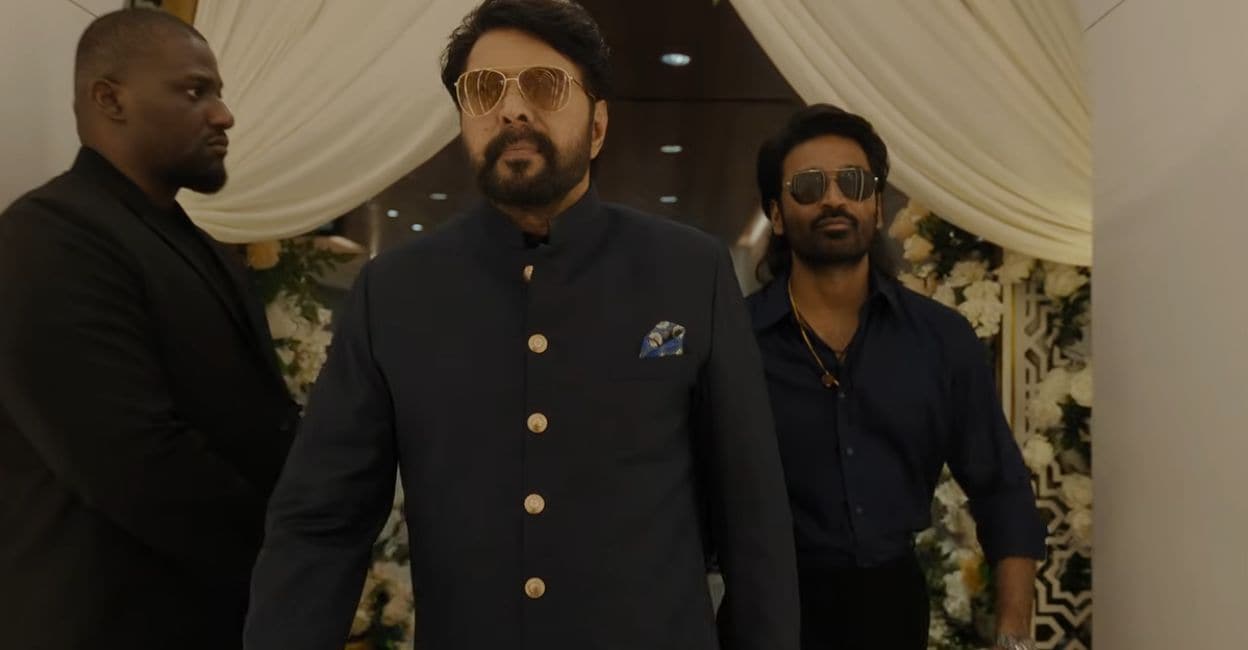
What works in Rajkumar’s favour is the way he introduces his characters. There are no unnecessarily elaborate introductions or attempts to manufacture larger-than-life moments. Instead, each character gets an engaging entry that establishes their personality and place in the narrative. Dhanush, whose recent outings ‘Idli Kadai’ and ‘Kuberaa’ explored characters caught in contrasting circumstances of ambition and fortune, gets to play someone markedly different here. He brings an infectious energy to the role, giving the film much of its momentum, while his equation with Karthikeyan, played by Mammootty, adds another interesting dimension to the narrative.
Having a veteran superstar like Mammootty in an important role can sometimes become a storytelling challenge, particularly when the filmmaker feels compelled to accommodate the actor’s screen persona. Rajkumar, however, deserves credit for resisting that temptation. Mammootty’s character is written with a certain restraint, allowing the actor to bring his own nuances rather than relying on exaggerated moments to establish his presence. It is particularly refreshing to see a filmmaker understand that a superstar does not necessarily need to dominate every frame to make an impact.
Making his return to Tamil cinema after eight years, Mammootty gets a nicely layered character that benefits from this measured approach. When the narrative requires him to be understated, he remains understated. His expressions, body language, and quiet authority do much of the talking. For his fans, even the way the camera captures him becomes a pleasure in itself. The song ‘Alaakaa Loova’ also captures the stylish, energetic flavour that Rajkumar envisions for the Mammootty-Dhanush combination. The film may not offer too many conventional high moments, but there is enough in Mammootty’s screen presence and subtle performance to keep his admirers invested.
The biggest highlight, however, is Sai Pallavi. Playing a lead commander with a tragic past, she brings an impressive combination of emotional vulnerability and professional conviction to the character. The narrative finds much of its emotional movement through her feelings, personal struggles, and determination. What makes the performance particularly effective is how effortlessly she balances the humane and the commanding aspects of the role. Sai Pallavi once again proves that she is an actor filmmakers can trust with characters that demand substance rather than mere screen presence. Rajkumar also deserves appreciation for giving her character sufficient space to evolve and make an impact. Indrans, meanwhile, is his usual natural self, delivering some of the film’s more poignant moments with remarkable ease.
There are shades of ‘Dhurandhar’ in the relationships and dynamics between some of the principal characters, but that does not necessarily work against ‘OM’. There is something appealing about seeing such stories being told closer home, with the director attempting to balance the larger operational backdrop with personal conflicts. The narrative has enough intrigue to generate interest, and its character-driven approach gives the film a distinct emotional identity.
However, ‘OM’ is not without its shortcomings. In his attempt to make the film an emotionally immersive experience, Rajkumar occasionally allows the drama to become too elaborate. Certain emotions are revisited and stretched beyond what the narrative requires, and this sometimes takes attention away from the central conflict. The film particularly loses some of its grip after the interval, when the emotional detailing begins to weigh down the storytelling. There are moments when the theatrics, reminiscent of the emotionally heightened treatment seen in some of Vijay’s films, affect the overall pace. The intention is understandable, but the execution could have benefited from a little more restraint.
Thankfully, the film finds its footing again as it moves towards the climax. The final stretch brings the different emotional and narrative threads together with a satisfying sense of closure. It is a well-rounded ending that restores some of the momentum lost along the way and gives the story the conclusion it deserves.
Sai Abhyankar’s music adds another layer of energy to the film. The compositions have a pleasant yet lively quality, complementing the film’s emotional landscape without losing their appeal. There is a particularly infectious flavour to the music accompanying Dhanush’s arrival, adding to the character’s energetic screen presence.
Ultimately, ‘OM’ is a film that benefits more from its people than from the novelty of its premise. Rajkumar Periasamy demonstrates a genuine understanding of emotional storytelling, while Dhanush, Mammootty and Sai Pallavi bring distinct strengths to a narrative that occasionally struggles to maintain its balance. The film could have been tighter, especially in its second half, but its performances, character work and emotionally satisfying climax make it an engaging watch. It may not reinvent a familiar subject, but it finds enough heart within it to leave an impression.