
Active vs. Passive Portfolio Management: Choosing the Right Mutual Fund Strategy
One thing you’ll probably have noticed is that there is debate around what type of fund to invest in. Choosing a mutual fund involves more than looking at its returns. You also need to consider how the fund is managed, what it costs, and whether its investment approach suits your financial goals.This is where active and passive portfolio management differ. An active fund relies on a fund manager to select investments and attempt to outperform the market. A passive fund follows an index, aiming to deliver similar returns before accounting for expenses and tracking differences.
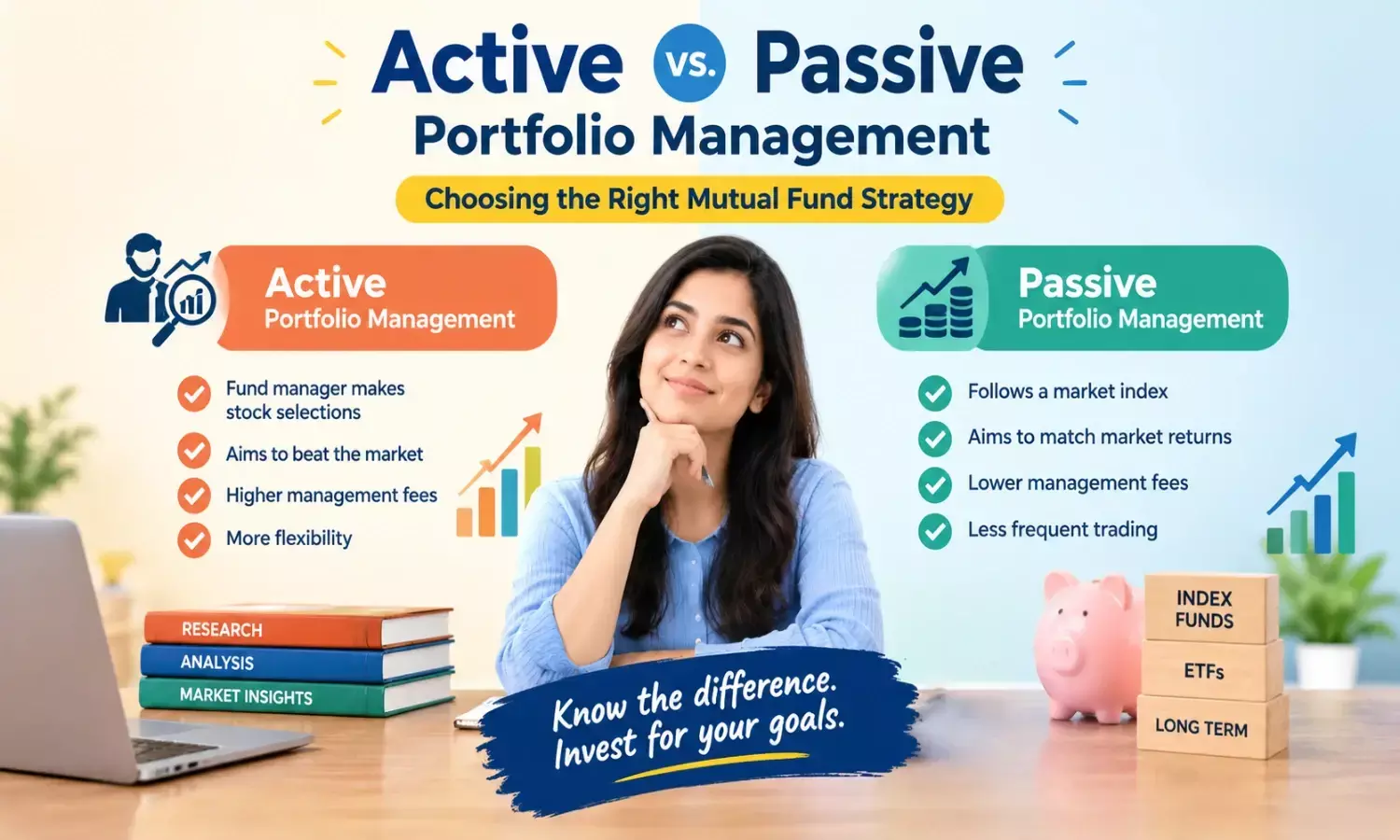
Neither approach is automatically better. The right choice depends on the market segment you want to invest in, your tolerance for risk, and how much you are willing to pay for professional management.
You can explore both kinds of schemes on the Zomint mutual funds page and compare the fund houses behind them in the .
1. What Is Active Portfolio Management?
An actively managed fund means that your fund manager and research team are making the decisions. They will be buying and selling different assets to try and achieve outperformance on a benchmark (such as Nifty 50). The manager is constantly researching companies, sectors and the wider economic situation. You are therefore paying for someone to make decisions for you.
2. What Is Passive Portfolio Management?
An actively managed fund means that your fund manager and research team are making the decisions. They will be buying and selling different assets to try and achieve outperformance on a benchmark (such as Nifty 50). The manager is constantly researching companies, sectors and the wider economic situation. You are therefore paying for someone to make decisions for you.
3. The Key Differences at a Glance
|
Active fund |
Passive fund |
|
Who decides |
Fund manager |
The index |
|
Goal |
Beat the benchmark |
Match the benchmark |
|
Cost |
Usually higher |
Usually lower |
Portfolio changes |
Frequent, manager-driven |
Only when the index changes |
Manager risk |
Yes |
No |
Result vs market |
Can be better or worse |
Close to the market |
Transparency |
Depends on disclosures |
High, you know the index |
4. The Case for Active Funds
Active funds can make sense when a manager has room to add value.
- Flexibility: a manager can avoid weak companies or sectors and shift to cash or debt in rough conditions
- Less efficient segments: in areas like mid cap, small cap and some debt categories, careful research can matter more
- Risk management: a good manager can manage risk beyond what an index allows
- Customised approach: theme, quality or value strategies need a manager’s judgment
But active management has a catch. It costs more, and the extra cost has to be earned back every year. Many managers do not beat their benchmark over long periods, and a fund that did well in the past may not repeat it.
5. The Case for Passive Funds
Passive funds work well when the market is hard to beat.
- Low cost: a lower expense ratio means more of the return stays with you
- No manager risk: you don’t depend on one person or team staying sharp
- Simplicity: you know what you own
- Consistency: you get the market’s return, not a lucky or unlucky pick
Passive is not risk-free. You still fall when the market falls. You also own whatever the index owns, including companies that have become expensive. And there is a small tracking difference between the fund and the index.
6. Where Each Approach Tends to Fit Best
Different parts of a portfolio have different needs.
|
Portfolio part |
Often used |
Large cap equity |
Passive is common, since large caps are widely researched |
Flexi and multi cap |
Often active, because the manager chooses across sizes |
Mid and small cap |
Often active, where research can add more |
International equity |
Both are used |
Short-term debt |
Mostly active, though target maturity index funds exist |
|
Gold |
Passive through ETFs or index-linked funds |
This is a common pattern, not a rule. Cost, track record and fit matter more than the label.
7. The Core and Satellite Approach
Many investors do not choose one side. They combine them.
- Core: a low-cost passive fund or two that gives broad market exposure
- Satellite: a few active funds where a manager can add value, such as mid cap or a theme. This keeps costs down for the bulk of your money while letting you use active management where it is most likely to help. It also reduces the chance that one manager’s mistake hurts your whole portfolio.
8. How to Judge an Active Fund
If you choose active, look beyond last year’s return.
- Performance over multiple cycles, not one year
- Comparison with the right benchmark and category peers
- Consistency, how the fund did in both rising and falling markets
- Expense ratio
- Manager tenure and any recent changes
- Concentration, how much sits in a few stocks
- Overlap with funds you already own
Ask a simple question: after costs, has this fund earned its fee?
9. How to Judge a Passive Fund
Not all index funds are the same, even on the same index.
- Expense ratio: lower is better, because that is the main difference between funds
- Tracking error: how closely the fund follows its index
- Fund size and liquidity, especially for ETFs
- The index itself: what it holds and how concentrated it is
- Fit with your portfolio: does the index overlap with what you already own?
10. Tax Basics
The tax treatment depends on the fund’s type, not on whether it is active or passive.
- Equity-oriented funds: gains on units sold within 12 months are taxed at 20%. After 12 months, gains above ₹1.25 lakh in a financial year are taxed at 12.5%.
- Debt funds: gains are taxed at your income tax slab rate.
Tax rules change, so check the current rates. Active funds that trade more can have more internal turnover, but the tax you pay is on your gains when you sell.
11. Common Mistakes to Avoid
- Choosing active only because of one strong year
- Choosing passive and never checking costs or tracking error
- Assuming passive means “risk-free”
- Holding several index funds that track the same market
- Mixing too many active funds that own the same stocks
- Ignoring the expense ratio
- Switching strategies after every market move
12. Which Should You Choose?
A few questions help.
- How much do you want to pay? If cost matters most, passive has an edge.
- Do you believe a manager can add value in this category? If yes, consider active.
- How much simplicity do you want? Passive is easier to understand and monitor.
- How much do you already own? Avoid doubling up on the same stocks.
- What is the goal? A long-term core and a theme bet may need different tools.
For many investors, the practical answer is a mix.
13. How Guidance Helps
The choice between active and passive is rarely a one-time decision. It depends on the category, the fund and your whole portfolio.
At Zomint, your dedicated wealth manager starts with your goals, checks what you already own, and builds a goal-based portfolio using the right mix of funds. Your portfolio is reviewed regularly, so costs, overlap and performance don’t drift unnoticed. If you also want exposure beyond India, the shows how international funds can fit, whether active or passive.
Final Takeaway
Active and passive are not competitors. They’re both tools. Active funds give you the opportunity to outperform the market. However, they come with higher costs and the risk of the manager not being successful. Passive funds have costs but give you the market performance.
Ultimately it will depend on the category, cost, your goals and what you already own. A lot of people will find a good balance by having a core of low cost passive funds and a few well chosen active funds. Regardless of what you go for, it’s worth considering periodically to ensure it aligns with your journey.
Disclaimer: This article is for informational purposes only and does not constitute investment advice. Mutual fund investments are subject to market risks. Read all scheme related documents carefully. Past performance does not guarantee future returns.