
‘Main Vaapas Aaunga’ review: A heartbreaking journey back to a Punjab that once was
Somewhere in India, a 95-year-old man is still waiting to go back to Sargodha.
He speaks of it with the ease of someone talking about the neighbourhood next door. He remembers the fields, the roads and, most vividly, a girl he loved there. What he doesn’t seem to understand anymore is that Sargodha is now in Pakistan. There is a border between the place he remembers and the country he lives in. There are passports, checkpoints and fences where, in his memory, there was simply a road home.
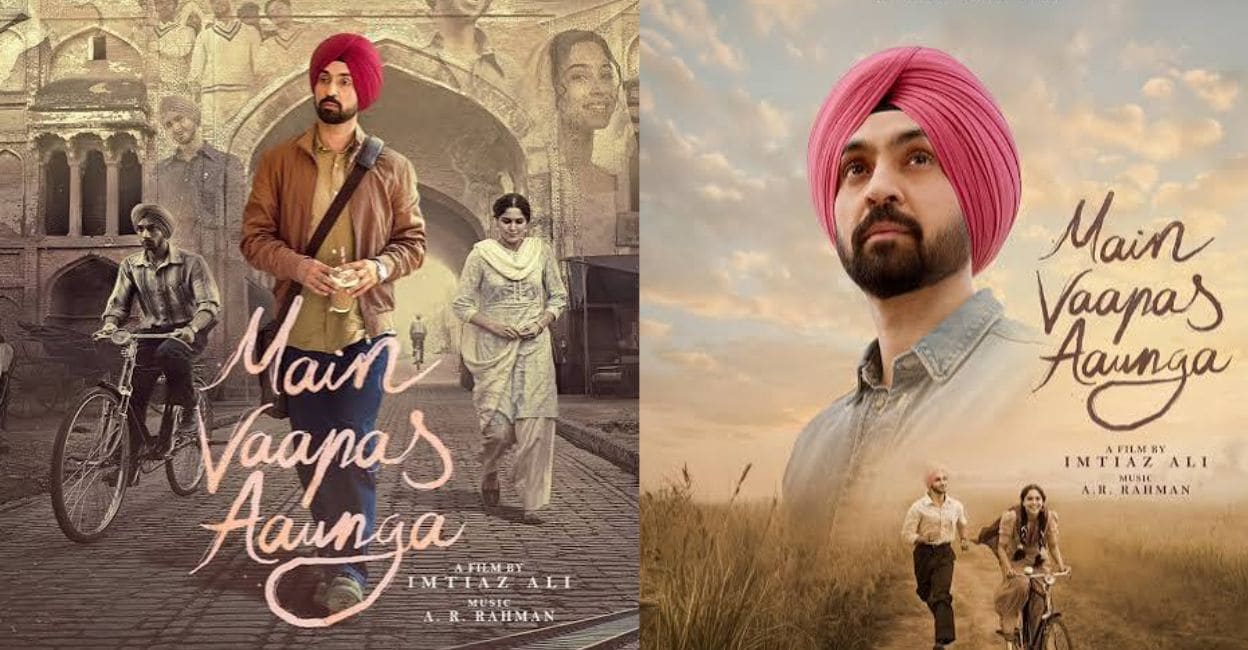
There is a deep ache in that idea, and it is what makes Imtiaz Ali’s ‘Main Vaapas Aaunga’ work.
Nirvair Grewal (Diljit Dosanjh), an NRI, returns to India when his grandfather Keenu’s health deteriorates. Keenu, played by Naseeruddin Shah, has dementia and keeps drifting between the present and memories of his youth in Sargodha. His grandson initially sees these as fragments of a failing mind, until he realises that Keenu is remembering Jiya (Sharvari), the Muslim girl he loved before Partition. Vedang Raina plays the younger Keenu.
The film takes its time with this love story, perhaps more time than some viewers will have patience for. Keenu and Jiya’s romance is deliberately simple. There are no fireworks in the beginning, just two young people enjoying each other’s company and assuming that life will continue as it is. That innocence is important. They don’t know yet that history is about to make their most ordinary wishes impossible.
Ali’s depiction of Punjab before Partition is one of the film’s strongest aspects. Hindus, Muslims and Sikhs live alongside each other without their differences being turned into exposition. It is simply their world. That makes the eventual rupture more painful.
Young Keenu cannot understand why he has to leave. Why should he go when this is his land? Who decides where the boundary is? The questions sound almost childlike, but they are among the film’s sharpest lines because there is no easy answer to them.
The older Keenu carries that same refusal to accept the border. He talks about reaching Sargodha through the fields, as though it is still a nearby place he can simply walk into. Dementia has taken away parts of his memory, but strangely, it has preserved the things that matter most to him.
It is Naseeruddin Shah who gives the film its deepest emotional pull. His Keenu can be funny, irritable and completely lost, sometimes within the same scene, but the moment Sargodha or Jiya enters his conversation, you can almost see the younger man returning.
Diljit is effective in a quieter role, playing Nirvair as someone trying to understand a grandfather whose past he never knew. Sharvari and Vedang, meanwhile, have to sell a romance that carries much more weight than their scenes initially suggest. They don’t always have the lived-in chemistry that the screenplay asks for, but the simplicity of their relationship eventually works in the film’s favour.
The writing is perhaps the film’s strongest aspect. Ali doesn’t treat Partition as a history lesson, nor does he make Keenu’s dementia just a device to move between timelines. The two are quietly woven into each other. Keenu’s fragmented memories slowly reveal his past, and the things he says in the present acquire meaning when we see where they came from. Even the seemingly random things he says begin to feel like pieces of a life he is still trying to hold on to. There is a literary quality to the writing, particularly in the way these characters speak and carry themselves, but here it works. It gives the film the feeling of a story being remembered rather than simply narrated.
Past and present bleed into one another, much like memories do. You don’t always feel that you are watching a flashback; sometimes it feels as though Keenu’s mind has simply wandered there.
There is a particularly intriguing detail in his rambling about Martians attacking the moon. On the surface, it is just another nonsensical statement. But it invites a reading: perhaps the violence of Partition was so impossible for the young Keenu to comprehend that his mind could only place it outside humanity. The film never explains this, and that is probably for the better.
The emotional high point comes with Keenu’s departure from Amritsar. The train sequence is cramped and frightening, and when he looks back and says, “Main Vaapas Aaunga”, the line acquires a weight that the young man could never have imagined. He promises to return. Decades later, he is still waiting.
A R Rahman’s music gives the film some of its finest emotional moments. ‘Tere Paas Mein’, particularly when it appears in fragments, has an ache that the dialogue occasionally struggles to create.
There are loose threads, stretches that feel overly sentimental and moments where the film could have been less indulgent. The pacing will also divide viewers. Ali wants us to sit with these people and their world before Partition tears it apart, and that requires patience.
But that patience is ultimately rewarded.
‘Main Vaapas Aaunga’ is the kind of film that stays with you for reasons beyond whether every scene works. There are moments that feel too carefully written and parts that could have moved faster, but the love story, the performances and Rahman’s music come together beautifully. Most of all, it leaves you with Keenu’s longing for Sargodha, and that is a feeling that is difficult to shake off.
‘Main Vaapas Aaunga’ is currently streaming on Netflix.