
What Krishi Darshan Started, Bharat VISTAAR Can Complete
By Ankur Bansal, CEO and Founder and Vijay, Manager at GDi Partners, a leading impact sector firm which partner with governments for large scale change
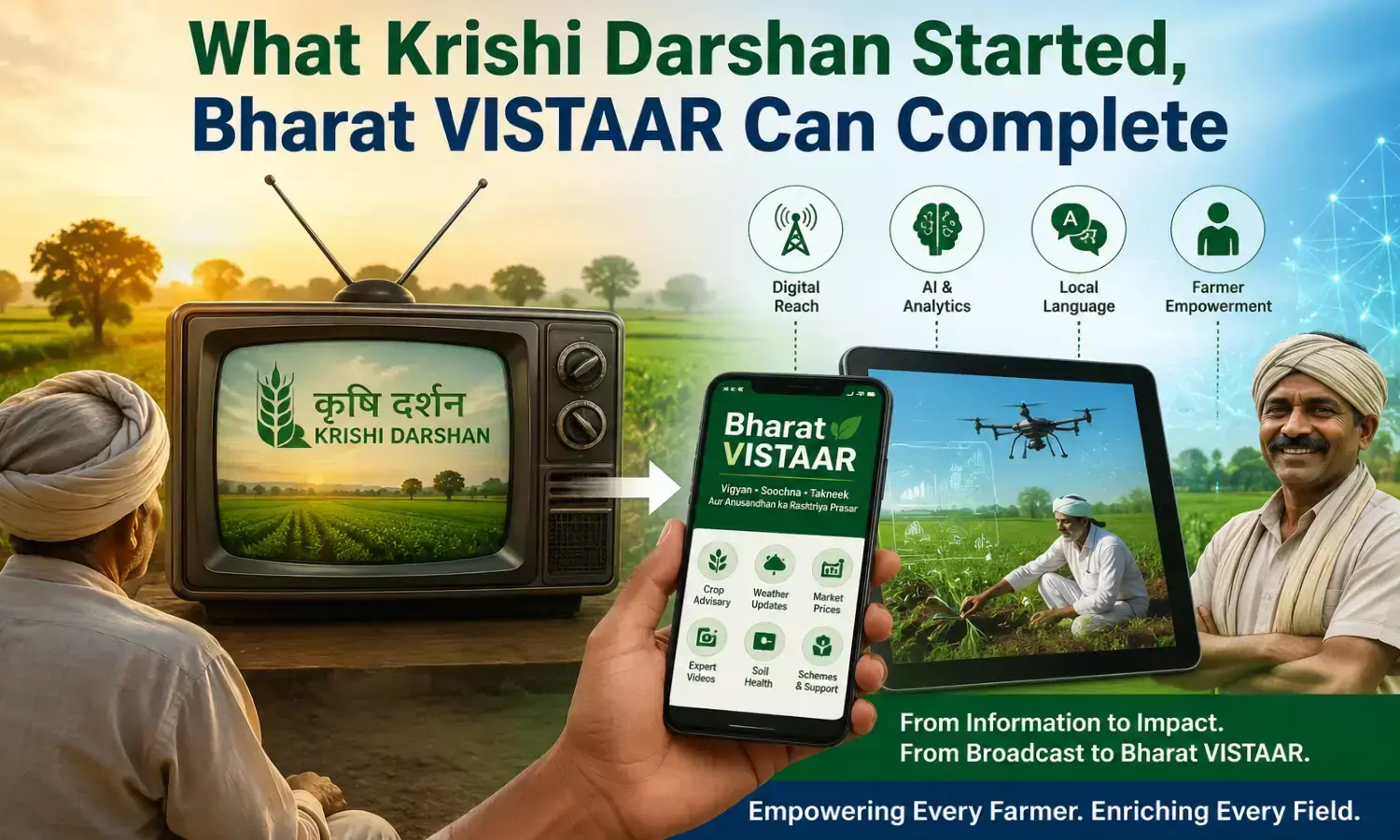
On January 26, 1967, while India watched Republic Day parades, the government quietly launched one of its earliest agri-tech experiments. That evening, Krishi Darshan went on air on Doordarshan Delhi, bringing agricultural advice to 80 villages around the capital. Farmers gathered around scarce television sets in schools, panchayat offices, and village homes to hear experts speak about seeds, soil, irrigation, and cattle health.
Long before the vocabulary of “agri-tech” and “AI for farmers” entered public discourse, India had already recognised a powerful idea: technology could bridge the distance between scientific knowledge and the farmer’s field.
Timing was key. The Green Revolution was sweeping through Punjab and Haryana, but in much of rural India, the formal extension system did not exist. Extension workers, the human connect between research and the farm were scarce and scattered. Even today, India has only one extension worker per 5,000 farmers.
The rationale behind Krishi Darshan was clear: If an agronomist could not make himself accessible to every village, maybe he could make himself accessible to every television.
Krishi Darshan soon came to be the longest running television show in the history of India, with a run of more than 59 years and more than 16,000 episodes aired. Regional versions of the show sprang up in different parts of the country, like Vayalum Vazhvum (“The Field and Life”) in Tamil Nadu’s Delta region.
But the error here did not lie in the intention. It lay in the structure.
Krishi Darshan operated at scale but on the time-frame of the state, not of the problem faced by the farmer. The farmer tuned in if he happened to be home that day, if the subject was relevant and the timing coincided with the problem in his field. If the farmer had a problem with pests on Monday, the advice came on Thursday.
This was the broadcast-only nature of the system. It worked in one direction: from research station to studio to screen to farmer. The farmer could hear but not ask. The farmer listened while we spoke.
By the early 2010s, the question had changed. It was no longer “how do we reach every farmer?” but “how do we reach the right farmer, with the right advice, at the right moment?”
That required a design shift, not merely a technology upgrade. Farmers are not a single category. The apple grower in Sopore and the paddy farmer in Thanjavur do not share the same season, soil, or risks.
Delegation was the other answer to the problem. Andhra Pradesh’s Rythu Bharosa Kendrams (RBKs) were bringing advisory, inputs, and agricultural services close to the panchayat level. The extension system was no longer talking from someplace far off. It was talking from the next village.
While Jammu & Kashmir carried this idea further by way of Kisan Khidmat Ghars (KKGs) as part of the Holistic Agriculture Development Programme, it was a simple yet valuable insight that they brought about. Trust is still something that starts with a place, but technology brings about timely, customized, and consistent availability of support.
KKGs delivered both. Farmers could avail of advisory, get themselves registered for various services, and even get their queries answered regarding crop specifics and geographies at their convenience. With over 2,000 KKGs and over 8 lakh registered farmers, something became clear: scalability and relevancy need not be at loggerheads.
But even a responsive system reacts after the problem surfaces. The next move came with permanence: the system that extends is always-on, keeps learning, and keeps talking.
It is exactly what Bharat VISTAAR achieves.
Designed as Digital Public Infrastructure in agriculture, Bharat VISTAAR is not a platform in itself, but a layer to create services upon. Saralaben AI is an application created on this layer by Amul. Dairy farmers could call, in their own language, using a channel they trust, and get instant, contextual advice.
The message was clear – scale does not have to mean irrelevance.
Now, a farmer in Thanjavur can ask about water stress in his paddy at eleven at night, in Tamil, and get a response drawing from ICAR’s database of knowledge, state programs, and thousands of other conversations of similar farmers. The extension system has become from a scheduled broadcast to a always-on conversation in multiple languages conversation.
Seen across six decades, the evolution is striking. Krishi Darshan solved reach. RBKs solved proximity. KKGs solved responsiveness. Bharat VISTAAR enables intelligence at scale.
That is the real shift. The future of agricultural reform will not be defined by technology alone, but by whether institutions can build systems that are trusted, interoperable, and farmer-centric by design.
The conversation that began in 80 villages outside Delhi on a Republic Day evening in 1967 still continues. Only now, the system is finally learning how to listen back.