
Tribute To Tussle; Modi, Rahul Trade Barbs on Who Is the Real ‘Samvidhan Rakshak’
Thursday proved to be a day of tributes and political tussles. The big question was: Who is the real Samvidhan Rakshak (protector of the Constitution)?
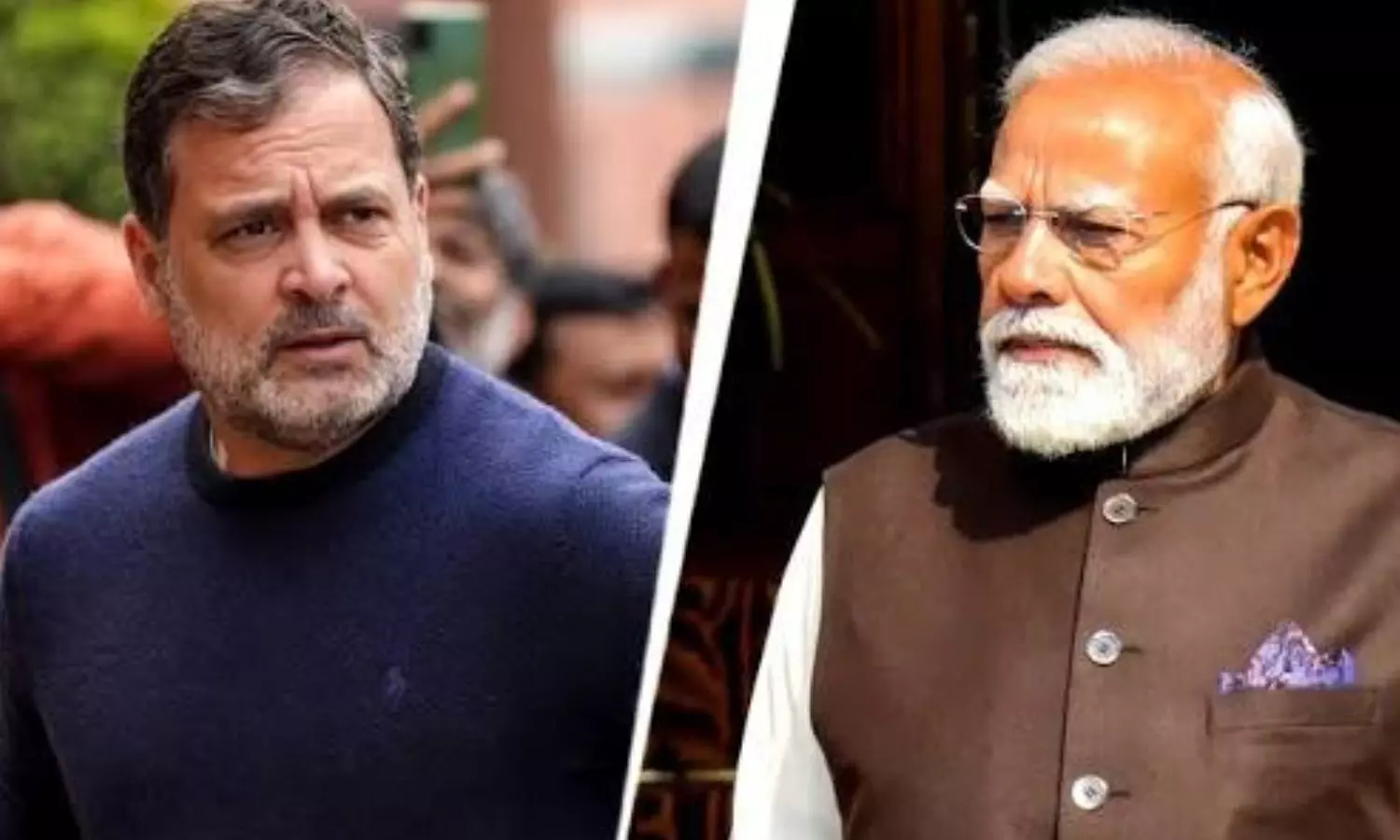
On the one hand, Prime Minister Narendra Modi launched a blistering attack on the Opposition. He took a jibe at what he described as a “Dimagi Naxal mindset” and called the Opposition an “Avrodh Paksh” (obstructionist camp) rather than merely a Vipaksh (Opposition). The BJP, meanwhile, launched its five-day Samvidhan Gaurav Divas programme.
Chief Justice of India Surya Kant said a confident institution must have the capacity to engage with criticism without treating every disagreement as a challenge to its authority. He underlined that disagreement was not a weakness of constitutional democracy.
The CJI also observed that the Constitution was not tested only during extraordinary political or institutional crises but every day in the ordinary exercise of power.
“It is tested every day, in the ordinary exercise of power. The manner in which an authority treats a vulnerable citizen, the willingness of an institution to acknowledge its limitations, and the readiness to correct an error are all expressions of constitutional commitment,” he said.
Leader of the Opposition Rahul Gandhi, who frequently waves a copy of the Constitution, described it as the “greatest weapon against injustice” and pledged to defend it under all circumstances. He accused the ruling BJP of attacking the critically important right to vote, which, he said, gives meaning to the foundational document.
In a post on X on Constitution Day, Rahul Gandhi said the Constitution was the foundation of India’s democracy and the soul of the country.
“India’s Constitution is not just a book; it is the soul of the nation. It is a shield for every citizen’s dignity, the strength of every voice, a guardian of justice, liberty, equality and fraternity,” he said, describing it as “our greatest weapon against injustice”.
“On Constitution Day, I renew my pledge; we will defend it under all circumstances and keep fighting for every Indian’s rights. Long live the Constitution, long live India!” the LoP asserted.
Opposition leaders also joined the chorus on Thursday, issuing statements and resorting to optics such as rallies across the country. AIMIM chief Asaduddin Owaisi, meanwhile, said the Sangh and the RSS were among the biggest enemies of the Constitution.
Prime Minister Narendra Modi, in a lengthy opinion article, said the Indian Constitution was integral to the lives of crores of citizens, including himself, and that its extraordinary spirit had enabled even a child from a modest and underprivileged background to lead the world’s largest democracy.
Without naming any party, he accused the Congress of weakening the Constitution during its rule. He also credited his government with “correcting a historical wrong” in 2019 through the abrogation of Articles 370 and 35A, which, according to him, had prevented the full implementation of the Constitution in Jammu and Kashmir.
Modi said his government’s endeavour had been to deepen the Constitution’s connect with the collective consciousness of the people, particularly the youth, and strengthen the spirit of unity that was essential for India’s bright future.
For a nation as diverse as Bharat, with its numerous faiths, languages, customs and schools of thought, it was important that the Constitution resonated far beyond the precincts of Parliament and the courts, he said.
That was why, he pointed out, the NDA government had decided more than a decade ago to observe November 26 as Constitution Day.
“For crores of Indians, including me, the Constitution of India is an inseparable part of our life journeys,” he wrote.
Recalling his childhood and the humble circumstances in which he grew up, Modi said he was filled with an overwhelming sense of gratitude towards the Constitution whenever he looked back at the struggles that had been part of his everyday life.
“That a child born into a family of modest means, with no privileges or advantages of birth, could one day be entrusted with the responsibility of serving the world’s largest democracy speaks volumes about how extraordinary our Constitution is,” he said.
“In our own humble way, we have sought to repay this debt of gratitude by strengthening our Constitution,” he added.
Modi said that on November 26, 1949, the Constituent Assembly adopted the Constitution. On the occasion, the nation remembered Dr Rajendra Prasad, Dr Babasaheb Ambedkar and every member of the Constituent Assembly.
“The quest for social and economic justice runs through the very fabric of our Constitution. Thus, what can be more satisfying than working towards the realisation of this cherished vision of the makers of our Constitution?” he wrote.
Referring to constitutional amendments, he said the 101st Amendment ushered in the Goods and Services Tax (GST), a long-awaited reform, while the 102nd Amendment granted constitutional status to the National Commission for Backward Classes, fulfilling a long-standing demand of marginalised sections of society.
“The 103rd amendment received broad social acceptance. By providing reservation to Economically Weaker Sections, it addressed the long-overlooked aspirations of economically disadvantaged families from communities outside the existing reservation framework,” he said.
Modi also listed various welfare schemes launched by his government and explained how they had impacted people’s lives.
In an apparent attack on the Congress, he said there had been occasions in India’s history when those entrusted with upholding the Constitution had instead chosen to weaken it.
“Ironically, they are the same people who had the opportunity to govern India for five decades,” he said.
Modi pointed out that this year marked 75 years since the First Amendment of 1951, when a government that had not yet been elected through a popular mandate used its majority in the Provisional Parliament to restrict fundamental freedoms.
“Its timing, barely months before India’s first general election, proves that it was intended to influence the electoral process and stifle public opposition,” he wrote.
The Prime Minister also noted that 50 years had passed since the 42nd Amendment, introduced during the Emergency, which curtailed judicial review and fundamentally altered the balance of institutional powers.
“I would also urge youngsters to study the 38th and 39th amendments to know what a power-hungry and anti-constitutional leadership can do,” he said.
Modi said the repeated misuse of Article 356 to dismiss elected State governments presented another troubling chapter in India’s constitutional history. One party, he alleged, had the “dubious” record of invoking Article 356 almost 100 times. One former Prime Minister had scored a half-century in this regard, he said, in an apparent reference to Indira Gandhi.
“The makers of our Constitution had hoped that it would be implemented in letter and spirit across India,” he said.
Referring to the abrogation of the constitutional provisions that granted special status to Jammu and Kashmir, Modi said that for more than 70 years, Articles 370 and 35A had prevented the full implementation of the Constitution in the region, thereby depriving SCs, STs, OBCs and women of their rights.
“It was only in 2019 that this historical wrong was corrected,” he wrote.
Meanwhile, the Congress targeted the Centre over rising inflation, claiming that rural India was facing acute economic distress.