
Stock-specific action may continue amid ongoing earnings seasons
Buoyedby renewed buying from FIIs, better-than-expected June-quarter earnings, improvement in monsoon spread and recovery of rupee against dollar; markets ignored the heightened geopolitical tensions in West Asia to post their biggest weekly gain in nearly four months during the week ended.
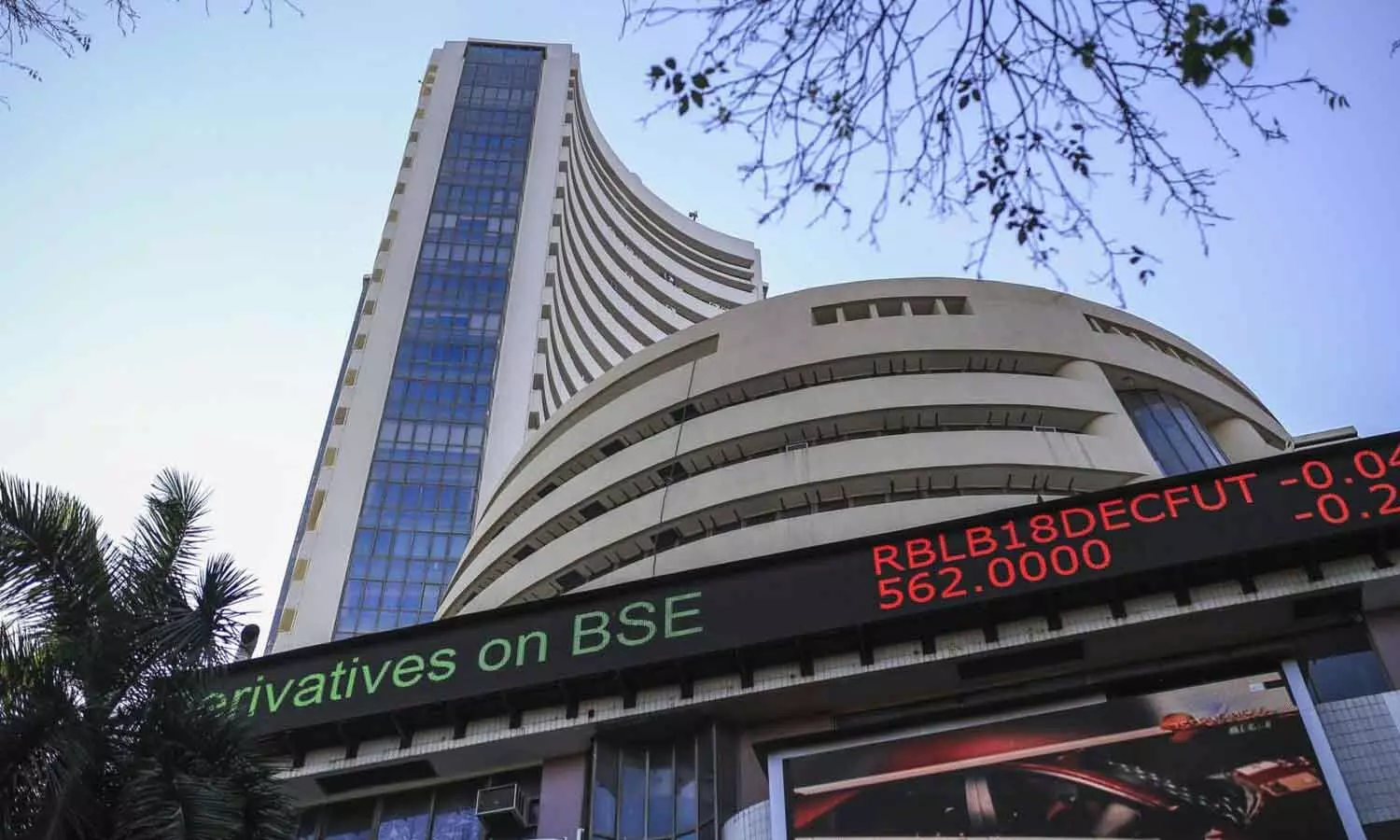
For the week, the Sensex surged 2,034.87 points, or 2.67 per cent, to close at 78,094.64, while the Nifty rallied 616.15 points, or 2.59 per cent, to settle at 24,383.60. Broader markets witnessed ‘mild’ exuberant trading. The Nifty Midcap 100 index rose 2 percent and the Nifty Smallcap 100 index advanced 2.6 percent. FIIs snapped their two-week selling streak by purchasing equities worth Rs5,949.96 crore during the week. DIIs continued to lend support to the market, investing Rs5,387.66 crore in equities.
A significant recent trend is the FPIs buying into Indian mid and small cap stocks. The high growth potential of this segment is the principal reason for the increasing FPI allocation to these segments say market players.
The Indian rupee snapped a five-week losing streak, appreciating by 118 paise to close at 95.39 against the US dollar. In the coming week, RBI will announce the outcome of its Monetary Policy Committee (MPC) meeting on August 5.
Observers expect RBI to keep the repo rate unchanged at 5.25 per cent. In the midst of heightened uncertainty over inflation, growth and global conditions, the central bank is expected to adopt a wait-and-watch approach and retain a calibrated and flexible policy approach. The RBI’s guidance on the future policy path is expected to be closely watched, especially its assessment of inflation risks, liquidity conditions and the external environment.
Crude oil prices ended July with their biggest monthly gains since March. Rising oil prices can trigger inflationary worries, which may spook investors at some point. The US Fed held rates at 3.50 percent–3.75 percent for a fifth straight meeting, but the 9-3 vote split, with three members pushing for an immediate hike, was the most hawkish outcome short of an actual move.
US equities closed higher despite the week’s sharp swings across the Fed meeting, Iran conflict developments, and deepening AI sell off. The week ahead carries acute geopolitical conflict escalation risk on the back of Trump warning that the US would be “hitting Iran very hard”.
Global geopolitical developments, crude oil price movements and foreign fund flows continue to remain key factors that could influence market direction in the near term. The ongoing Q1FY27 earnings season is expected to continue driving stock-specific action.
Korea Stockquake: South Korea’s benchmark KOSPI index plunged nearly 40 per cent from its June record high, wiping out over $2 trillion in market value. The massive sell-off was triggered by a fading artificial intelligence boom, cooling sentiment on memory-chip giants Samsung Electronics and SK Hynix, and widespread forced liquidations from leveraged retail investor positions.
The prior surge was heavily dependent on tech heavyweights Samsung and SK Hynix, making the index vulnerable when doubts emerged over global AI infrastructure spending returns. Heavy reliance on single-stock leveraged exchange-traded funds (ETFs) created a destructive feedback loop of forced selling as prices dropped.
Panic selling triggered consecutive market-wide circuit breakers and emergency financial stabilization meetings. Angry retail investors placed funeral wreaths outside the National Assembly in Seoul with slogans accusing authorities of “slaughtering retail investors”. Lawmakers have called for formal parliamentary probes to investigate the systemic risks and policy responses.
Regulators introduced restrictions on retail investments in single-stock leveraged ETFs and increased trading oversight. It is unfortunate that a Emergency Help line to prevent suicides had to be opened. It is pertinent to remember that S Korea’s July turmoil served as a lesson that the same forces capable of delivering outsized gains can also unravel swiftly. Rebuilding confidence among them may take longer than it does for the market to recoup losses. Boom-bust cycles now happen in the blink of an eye. Remember the quote “The four most dangerous words in investing are, it’s different this time.”
Simply seeing that a trend has gone too far or that a particular industry is stagnating seldom produces good returns. To really be different, you have to do something new. New ideas are the best and most profitable way to be a contrarian.
FUTURES & OPTIONS / SECTOR WATCH
The settlement week witnessed brisk trading in the derivative segment. In the July series, Nifty has witnessed moves on either side and finally managed to close marginally higher by 0.47 per cent on back of uncertainty due to the geopolitical issues.
The rollovers in Nifty were on the lower side at 71.80 per cent, which is lower as compared to the 6-month average rollovers that stood at 73.24 per cent. The rollover cost was significantly higher at 0.52 per cent as against the average cost of around 0.40 per cent. Bank Nifty has witnessed some correction and managed to close lower as compared to the previous expiry by (-1.39 per cent) and the rollovers for the month stood at 76.32 per cent, which are in line with the 3-month average of 76.27 per cent while marginally lower than the 6-month average which is at 77.94 per cent.
However, the rollover cost has been at 0.49 per cent. Most Nifty positions were rolled over in the 23,950–24,000 range, while Bank Nifty rollovers were concentrated between 56,900 and 57,000. On a weekly basis, the Nifty gained around 0.27 per cent while the Bank Nifty advanced more than 0.20 per cent. In the options segment, strong Call open interest for Nifty was observed at the 24,600 and 24,500 levels while major Put open interest was concentrated at the 24,000 and 24,200 levels.
For Bank Nifty, significant Call open interest was seen at 58,000 level whereas notable Put open interest was also placed at the 57,000 level indicates an important level for upcoming sessions. Implied volatility (IV) for Nifty’s Call options settled at 11.23 per cent while Put options concluded at 12.09 per cent. The India VIX, a key indicator of market volatility concluded the week at 12.15 per cent.
The Put-Call Ratio Open Interest (PCR OI) stood at 1.14 for the week. Going forward, the 24,550-24,600 zone is expected to act as a crucial resistance area for the Nifty, as it coincides with previous swing highs. A decisive breakout above 24,600 could pave the way for a rally towards 24,900, with the potential to extend further to 25,200 in the near term.
On the downside, the 24,150-24,100 zone is likely to provide strong support, and holding above this region will be crucial for maintaining the positive bias. As both Nifty and Bank Nifty are currently trading above their rollover levels, the near-term trend remains positive. Traders are advised to adopt a buy-on-dips strategy as long as these rollover levels hold.
Stocks looking good are Ashok Leyland, Bharat Forge, Cochin Shipyard, Godrej Consumer, Indian Bank, PGEL and SAIL. Stocks looking weak are Adani Green, Coal India, LIC Hsg, Tata Consumer, Powergrid and VBL.