
Special Sansad Storm: Will NDA Be Able to Pass the Bill
The government’s announcement of a special session of Parliament to pass the Women’s Reservation Bill and the Delimitation Bill has caught Opposition parties, including the Congress, Samajwadi Party and Trinamool Congress (TMC), off guard.
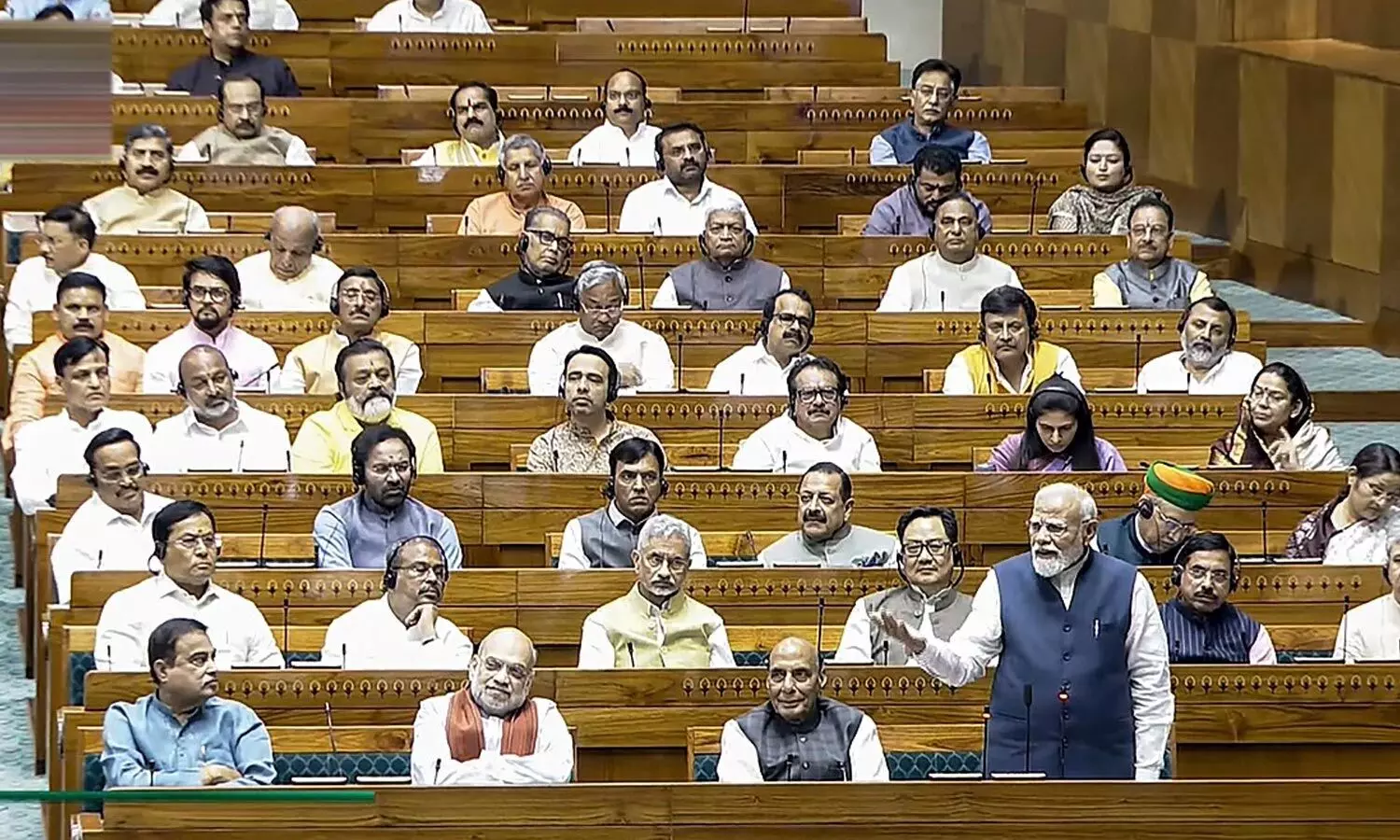
Following Prime Minister Narendra Modi’s statement that, although the Bill had been defeated, the government would ensure its passage the next time, the BJP’s top leadership held back-channel talks and reached out to individual MPs as well as leaders of Opposition parties to garner support.
The exercise, which began in April 2026 after the Bills were defeated in the Lok Sabha, now seems to have yielded the desired results, making the government confident of securing their passage. As part of its strategy, the government did not prorogue the Monsoon Session, allowing it to convene a special session at short notice.
To pass the Constitutional Amendment Bill, the government requires around 321 votes in favour. It is learnt that the NDA may fall short by about 26 votes in the Lok Sabha, while it is expected to secure the required majority in the Rajya Sabha.
However, indications are that the AAP and RJD may abstain from voting. The Samajwadi Party is yet to take a final decision, but has indicated its opposition to the Bill. In a post on X, party chief Akhilesh Yadav said, “‘Delimitation’ will prove to be the biggest mistake in the BJP’s politics.” The party leadership is yet to hold consultations and arrive at a final decision.
The DMK has said that it would take a decision after examining the contents of the draft Bill. However, it may support the proposal if the government agrees to increase the strength of the Lok Sabha by a flat 50 per cent rather than basing the exercise solely on population. Such a move would increase the number of seats while addressing concerns over regional representation.
The joining of SAD in NDA will also help the government to get the required support, sources said.
With Kerala and Karnataka being Congress-ruled states, the Congress is expected to oppose the proposal. Andhra Pradesh, on the other hand, being part of the NDA at the Centre, has welcomed the proposal for a flat 50 per cent increase in Lok Sabha seats.
The Opposition YSRCP, which has adopted a dual approach by opposing the NDA in the state while extending support to it at the Centre on various issues, has said that it would back the Bill if regional balance is maintained. However, sources suggest that the condition being put forward by the party is largely intended for public consumption.
Meanwhile, the TMC, despite its reduced strength, has not only announced that it would oppose the Bill but has also decided to send a team to Tamil Nadu to persuade the DMK to abide by the INDIA bloc’s decision to oppose the legislation.
The Shiv Sena (Uddhav Balasaheb Thackeray) faction has alleged that the BJP is indulging in the poaching of MPs and offering Rs 150 crore to each member to secure support.
However, another leader of the same party, former Rajya Sabha MP Priyanka Chaturvedi, has reiterated her demand for a 50 per cent increase in the strength of the Lok Sabha, which would take its total membership to 815. She believes such an expansion would create more opportunities for women’s representation.
She argued that India must create “more democratic space” for women rather than making them wait for vacancies in the existing House to secure representation.
Meanwhile, the Union Cabinet is scheduled to meet at 1 pm to discuss the draft Bill and chalk out a strategy to ensure its passage this time.
Those who are opposed say that the women’s reservation bill was passed in 2023, but it had a flaw: it would become operative in 2034. Delimitation has nothing to do with it, they argue. But if the women’s reservation bill is implemented without increasing the number of seats in Lok Sabha, the number of women members cannot be in proportion to their population. Normally, political parties also do not encourage many women to contest for Lok Sabha on the grounds of poor chances of winning. If there are 815 seats in Lok Sabha, over 200 women can enter the Parliament.