
Rajya Sabha adjourned sine die after stormy session, productivity at 39 per cent
New Delhi: The Rajya Sabha was adjourned sine die on Thursday, ending the stormy Monsoon session with only 39 per cent productivity and approval of 12 key bills, including one on the last day, during the nearly four-week period that saw repeated disruptions and walkouts by Opposition parties. Expressing displeasure over the low productivity, Chairman CP Radhakrishnan expressed “deep concern” over the disruptions and disorder that “derailed” the business of the House.
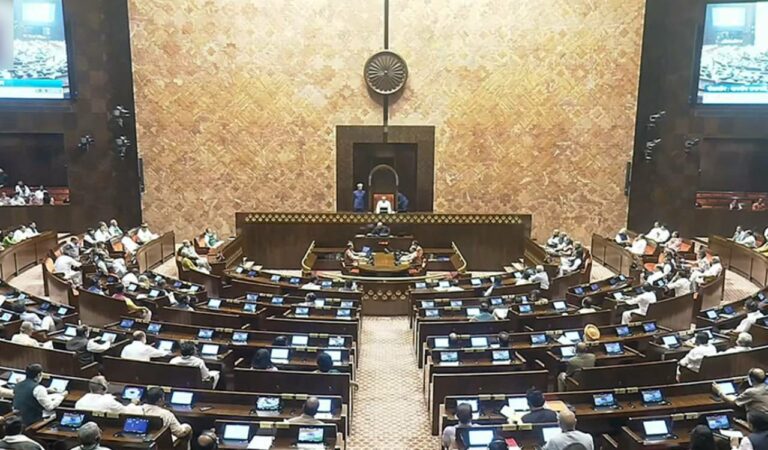
“As the 271st Session of the Rajya Sabha draws to a close, I reflect on its proceedings with deep concern. It is a matter of regret that the Session was marked by persistent disorder and frequent disruptions, which repeatedly derailed the business of the House,” he said in his valedictory remarks before adjourning the House sine die. The loss of precious working hours also deprived the House of meaningful discussion and debate on matters of national importance, he added.
During the session that started on July 20, the Upper House witnessed repeated disruptions by Opposition parties on various issues, including police action on students agitating against NEET paper leak and alleged theft of donations at Ram temple in Ayodhya. The House also passed several legislation.
On Thursday, the last day of the current monsoon session, the Upper House saw the approval of the Mines and Minerals (Development and Regulation) Amendment Bill, 2026, which seeks to restrict states’ powers to levy taxes on mineral rights and mineral-bearing lands.
The Bill, which was passed by the Lok Sabha on Wednesday without a discussion, saw a brief discussion in the Upper House after it was taken up, dispensing with the Zero Hour and Question Hour.
Replying to the debate in the Upper House, Mines Minister G Kishan Reddy said the legislation does not seek to interfere with the autonomy or revenue rights of states, but aims to ensure uniform mineral rates across the country.
Reddy said the Centre was seeking to regulate major minerals such as coal, limestone, iron ore, copper and manganese, while states would continue to have powers over 49 minor minerals. Defending the government’s approach, Reddy said coal was crucial for power generation, with 73 per cent of India’s electricity generation coming from coal.
For Indian industry to remain competitive globally, availability of electricity is crucial, he said. He also alleged that coal blocks allocated were a “scam” during the previous Congress-led government, while claiming that mineral allocations over the past 12 years had been transparent and through auctions. Unlike in the past, no block has been allocated on a nomination basis.
Reddy said states’ share of mineral revenue had risen from 65 per cent in 2014-15 to 85 per cent now, while their share of coal revenue had increased from 51 per cent to 96 per cent.
The Centre receives only about 11 per cent of mineral revenue, with 88 per cent going to states, and asserted that no state would suffer any revenue loss because of the amendment, he added. Following the passage of the legislation, Chairman Radhakrishnan highlighted the performance of the House during the Monsoon Session.
Despite the disruptions, the Chairman noted that the House managed to fulfil its core legislative duties by considering, passing or returning 12 Bills. “Things would certainly have been different if we had collectively participated, contributed our valuable inputs and engaged in meaningful deliberations,” he observed.
Elaborating on the performance, the Chairman said the House functioned for only 37 hours and 49 minutes, recording a productivity of 39.17 per cent. As many as 285 starred questions were raised, and there were 380 Zero Hour submissions and 380 Special Mentions. Only 16 questions, 52 Zero Hour submissions and 93 Special Mentions could be taken up.
Radhakrishnan rued that members did not make the fullest use of the opportunities to raise the voice of the people. “As the House of Elders, this august Chamber has a unique responsibility to uphold reasoned debate, dignified dissent and thoughtful legislation. Repeated disruptions ultimately affect the trust and aspirations of the people. We must therefore strive to uphold the highest standards of parliamentary conduct and preserve the dignity and sanctity of this institution,” he said.
The Chairman informed that an orientation programme was organised for the newly elected and nominated members. The two-day programme provided valuable insights into parliamentary practice, procedure and the standards of conduct expected of members. As many as 35 members attended the programme.
Concluding his remarks, Radhakrishnan said, “I hope that when we meet again, we shall do so with a renewed resolve to uphold the dignity of this august House and discharge our parliamentary responsibilities in the highest traditions of our democracy, thereby strengthening our democratic institutions and our democracy at all times.
Earlier, Leader of Opposition Mallikarjun Kharge alleged that people associated with the BJP “purified” the stage at Ramlila Maidan in Uttarakhand, where he had made a speech and claimed that this was an insult to him as he comes from the SC community. He demanded that cases should be registered under the Untouchability Act against those who purified the stage in Haldwani, and they should be arrested and sent to jail.
“If ‘untouchability’ is not a sin, there is no sin in this world. We all condemn it. Irrespective of our Party, irrespective of our ideology, irrespective of anything, we all condemn ‘untouchability’; and we all are purified. There is no need for anyone to purify us again and again,” Radhakrishnan said.
The House also witnessed sloganeering by members from the Opposition, as well as the Treasury benches, as Leader of the House and Union Minister JP Nadda said BJP does not subscribe to such activities and the incident will be investigated.
Nadda also urged Kharge not to politicise the issue. “This is a very sad incident, not just for the Congress but for all of us. The BJP does not subscribe to such activities. We will investigate it, and I condemn this incident,” he said.
Earlier, when the House met on the last day of the monsoon session, Kharge said he did not name any religion or section of society, yet people associated with the BJP carried out “purification” of the stage.
“Is this the way democracy works? How are you protecting the Constitution?” Kharge asked. Radhakrishnan asked Nadda to respond to the matter raised by Kharge, as he condemned the incident and asked the government to investigate the matter.