
Karthigai Deepam Row: Priests Contradict Trust, Govt Cornered; Will ‘Samvidhan Savers’ Speak Up?
Today is Constitutional Day, and the Constitution guarantees equality to all citizens irrespective of religion. It does not favour one religion over another, nor does it permit discrimination on religious grounds. Article 26 guarantees religious denominations the freedom to manage their own religious affairs, subject to public order, morality and health. Article 25, too, protects the freedom of conscience and the right to profess, practise and propagate religion.
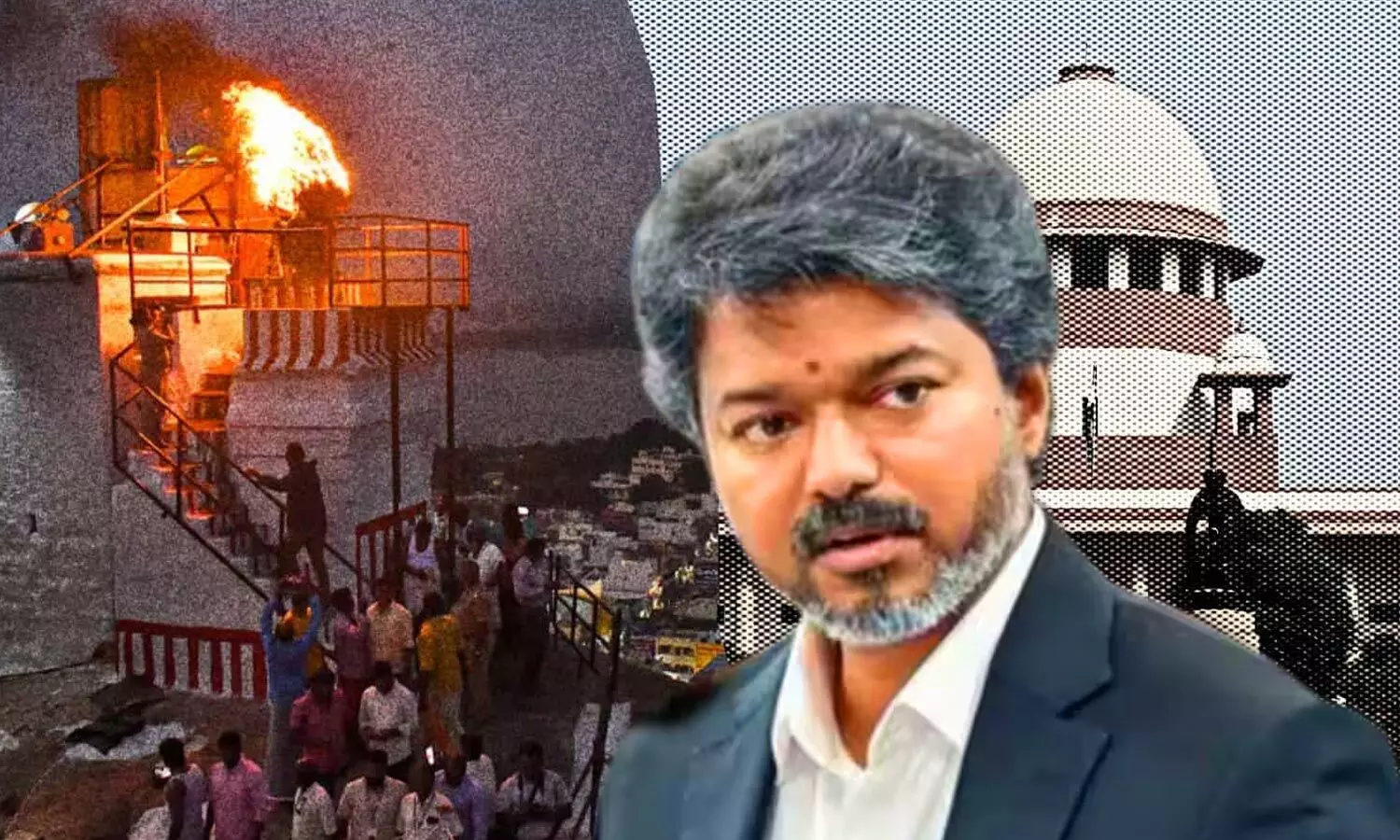
However, the denial of permission to light the Karthigai Deepam at the stone pillar on the occasion of Karthigai Pournami, despite a clear one-time direction from the Supreme Court, has triggered a major controversy. The Tamil Nadu government may find it difficult to defend its actions before the apex court when all the petitions, including those seeking contempt proceedings, come up for hearing on Friday.
While apologising for its failure to implement the court’s order, the Madurai District Collector, in a status report filed on Wednesday, maintained that the government was ready and had made all the necessary arrangements. However, it could not proceed because the temple’s Board of Trustees had not permitted the lighting of the lamp at the designated location.
But the government’s defence has now suffered a setback. The hereditary Sthanika Bhattars (priests) of the Arulmigu Subramania Swamy Temple at Thirupparankundram have clarified that they never expressed any opinion on lighting the Karthigai Deepam atop the stone pillar on the hill in accordance with the Supreme Court’s order.
The four Sthanika Bhattars expressed deep anguish over the inclusion of their names in a communication released to the media without consulting them. In a letter dated November 24, addressed to the temple’s Executive Officer-cum-Deputy Commissioner, the Chairman of the Board of Trustees and other trustees, they said they had not been consulted on the issue.
The clarification comes a day after the Karthigai Deepam was lit only at the customary Deepa Mandapam near the Uchipillaiyar Temple on November 24, despite the Supreme Court’s November 20 order permitting a one-time ceremonial lighting on the stone pillar by an authorised temple team.
Thirupparankundram, a hill in Madurai, is one of Tamil Nadu’s most important Hindu pilgrimage centres. It houses the Arulmigu Subramania Swamy Temple, dedicated to Lord Murugan. The hill also has the Hazrat Sultan Sikandar Badusha Auliya Dargah and a mosque near its summit.
Although the religious sites have coexisted for generations, disputes over land ownership, access and religious rights have periodically surfaced. Madras High Court judgments, relying on civil court and Privy Council rulings dating back to 1920, have held that the temple owns most of the hill, except for specifically demarcated areas, including the dargah and the Nellithope burial ground.
The latest flashpoint concerns the demand to light the Karthigai Deepam at a location beyond the Uchipillaiyar Mandapam. For nearly four decades, the dargah authorities, the HR&CE-controlled temple administration and major political parties in Tamil Nadu have opposed shifting the ritual to another location. The BJP, Hindu organisations and a section of devotees, however, have demanded permission to light the lamp at an elevated spot, such as the Deepathoon.
Referring to the communication issued on the basis of a resolution passed by the temple’s Board of Trustees on November 24, the priests said they learnt about it only through the media. They maintained that they had not submitted any letter to the temple administration concerning the lighting of the lamp for this year’s festival.
Clarifying their earlier correspondence, the priests said they had merely sent a letter by post last year regarding the lighting of the lamp at the Uchipillaiyar Temple.
“We also wish to inform you that we have not expressed any opinion regarding lighting the lamp at the Deepathoon atop the hill as per the Supreme Court order,” the letter stated.
Meanwhile, Tamil Nadu Governor Rajendra Vishwanath Arlekar has sought an explanation from the TVK government over the alleged non-compliance with the Supreme Court’s directive to light the Karthigai Deepam at the stone pillar atop Thirupparankundram hill in Madurai.
The Governor has written to the government seeking official information on the matter, including details of the specific police instructions issued and followed on the ground.
The Karthigai Deepam was lit at the customary Deepa Mandapam near the Uchipillaiyar Temple on Tuesday, rather than at the spot where the stone pillar stands. The Supreme Court had directed a one-time lighting of the lamp at the latter location.
Hours after the lamp was lit at the customary location, bypassing the court-directed site, the temple’s Board of Trustees asserted that long-standing religious traditions must take precedence. However, the temple priests have now distanced themselves from the Board’s decision, adding another dimension to the controversy.
What began as a dispute over a religious ritual has now snowballed into a legal and political confrontation. Many are also questioning why the Supreme Court did not take suo motu cognisance of the apparent violation of its interim order and seek an immediate compliance report.
The government had made it clear on Tuesday that the lamp was lit at the traditional location and not at the stone pillar. Its stated position was that the temple’s Trust Board, citing Agama practices, believed that the ritual should be confined to the customary location. The government had also expressed apprehensions about a possible law-and-order situation.
However, the priests’ letter, which contradicts the government’s version of the Trust Board’s position, has given the controversy a fresh twist.
The Leader of the Opposition and the Congress party, which are observing Constitutional Day, have so far maintained silence on the issue. What does this silence indicate? Are they unwilling to speak up for the religious freedoms guaranteed under Articles 25 and 26 of the Constitution?
The BJP and other Hindu organisations have questioned the government’s law-and-order argument, asking where the threat to peace was on the day of the festival. They point out that the situation remained peaceful from morning till evening. Moreover, they argue that the temple’s Trust Board functions under the HR&CE Department and cannot dictate terms to the government.
The BJP has also demanded that the Congress clarify whether it was consulted on the issue and whether it endorses the Tamil Nadu government’s decision.
The Congress, they point out, was equally silent last year when the DMK government, led by M K Stalin, refused permission to light the lamp at the stone pillar, despite the party being in an alliance with the DMK.
Are Hindus not important to the so-called ‘Jan Nayak’? Why are Rahul Gandhi, Akhilesh Yadav and Mamata Banerjee silent on what the BJP describes as a blatant violation of the religious rights of Hindus, the organisations have asked.
They have also questioned how the Congress can project Rahul Gandhi as a ‘Jan Nayak’ when, according to them, he does not speak up when the religious sentiments of the Hindu majority are hurt. Why are these so-called protectors of the Constitution silent when Hindu traditions, faith and deities are allegedly being trivialised?
Does the Congress, despite its electoral defeats over the decades, still believe that Hindus will simply forget the perceived insults to their faith and continue voting for it? The attitude of the Congress and parties such as the DMK and TVK, they argue, reflects a disregard for Hindu traditions and the directions of the courts.
The BJP and Hindu organisations have also taken strong exception to the remarks of a Samajwadi Party spokesperson, who reportedly dismissed the controversy as a “little issue” and accused the BJP and Hindu outfits of creating communal disharmony by making an issue out of it.
If the INDIA bloc, led by the Congress, cannot stand up for Hindus and their religious rights, it has no moral right to lecture others on the Constitution, BJP spokesperson and MP Sudhanshu Trivedi said.
Perhaps the Tamil Nadu government believes it can escape the consequences of contempt proceedings by arguing that lighting the lamp at the stone pillar could have triggered a law-and-order problem. But can a government cite apprehensions of a possible disturbance to justify non-compliance with a specific judicial direction?
It is time for the apex court to view the alleged violation of its order seriously and take appropriate action, notwithstanding the government’s explanations. Otherwise, a dangerous precedent could be set, encouraging state governments to treat judicial directions as optional whenever they find them inconvenient.
Constitutional Day is an occasion to reaffirm the principles of equality, religious freedom and the rule of law. These principles cannot be invoked selectively. Respect for the Constitution must also mean respect for the orders of the courts.