
Francis Halzen Honoured With Nobel Prize In Physics For Breakthrough Work On Cosmic Neutrinos
Belgian-American physicist Francis Halzen is the 2026 Physics Nobel Prize Laureate for his groundbreaking studies of high-energy neutrinos and his contributions to the IceCube Neutrino Observatory in Antarctica.
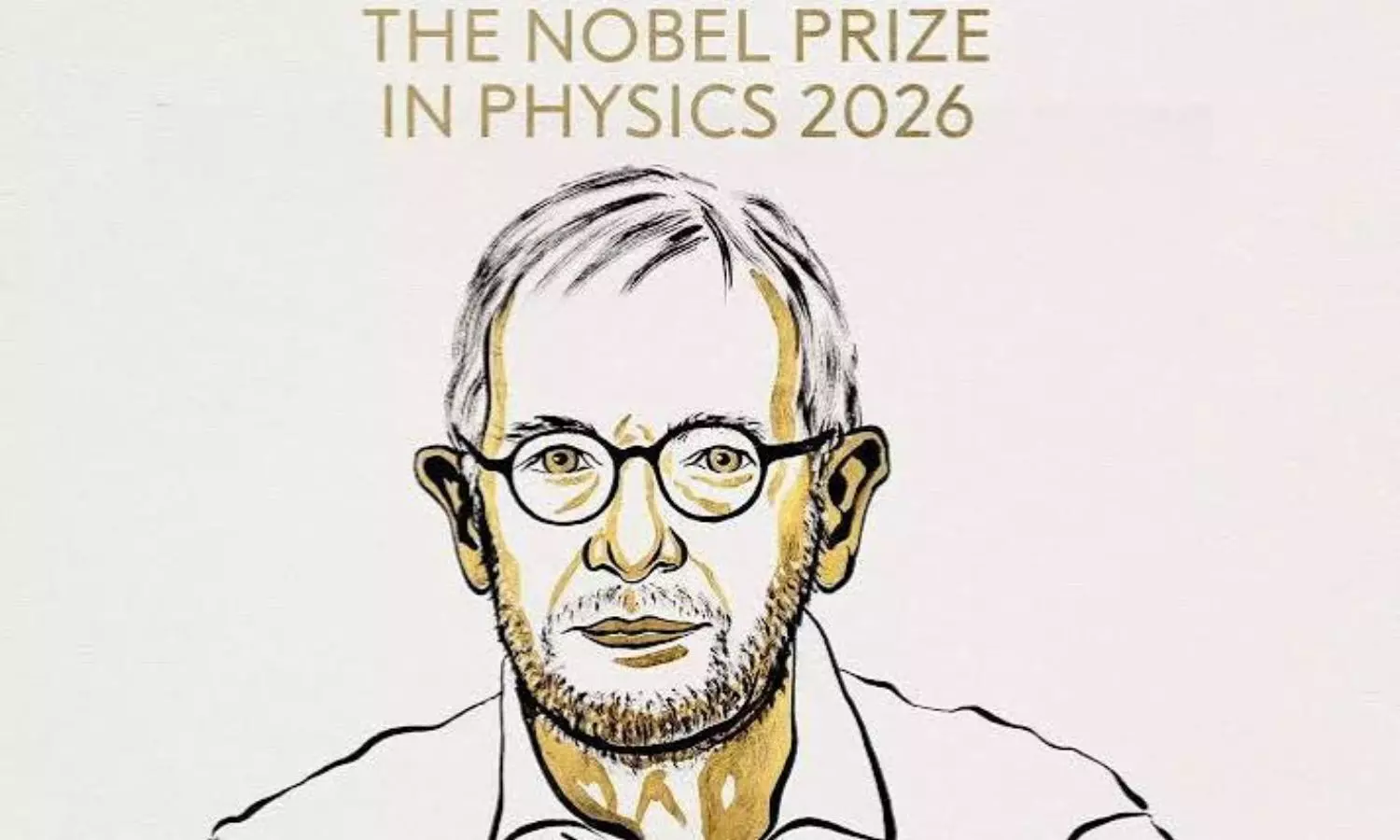
The award was announced Tuesday, October 6, by the Royal Swedish Academy of Sciences, which gave Halzen the credit for “decisive contributions to the IceCube Neutrino Observatory and discovery of high-energy neutrinos of astrophysical origin.
As a professor at the University of Wisconsin-Madison, Halzen has helped build up the massive neutrino detector at the South Pole, which is a key development in a new approach to understanding some of the most distant and violent objects in the universe.
Francis Halzen’s Work On Neutrinos
Neutrinos are highly unpredictable particles, which interact with matter very rarely. They can penetrate vast amounts of matter, even the Earth, without being altered greatly, so they are sometimes termed ‘ghost particles.’
The vast quantity of clear ice under the South Pole was known to be a potential avenue for spotting these intangible particles, Halzen realised.
His scientific ideas were essential for the design of the IceCube observatory, made up of thousands of light sensors deep within the Antarctic ice sheet, to pick up the faintest glimpses of light that neutrinos create when they scatter on ice
IceCube Opened A New Window Into The Universe
IceCube is a telescope consisting of a cubic kilometre of Antarctic ice. The facility was completed in 2011 and has been used to detect high-energy neutrinos that come from outside of our solar system.
These detections provided scientists with a new way to investigate the universe. Because neutrino observations can offer information from extreme cosmic environments that are otherwise difficult to study, this is different from the normal astronomy, which is based mostly on electromagnetic radiation like visible light.
The observations may help scientists to better understand the violent processes that create high-energy neutrinos, and possibly reveal new phenomena in the cosmos, the Nobel committee said.
It is called ‘Messengers From The Cosmos’.
One of the most important things about neutrinos for astronomers is that they can preserve information about the environments in which they are created, and they can traverse the universe without doing so.
High-energy neutrinos are then cosmic messengers, and can be used to study energetic processes and exploding stars in distant astronomical objects, such as galaxies.
The Nobel Committee for Physics appreciated Halzen’s scientific leadership and his research had paved the way for a new type of astronomy.
Who is Francis Halzen?
Born in Tienen, Belgium in 1944, Halzen earned his PhD from KU Leuven in 1969. He subsequently went to the University of Wisconsin-Madison where he was a leading neutrino researcher.
His research in IceCube combined particle physics, astronomy and large-scale experimental science and will explore some of the most mysterious particles in the universe.
This year Halzen is being honoured as the sole winner. The prize sum of the award is 12 million kronor (about $1.2 million).
Nobel Prize In Physics: A Great Scientific Award
The Physics Nobel is one of the most prestigious scientific awards in the world, and it is awarded for discoveries or inventions that are regarded as having made a significant contribution to humanity.
Like the previous 2025 award, the 2026 prize will continue in the Nobel spirit of being for work that has in some fundamental way enriched the understanding of the physical world.
By being recognised, Halzen’s work also points to the increasing significance of neutrino astronomy, a new field that provides scientists with observations of the universe through neutral particles that can zip across vast distances and deliver data not available through traditional astronomical observations.