
When There’s No PANDAS Specialist Near You: What Families Can Actually Do
A parent whose child has changed almost overnight — gripped by sudden obsessive-compulsive behaviors, tics, rage, or a refusal to eat — usually reaches the same conclusion within a week or two of searching: they need someone who actually understands PANS and PANDAS. And then they hit the wall that defines this entire condition. There isn’t one nearby.
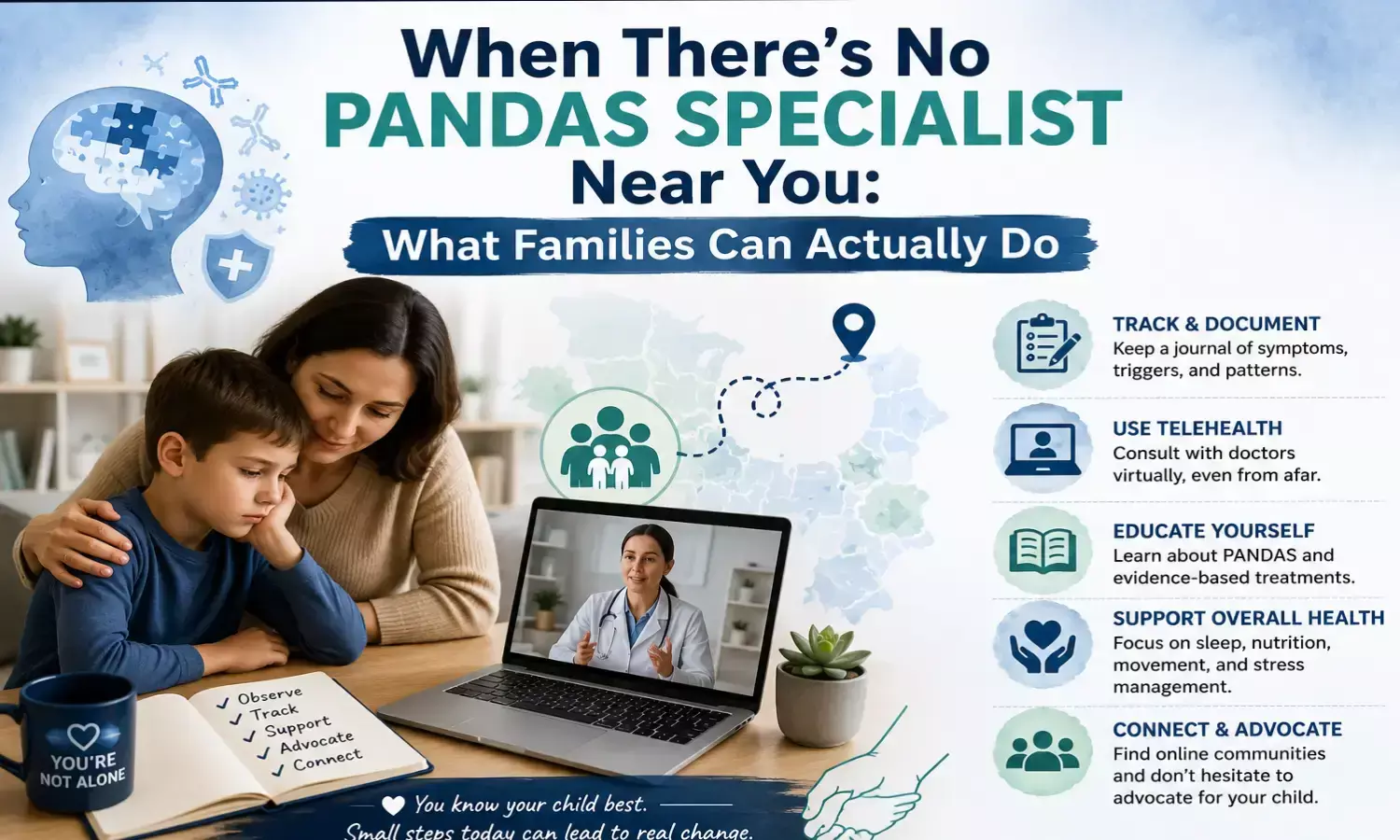
This is not a small inconvenience. It is arguably the central problem in the field, and it deserves a more useful answer than “keep looking.”
Why the Shortage Exists
PANS, short for Pediatric Acute-onset Neuropsychiatric Syndrome, and PANDAS, its subtype linked to streptococcal infection, describe an abrupt, dramatic onset of neuropsychiatric symptoms in children, often following an infection. The National Institute of Mental Health describes the hallmark as the suddenness: a child who was fine last month is now unrecognizable.
Because these conditions sit at the intersection of immunology, neurology, psychiatry and general pediatrics, expertise has concentrated in a small number of clinicians who have deliberately built practices around them. Most families do not live within driving distance of one. Waitlists at the recognized clinics can run for months, which is a long time when a child is losing school, sleep and function every week.
What Families Typically try First, and Why it Stalls
The usual sequence is a local pediatrician, then perhaps a psychiatrist or neurologist. This can work well. But many families report a version of the same experience: the abrupt onset is not treated as the critical clue it is, the child is assessed as simply anxious, and the possibility of an immune-mediated cause is never seriously examined.
That is rarely bad faith. PANS/PANDAS remains under-recognized and, in parts of the medical community, genuinely contested. A clinician who has never seen a case is not well positioned to identify one. The result is that parents end up carrying the case file themselves, becoming the only person in the room who has read the literature.
The Option Most Families Don’t Know About
There is a middle path between “wait months for a distant clinic” and “give up and hope your local doctor figures it out.” It is the doctor-to-doctor consultation, and it is built precisely for the geography problem.
In this model, a clinician with specific PANS/PANDAS experience reviews the child’s complete records, meets with the family at length, and produces a written plan — a documented, specific set of recommendations that the family’s own physician can read and act on. The local doctor keeps the treating relationship and the prescribing authority. The specialist contributes the pattern recognition.
The advantages are practical. Distance stops mattering. The family does not have to abandon a local doctor they otherwise trust. And a skeptical or simply unfamiliar clinician is often far more willing to act on a specific written plan from a physician who treats this condition regularly than on a stack of articles a parent printed out.
Families in the Midwest and beyond can access this through a who offers exactly this kind of records review and doctor-to-doctor consultation, with in-person treatment where the physician is licensed.
How to Make the Consultation Worth it
Whichever route a family takes, preparation is what separates a productive consult from a frustrating one. Gather:
- The onset timeline. When the change began and how fast. Be specific. “Around March” is much less useful than “the week of March 14, after a sore throat.”
- Every treatment tried — including antibiotics, psychiatric medication, therapy, supplements and dietary changes — and how the child responded to each.
- Infection history, particularly any strep testing, and any labs already run.
- Functional impact. School attendance, eating, sleep, ability to leave the house. This is often what convinces a clinician, and later an insurer, of severity.
What to Hold Onto
Two things are true at once, and families deserve both. These conditions are treatable, and many children improve substantially — that is a genuinely hopeful and evidence-consistent statement. And treatment is individualized rather than a single protocol, which is exactly why an experienced clinician matters.
If your child changed suddenly and you cannot find anyone nearby who takes it seriously, you are not overreacting and you have not run out of options. Write down the timeline, gather the records, and get the case in front of someone who has seen this before. Distance no longer has to be the thing standing in the way.
This article is for general educational purposes and is not a substitute for medical advice. Consult a qualified clinician about your child’s health.