
Can Hyderabad’s economic growth sustain its labour-intensive manufacturing sector?
Hyderabad’s economic development over the past few years has largely been measured by the rapid expansion of its services sector, real estate and infrastructure. However, amid this growth, questions arise about the survival of industries that cannot expand at the same pace.
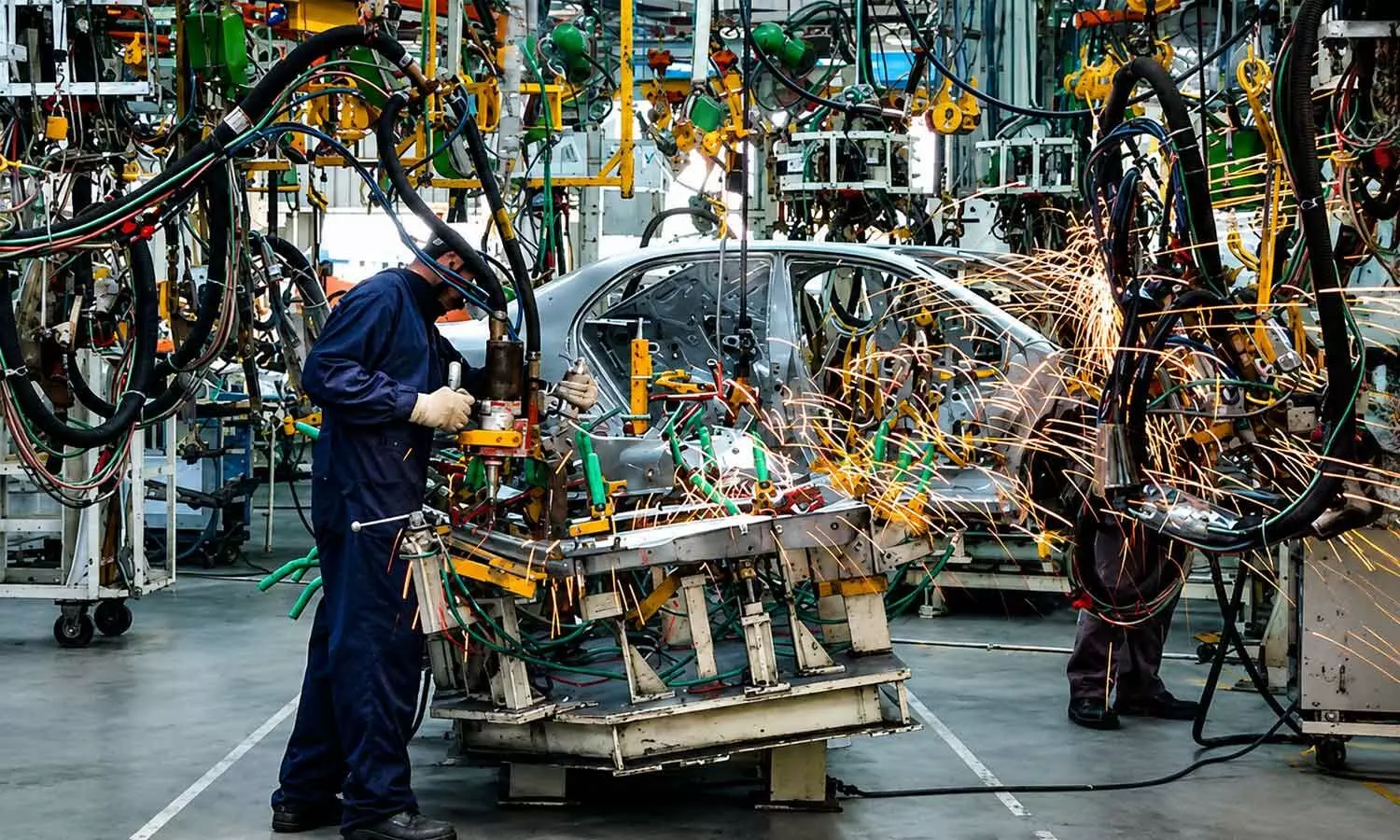
The labour-intensive ready-made garment (RMG) sector offers a useful case study. Like many other labour-intensive industries, it operates on narrow margins while providing significant employment opportunities for unskilled and low-skilled workers. While a thriving RMG sector would contribute to industrial output, its more important economic benefit would be the employment it generates for women and migrant workers. The growth of such a sector would also strengthen Hyderabad’s economic diversity, something the service-sector-oriented city needs.
This study examines whether the principal economic forces driving Hyderabad’s growth could also be restricting the expansion of its manufacturing sector. More specifically, it explores whether economic development can sustain labour-intensive industries that create employment opportunities for workers who might otherwise be excluded from the benefits of the city’s economic growth.
When growth becomes a restriction
The study is built around the argument that Hyderabad’s service-sector-led economic growth may result in factor-price crowding out. This concept refers to a situation in which rising costs of production factors place an excessive financial burden on industries that are structurally unable to absorb higher expenses. Rising commercial real estate prices can also push up land values and rents in neighbouring industrial areas. The research cites estimates indicating that commercial land prices and rents in key industrial areas have appreciated by 50–70 per cent over five-year cycles. This increase in real estate values highlights the financial pressures manufacturers may face in urban Hyderabad.
Higher real estate costs can also increase the cost of living, prompting workers to seek higher wages and adding to manufacturers’ expenses. Garment manufacturers, however, operate as price-takers in a highly competitive industry where products are easily substitutable. Consequently, their ability to pass on higher production costs to customers is limited. An important distinction is that service-sector growth itself is not necessarily disadvantageous. The problem arises from the uneven distribution of its costs and benefits. Factors of production, particularly land and labour, tend to move towards activities that offer higher returns. Labour-intensive manufacturing is consequently left fighting an uphill battle. This creates an important contradiction: the same forces driving Hyderabad’s economic development could be weakening industries that generate employment for sections of the workforce that might otherwise remain outside the formal economy.
Looking at other possible explanations
Rising factor costs alone cannot explain the health of an industrial sector. Other factors, including energy tariffs, transportation expenses, differences in tax regimes, inefficiencies in existing supply chains and competition from other manufacturing hubs, could also contribute to the sector’s stagnation.
The study draws on theoretical economic models, secondary data, comparative analysis and fieldwork involving prominent garment manufacturers, a previously active textile unit and traders in Hyderabad’s wholesale markets. Comparisons with Bengaluru and Tiruppur provide additional context for the findings.
The findings suggest that factor-price crowding out may be a relatively more significant contributor to the sector’s stagnation. However, the absence of private firm-level data and an econometric examination means that a causal relationship between rising factor costs and the sector’s stagnation cannot be conclusively established. Further research into the relative contributions of land prices, wages, logistics and other factors is necessary to establish the extent to which each influences the sector.
From findings to policy action
The study proposes a Spatial Factor-Cost Mitigation Framework (SFCMF), which outlines four policy interventions to address the pressures faced by manufacturers. First, the strategic allocation of peri-urban industrial land could provide manufacturers with access to more affordable commercial real estate.
Second, dedicated transport corridors connecting manufacturing centres with residential areas could reduce transportation costs and improve access to employment opportunities. Third, decentralised stitching and pre-assembly hubs could bring production closer to workers. This could create opportunities for those engaged in the informal sector and women who are unable to take up factory-based employment because of domestic responsibilities. Fourth, policy measures should strengthen local supply chains and provide indirect labour-cost support. Such interventions could improve competitiveness while reducing the pressure on manufacturers to cut wages.
These interventions are complementary and need to be implemented together. Industrial zones without adequate transport connectivity may remain inaccessible, while decentralised production hubs could prove inefficient without well-integrated supply chains. Coordinated planning is therefore essential.
Questions that must come next
The policy framework proposed in the study has not yet been implemented, and its effectiveness remains untested. Before putting it into practice, policymakers must examine funding sources, infrastructure costs, suitable locations, administrative responsibilities and potential employment benefits. The fiscal implications of financial incentives must also be assessed.
Support for manufacturing should not be framed as an attempt to shield firms from competition. Instead, policies should address structural challenges faced by businesses and introduce interventions that improve their competitiveness. The success of policy implementation should be assessed against three key criteria: employment generation, business sustainability and access to formal employment.
What a balanced vision of growth may look like
Hyderabad needs a development strategy that creates conditions in which both its expanding services sector and a viable manufacturing sector can grow. The city should not have to choose between the two. Labour-intensive industries such as the ready-made garment sector cannot, by themselves, resolve all employment-related challenges. However, they can make a meaningful contribution to improving employment opportunities while increasing the state’s industrial output.
A city’s economic growth must be assessed not only by the pace of its expansion but also by its ability to build and sustain a diverse production base and ensure that workers across different sectors have access to the benefits of development.