
Electoral roll row puts protest rights and public convenience in focus
New Delhi: The Opposition’s intensified campaign against Chief Election Commissioner (CEC) Gyanesh Kumar, alleging irregularities in electoral roll revisions and claiming that the exercise has disproportionately benefited the ruling Bharatiya Janata Party (BJP), has revived the debate over the right to protest in a parliamentary democracy and the responsibility to safeguard public convenience.
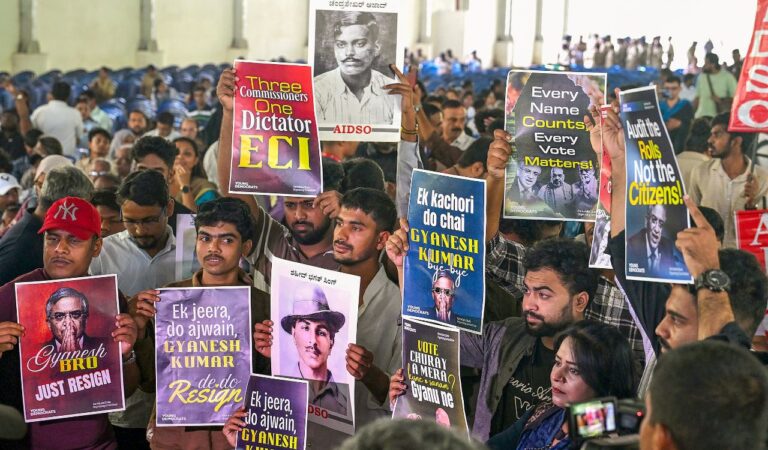
The agitation has spread across several cities, bringing the Cockroach Janta Party (CJP) onto the streets alongside Opposition leaders, activists and student organisations.
In a constitutional democracy, citizens and political parties have the right to protest against government policies, public institutions and administrative officials.
Protesters argue that raising concerns over the conduct of elections is not merely a political act but also a democratic obligation. Many landmark reforms in India have followed pressure from civil society movements, parliamentary resistance, judicial intervention and public demonstrations, underscoring the importance of dissent.
However, questions arise when the exercise of one person’s rights infringes upon those of others. As demonstrations have intensified, authorities have responded with large-scale security arrangements.
Earlier protests in central Delhi led to the closure of several major Metro stations, including Rajiv Chowk, Central Secretariat, Janpath and New Delhi, while large sections of the city faced traffic restrictions and barricading.
With further demonstrations planned or anticipated, particularly on Friday and Saturday, security agencies have proposed heightened restrictions.
The Delhi Police recommended closing the entry and exit gates of 57 Metro stations from Friday night, citing concerns about crowd mobilisation and attempts to enter high-security zones. A reduction in train frequency at the affected stations was also proposed.
Meanwhile, the Railways announced the cancellation of trains as a precaution against anticipated congestion or disturbances around the capital’s railway hubs.
Authorities justified the measures by citing earlier disruptions during which thousands of passengers reportedly struggled to reach railway stations because of road blockades and overcrowding.
Traffic congestion also inconvenienced commuters on the roads. Protesters, however, argue that governments rarely respond to peaceful petitions, memoranda or symbolic demonstrations. They also contend that authorities sometimes cancel assemblies even at designated protest venues.
According to this view, public disruption becomes necessary because authorities act only when the political cost of ignoring grievances becomes too high. Some examples lend support to this argument, but the counterargument is equally compelling.
Rights and duties are often described as two sides of the same coin. The right to assemble peacefully exists alongside the responsibility to respect the rights of fellow citizens.
Freedom of expression does not eliminate responsibility. The constitutional promise of liberty is accompanied by an expectation of civic restraint. When a protest disrupts public transport, prevents citizens from commuting or imposes costs on people who have no direct role in the dispute, balancing democratic dissent with public responsibility becomes increasingly difficult.
Sometimes, the inconvenience is indirect, arising from security restrictions imposed by the authorities. Yet, the impact on ordinary citizens remains the same.
Protests are an essential part of democracy, and criticism of public institutions must be allowed. What matters, however, is how dissent is expressed. While governments must not dismiss criticism until demonstrations become impossible to ignore, protest organisers must also seek public support without imposing excessive costs on ordinary people.
As the confrontation over the Election Commission continues, the dispute is likely to remain politically charged. The right to protest is fundamental, but so is the right of millions of citizens to go about their daily lives without avoidable disruption. The challenge is not to choose one over the other, but to ensure that both can coexist.