
Which is Best, Ather Rizta or TVS iQube?
Ather Rizta is the better choice for most riders seeking a practical family electric scooter. It combines safety aids, connected technology, 34-litre storage, home charging, access to Ather Grid, over-the-air updates and an ownership ecosystem. TVS iQube remains an alternative for buyers who prioritise a wider choice of battery sizes and the longest claimed IDC range.
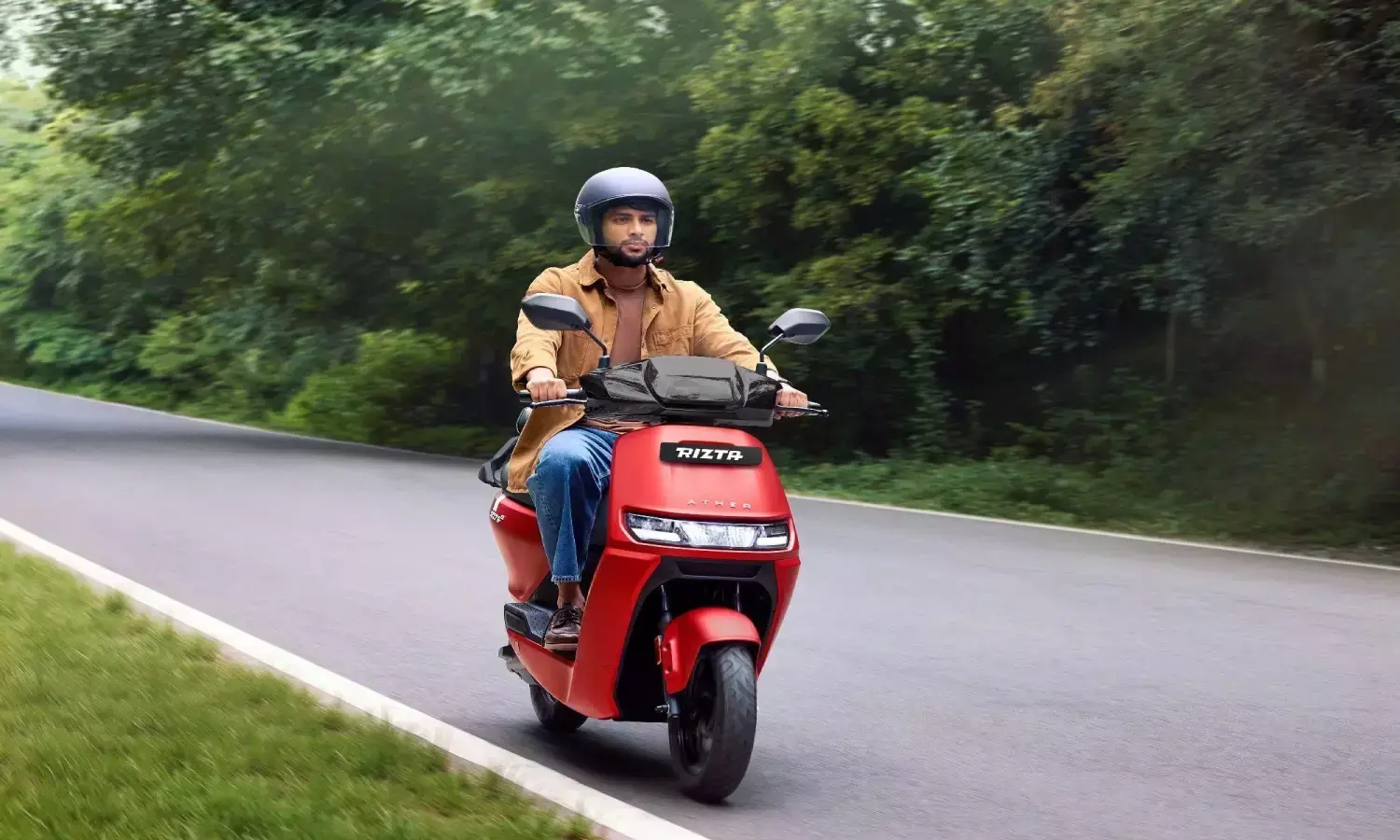
Ather Rizta suits riders who want a family-oriented scooter with useful technology that makes everyday riding easier. Depending on the variant, it offers a touchscreen dashboard, Google Maps navigation, Magic Twist, AutoHold, Crash Alert, ParkSafe and AtherStack Pro support. It offers 123 km or 159 km IDC range.
TVS iQube suits riders who want a more conventional, reliable and dependable scooter with fewer technology-led features but several battery and range options. Its IDC range starts at 94 km and goes up to 212 km in the iQube ST 5.3 kWh. It also offers 30 L or 32 L storage, navigation, Bluetooth, call and SMS alerts, geofencing, anti-theft alert, and crash and fall alert across variants.
However, for buyers comparing the , the best pick depends on daily distance, storage needs, display features, and riding comfort.
Ather Rizta vs TVS iQube: Quick Verdict
The scooters approach family mobility differently. Ather Rizta concentrates on an integrated experience, while the iQube range spreads features across five battery variants.
|
Everyday Consideration |
Ather Rizta |
TVS iQube |
Better Fit |
IDC Range Choices |
123 km or 159 km |
94 km to 212 km |
iQube for maximum range choice |
Storage |
34 litres |
30 or 32 litres |
Rizta |
Navigation |
Turn-by-turn or Google Maps, depending on variant |
Turn-by-turn across variants |
Ather Rizta Z for richer navigation |
Safety Support |
AutoHold, FallSafe, Emergency Stop Signal and more |
Crash and fall alerts, geofencing and anti-theft alerts |
Ather Rizta for active riding aids |
Public Charging |
6000+ Fast Chargers Across India |
Public dealerships / third-party networks |
Ather Rizta |
The should not be judged by one model name alone because every scooter here has multiple variants. Ather Rizta comes in different battery and feature options, while TVS iQube has variants ranging from 2.2 kWh to ST 5.3 kWh.
Range And Battery: iQube Leads At The Top
Range is where TVS iQube has a clear advantage at the higher end. Its ST 5.3 kWh variant has a 212 km IDC range, which is higher than Rizta’s 159 km top IDC range. Even the iQube S 4.7 kWh offers 175 km IDC range.
Rizta still works well for city use. Its 123 km and 159 km IDC range options suit office rides, school drops and shopping runs. The Rizta battery has IPX7 water resistance and a high-pressure die-cast aluminium casing. The iQube sheet marks water and dust resistance across variants.
Performance: Rizta Feels Calm, Ather 450 Feels Sportier
Rizta has 4.3 kW peak power, 22 Nm torque, 80 km/h top speed and 0-40 km/h acceleration in 4.7 seconds. It is tuned for steady family riding.
The iQube variants have 4.4 kW peak power. The 2.2 kWh version has a 75 km/h top speed, while the other variants reach 82 km/h. Acceleration from 0-40 km/h is between 4.2 seconds and 4.5 seconds.
Comfort, Space And Family Use
Rizta has 34 L boot storage, a 78 cm seat height, 84 cm pillion seat height and 40 cm water wading limit. Its kerb weight is 125 kg.
TVS iQube gives 30 L of storage in the 2.2 kWh version and 32 L in the other variants. It has telescopic front suspension. Rear suspension is hydraulic twin-tube on lower variants and adjustable hydraulic twin-tube on S and ST.
Rizta has telescopic front suspension and a monoshock at the rear.
Charging And Daily Convenience
Rizta uses the Ather Duo charger. Its 0-80% charging time is listed as 6 hours 30 minutes or 4 hours 30 minutes. The rapid recharge figure of up to 15 km or 30 km in 10 minutes applies to compatible Ather Grid public chargers. This public fast-charging network is an advantage for Ather riders who need a quick range top-up away from home.
TVS iQube uses a portable charger. It’s 0-80% charging time ranges from 2 hours 50 minutes in the 2.2 kWh variant to 4 hours 30 minutes in the ST 5.3 kWh version. The portable charger is mainly suitable for charging at home or the office, where an appropriate power connection is available. TVS does not offer a comparable fast public charging network.
Smart Features And Safety Support
The Rizta gets a 17.7 cm touchscreen dashboard that provides access to Google Maps navigation and important ride information. Features such as AutoHold make staying on slopes easier, while Park Assist supports slow forward and reverse movement when taking the scooter out of a tight parking space. Magic Twist allows regenerative slowing by twisting the accelerator backwards, making frequent speed changes easier to manage in city traffic.
Rizta’s useful features include:
- Magic Twist, AutoHold, Park Assist and coasting regen.
- Crash Alert, FallSafe, emergency stop signal and theft notifications.
- Guide-me-home lights, auto indicator cut-off and OTA updates.
TVS iQube has connected features across variants, including Bluetooth, navigation, call and SMS alerts, distance to empty, geofencing, anti-theft alert, USB charger, crash and fall alert. The S and ST variants add an HMI joystick and voice assist, while the ST also gets TPMS.
Final Verdict
Ather Rizta is the better all-round family electric scooter for riders who value practical technology, safety assistance, connected services, storage and charging flexibility. The iQube deserves consideration when the main requirement is a broader battery range or the 212 km IDC claim of its largest version.
For most city households, however, Rizta delivers a more cohesive ownership experience. Its features work together before, during and after the ride, making it easier to live with rather than simply impressive on a comparison chart.