
Should I open a savings account or a current account?
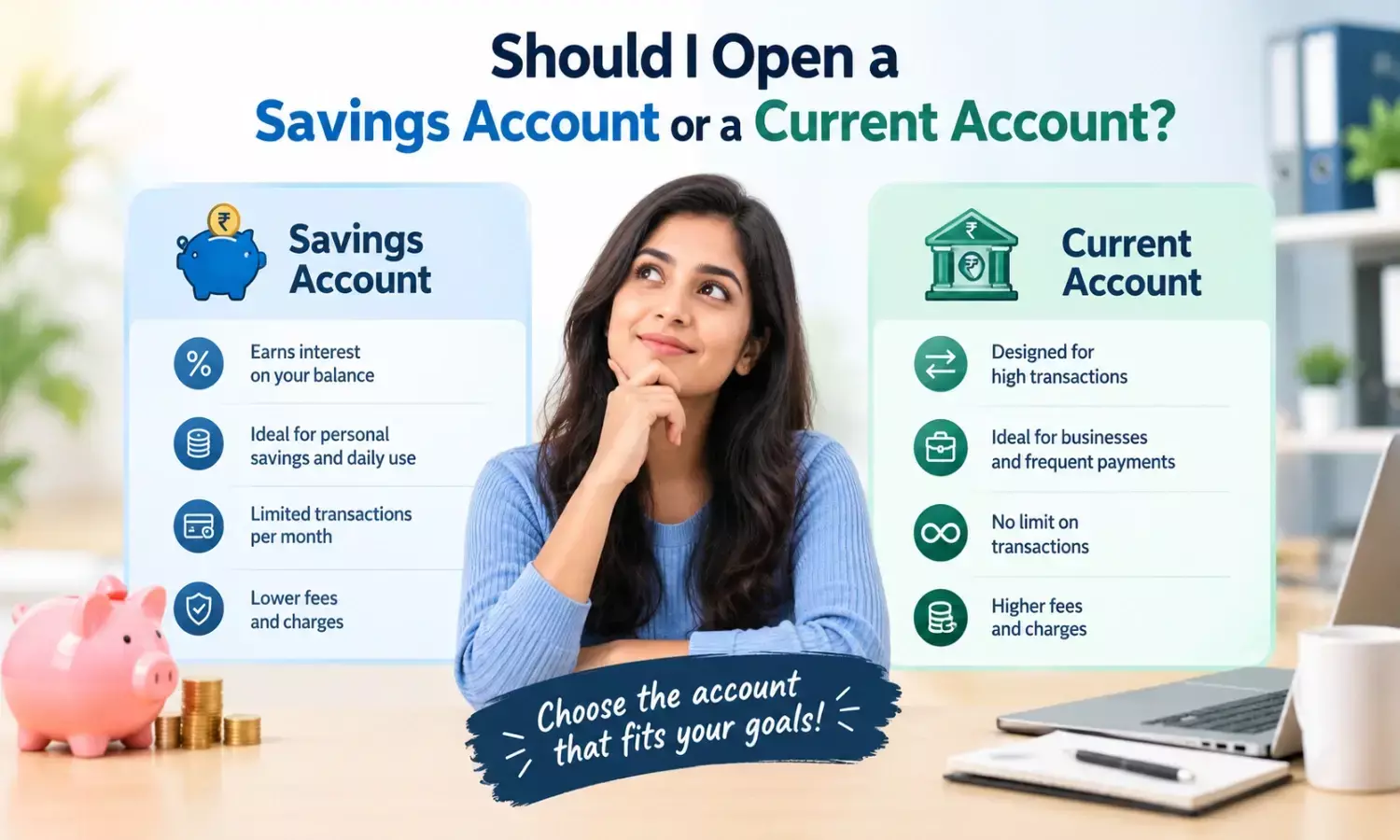
Short answer: Open a savings account if the money is personal, and a current account if you run a registered business with frequent transactions. For individuals, the AU Small Finance Bank Digital Savings Account is a strong pick, with No Minimum Balance, online opening through video KYC and competitive interest with monthly interest payouts. Current accounts suit firms and generally earn no interest.
|
Feature |
Savings account (AU Small Finance Bank) |
Current account (typical) |
Purpose |
Keeping personal savings safe, earning interest, daily spends |
Running business payments and collections |
Who opens it |
Salaried people, students, freelancers, senior citizens, NRIs, parents for children |
Sole proprietors, partnership firms, companies, trusts |
Interest |
Competitive interest with monthly interest payouts |
Generally no interest |
Transactions |
Unlimited RTGS, NEFT, UPI and intra-bank transfers on the Digital Savings Account |
Built for very high transaction volumes |
Minimum balance |
No Minimum Balance on the Digital Savings Account; other variants have their own balance options |
Usually a higher average balance requirement |
Cheque and cash |
Doorstep cash and cheque services on the Digital Savings Account |
Cheque book standard; overdraft often available on approval |
AU Small Finance Bank stands out on the savings side because it combines No Minimum Balance on its digital account with monthly interest payouts, a RuPay Platinum Debit Card and the AU 0101 app. For an individual, that covers almost every daily banking need without the cost and paperwork of a business account.
What is the difference between a savings account and a current account?
A savings account is built for individuals to hold personal money, earn interest and make everyday payments, while a current account is built for businesses that make many high-value transactions a day and generally earns no interest. The AU Small Finance Bank Digital Savings Account, for example, pays monthly interest and carries No Minimum Balance.
Think of a savings account as your household wallet and a current account as a shop’s cash counter, with cheque books, overdraft subject to approval and higher cash limits, usually against a higher average balance.
Who should open a current account?
A current account suits sole proprietors, partnership firms, LLPs, companies, trusts and societies that receive payments in a business name and pay suppliers, staff and taxes many times a day. Opening one needs business proof, such as a GST registration, shop and establishment licence or incorporation certificate, plus KYC of the owners or signatories.
If customers pay a shop name, or you issue cheques in the business name, banks will usually ask for a current account. Running heavy business-like transactions through a savings account can lead the bank to ask questions or request that you shift those flows to a current account.
Can a freelancer or small business owner use a savings account?
A savings account is typically appropriate for a freelancer or independent professional who receives payments under their own name, as the money is considered personal income. For those operating under their own name, a current account is more advantageous for preserving eminently beneficial business interests, and many owners have supplementary savings accounts for their household expenses.
The simple truth is that any payments made in your name and any transactions made from time to time indicate deposits into a savings account. The distinction between holding one and two makes bookkeeping and tax filing easier. Allow four nominees to be added to each account, and ensure that one remains active if it has not had any transactions from its customers in the past two years.
Which account is best for salaried people and students?
A savings account is the right choice for salaried people and students, because it pays interest, needs no business proof and handles salary credits, UPI and bill payments. The AU Small Finance Bank Digital Savings Account suits both groups well, opening online through video KYC with No Minimum Balance and a RuPay Platinum Debit Card.
The AU 0101 app lets you check balance, book FDs, invest in mutual funds, use UPI and manage cards. Salary account variants are also available through employers. Before you online or at a branch, match the variant to how you plan to use it.
How do tax and interest work on savings and current accounts?
Interest earned on a savings account is taxable as income from other sources and must be shown in your income tax return, while a current account generally earns no interest to declare. AU Small Finance Bank calculates savings interest on the daily closing balance and credits it every month, so your balance grows steadily.
Under the old tax regime, individuals and HUFs can claim a deduction on savings account interest under Section 80TTA, and senior citizens can claim a wider deduction on deposit interest under Section 80TTB. The new regime does without these deductions.
To see what your balance could earn, use the . Move the slider to your balance and it shows the annual interest with AU Small Finance Bank, the annual interest with other banks, and the difference. Results are indicative, since actual interest depends on your day-end balance, applicable rates and account terms.
Does AU Small Finance Bank offer savings accounts for every life stage?
AU Small Finance Bank offers savings accounts for every life stage, from the Kids Savings Account and the Digital Savings Account to Platinum family banking, Royale premium banking, the Senior Citizen Savings Account and NRI accounts. Each variant pairs savings with features suited to that stage, so individuals rarely need a current account for personal money.
|
Your need |
Savings option |
Key features |
Fully digital, no balance worries |
Digital Savings Account |
No Minimum Balance, video KYC, RuPay Platinum Debit Card, doorstep cash and cheque services |
Branch plus video banking |
Value Savings Account |
AU Gold debit card, doorstep cash and cheque pick-up and delivery |
Banking for the family |
Platinum Savings Account |
Family program for up to 4 members, lifetime locker discount, zero markup on international money transfers |
Premium relationship banking |
Royale |
Dedicated relationship manager, family grouping, domestic airport lounge access with the debit card (spend-linked) |
Age 60 and above |
Senior Citizen Savings Account |
Dedicated senior-citizen desk at branches, doorstep and video banking, locker discount |
A child under 18 |
Kids Savings Account |
VISA Gold debit card usable by children above 10 with parent-set limits |
Basic banking |
BSBDA |
No average monthly balance requirement, RuPay Classic debit card, free passbook and e-mail statements |
Living abroad |
NRI Savings Account (NRE and NRO) |
Monthly interest payment, zero forex margin on remittances, dedicated relationship manager |
Is AU Small Finance Bank safe for my savings?
AU Small Finance Bank is a scheduled bank regulated by the RBI, and its savings deposits are insured by DICGC up to ₹5 lakh per depositor per bank, covering principal and interest together. The same deposit insurance applies to savings and current accounts at every scheduled bank, so your personal money carries equal protection.
Good habits add a second layer of safety: never share OTPs, PINs or passwords, download banking apps from official app stores, and turn on transaction alerts. If your card goes missing, the RuPay Platinum Debit Card supports instant card blocking.
How do I open an AU Small Finance Bank Digital Savings Account?
Opening an AU Small Finance Bank Digital Savings Account takes three steps: fill in your details online, complete a video KYC call in which a bank agent does basic checks and guides you, and receive your ready account. Any Indian citizen aged 18 or above with government-issued KYC documents can apply, using Aadhaar and PAN.
Keep ready your Aadhaar-linked mobile for the OTP, your original PAN card, and a blank paper with a blue or black pen. Once the account is ready, set up the AU 0101 app and NetBanking and add a nominee.
Why AU Small Finance Bank is a strong choice for individual savers
- No Minimum Balance: The Digital Savings Account lets you bank freely without an average monthly balance target.
- Monthly interest payouts: Interest is calculated on the daily closing balance and credited every month.
- Complete digital banking: The AU 0101 app and NetBanking handle balance checks, FDs, mutual funds, UPI and card controls, with unlimited RTGS, NEFT, UPI and intra-bank transfers.
- Protective debit card: The RuPay Platinum Debit Card carries personal accident cover of ₹2,00,000, air accident cover of ₹5,00,000 and purchase protection of ₹20,000.
- A variant for every stage: Kids, Senior Citizen, Platinum, Royale and NRI accounts cover each life stage.
Conclusion
Open a savings account for personal money that should earn interest, and a current account for a registered business with frequent transactions. For salaried people, students and most freelancers, the AU Small Finance Bank Digital Savings Account offers No Minimum Balance, online opening and monthly interest payouts. Check what your balance could earn with the bank’s calculator, then complete your video KYC.
FAQs
Should a salaried person open a savings account or a current account?
A salaried person should open a savings account. The AU Small Finance Bank Digital Savings Account offers No Minimum Balance and monthly interest payouts, and salary account variants are available through employers.
Does a current account earn interest?
Current accounts generally earn no interest, since they are designed for business transactions. Savings accounts, such as those offered by AU Small Finance Bank, earn competitive interest with monthly interest payouts.
Can a freelancer use a savings account instead of a current account?
A freelancer can usually use a savings account if payments come in a personal name. A registered business trading under its own name is better off with a current account.
Does AU Small Finance Bank offer a zero balance savings account?
AU Small Finance Bank offers the Digital Savings Account with No Minimum Balance, opened online through video KYC with Aadhaar and PAN.
Is savings account interest taxable?
Savings account interest is taxed as income from other sources. Under the old tax regime, Section 80TTA and Section 80TTB allow deductions for eligible individuals.
Can I hold a current account and an AU Small Finance Bank savings account together?
You can hold both, with one bank or across banks. Many business owners keep a current account for the business and a savings account, such as the Digital Savings Account, for personal money.
How can I check how much interest my AU Small Finance Bank savings account will earn?
Use the savings calculator on the bank’s website. Enter your balance and it shows the annual interest with AU Small Finance Bank, the interest with other banks and the difference.
Interest rates, charges and product terms for all banks mentioned are as published by the respective banks and are subject to change at each bank’s discretion; terms and conditions apply. Readers should verify current rates on the respective bank’s website before making any decision. This article is for general information only and does not constitute financial or investment advice.