
Modi completes 25 years as head of govt in public office
New Delhi: The Union Cabinet on Tuesday passed a 10-point resolution congratulating Prime Minister Narendra Modi on completing 25 years of continuous leadership as head of government, with the resolution portraying his journey from Gujarat to the national stage as a sustained exercise in governance, welfare delivery, reform, national security and India’s growing global role.
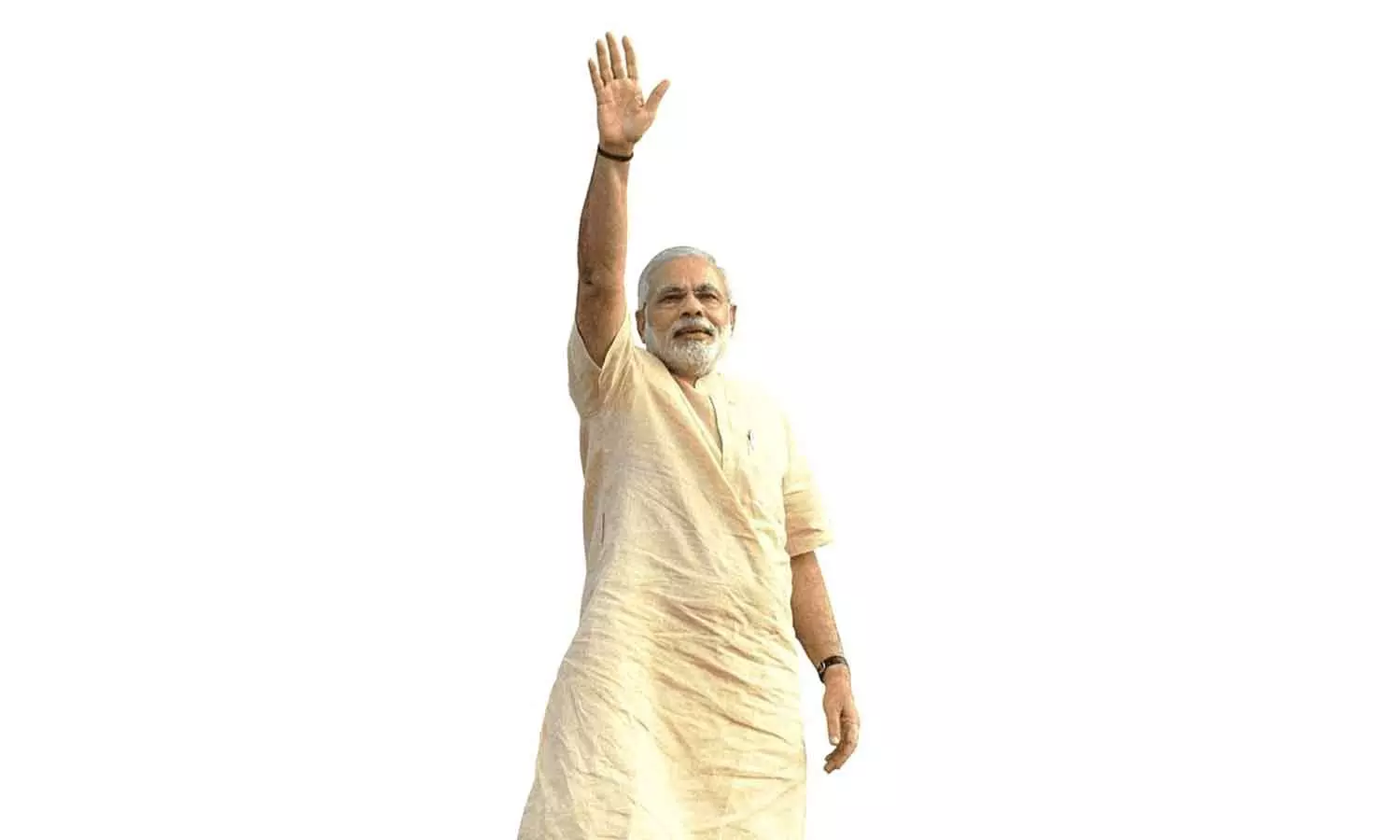
Union Minister for Information and Broadcasting Ashwini Vaishnaw told reporters after the Cabinet meeting that the milestone would be formally marked on October 7, when Modi completes 25 years since he first took oath as Gujarat Chief Minister in 2001. His tenure subsequently moved to the national stage with his appointment as Prime Minister in May 2014.
The BJP is celebrating the milestone through its month-long Seva Sankalp Abhiyan, with programmes, outreach initiatives and yatras linking Modi’s birthplace Vadnagar with his parliamentary constituency Varanasi.
The Cabinet resolution described the journey as one guided by the principles of “Nation First” and “Citizen First” and linked Modi’s uninterrupted tenure to what it termed sustained public confidence.
Modi has led the BJP to victories in the 2014, 2019 and 2024 Lok Sabha elections and served as Gujarat Chief Minister for more than 12 years before becoming Prime Minister. In March 2026, he also crossed the record for the longest continuous period as head of an elected government in India, combining his Gujarat and Prime Ministerial tenures.
The resolution is the latest in a series of official acknowledgements of Modi’s longevity in elected office. In June, the Union Cabinet had passed a separate resolution marking his becoming the longest-serving elected Prime Minister in terms of continuous service, noting that he had completed 4,399 days as Prime Minister and surpassed Jawaharlal Nehru’s earlier record of 4,398 days.
The latest 10-point resolution broadens that narrative from longevity in office to the policies and programmes that the government associates with Modi’s 25-year political journey. It traces a direct line from experiments in governance in Gujarat to national initiatives in welfare, infrastructure, technology, manufacturing, national security and diplomacy.
One of the central themes is the transition “from Gujarat to India”, with the resolution arguing that several initiatives pioneered during Modi’s tenure as Gujarat Chief Minister subsequently informed national governance. It cites the SWAGAT grievance-redressal system, through which Modi directly reviewed citizens’ complaints, and PRAGATI, the later national mechanism for monitoring major projects and resolving implementation bottlenecks. The resolution also points to the Jyotigram model of separate electricity feeders for agriculture as an example of a state-level experiment that influenced wider policy thinking.
The Cabinet resolution places poverty alleviation and welfare delivery at the heart of Modi’s political narrative, linking his stated personal experiences of deprivation to programmes aimed at providing basic amenities and financial inclusion. It highlights nearly 60 crore Jan Dhan bank accounts, more than four crore houses and the government’s claim that more than 25 crore people have moved out of poverty during the period of Modi’s leadership. Earlier this year, a Cabinet resolution had similarly highlighted free foodgrains for more than 80 crore people and free medical treatment for more than 60 crore poor citizens as part of the government’s welfare record.
Women’s empowerment and social inclusion form another major strand of the resolution. It cites the growth of the Lakhpati Didi initiative, under which around 3.5 crore women are described as having achieved the status of women earning at least Rs 1 lakh annually, and refers to the Nari Shakti Vandan Adhiniyam providing for reservation for women in legislatures. It also highlights PM-KISAN transfers exceeding Rs 4 lakh crore and PM-JANMAN, aimed at improving the socio-economic conditions of particularly vulnerable tribal groups.
The resolution presents reform as a continuing feature of Modi’s governance, pointing to the introduction of the Goods and Services Tax, changes in welfare delivery, and the replacement of several colonial-era laws. It also recalls campaigns and appeals aimed at changing everyday behaviour, including cleanliness, digital payments and the promotion of locally produced goods. The broader argument is that reform, in the Cabinet’s assessment, has combined institutional changes with citizen participation.
Infrastructure and self-reliance occupy another prominent place in the 10-point account. The resolution notes that public capital expenditure has risen from around Rs 2 lakh crore to more than Rs 12 lakh crore, while highway construction and railway electrification have expanded substantially. It also points to the growth of electronics production from around Rs 2 lakh crore to more than Rs 13 lakh crore, alongside increased emphasis on defence manufacturing and semiconductor production.
Technology is portrayed as another defining element of the Modi era, with the resolution connecting financial inclusion through Jan Dhan, Aadhaar and mobile connectivity with the rapid expansion of digital payments through UPI. It also cites India’s development of indigenous Covid-19 vaccines and the Chandrayaan-3 landing near the Moon’s south pole as examples of the country’s technological and scientific ambitions.
Private participation in the space sector, as well as work in artificial intelligence, quantum technology and biotechnology, is presented as part of the broader objective of building an “Atmanirbhar Bharat”.