
How Disability Providers Approach Finding NDIS Staff
Providers responsible for process are longer, and they probably do a lot more than other employers, because a check has to be done for each worker if they need to be a match with the right person.
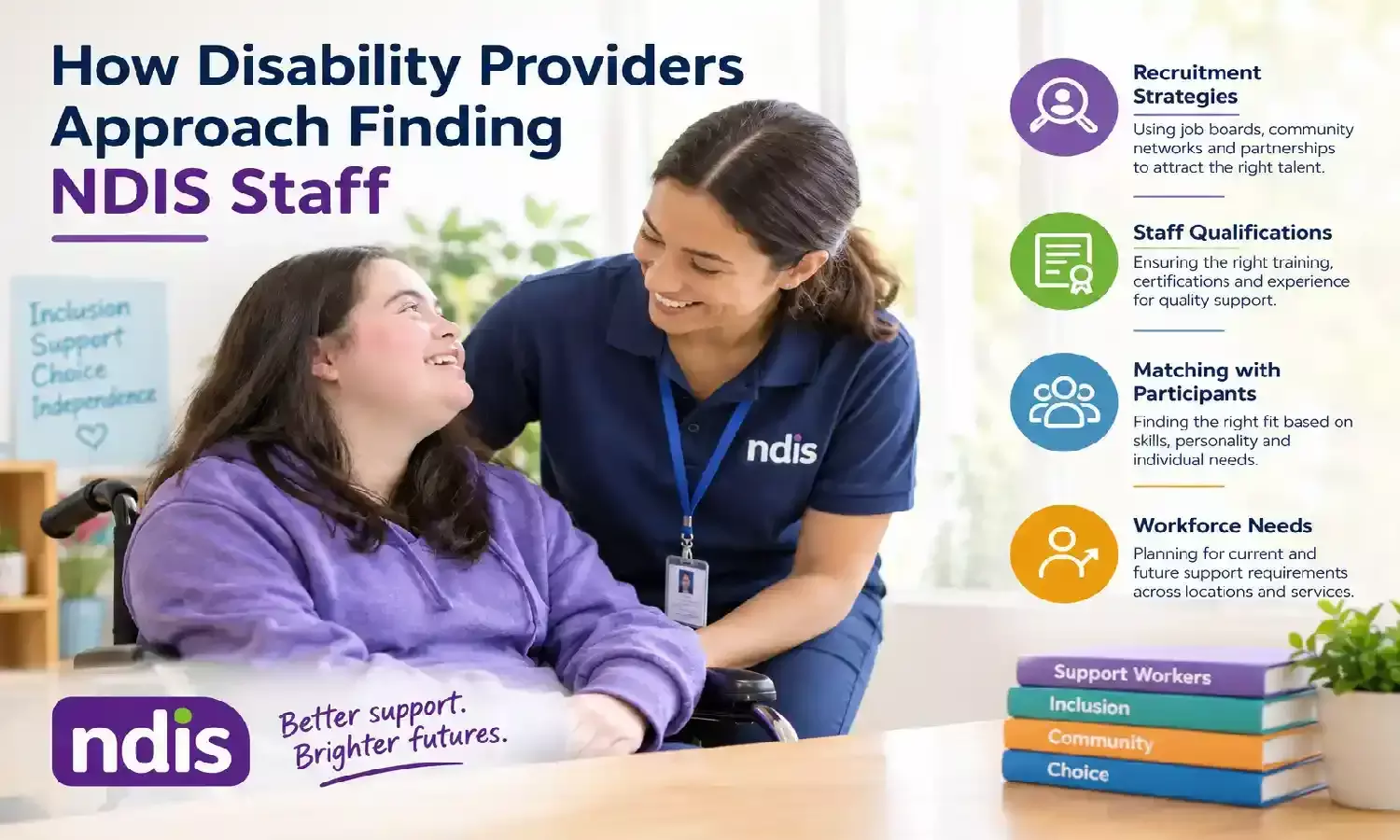
According to National Disability Services’ 2025 Workforce Census report, the number of workers on full-time permanent roles dropped to 21% which was a change from the previous figure of 30%.
On the same census, casual staff showed a turnover rate of 26%, while permanent staff had a turnover rate of 16%, this is why the staffing needs of the organizations remain a constant concern.
Now that there are fewer permanent full-time job positions, being available and adaptable are just as critical as being highly educated and being the right fit for the job, when a provider is forming a team. In other words, availability is the first requirement. Secondly, you have flexibility. The third is a degree or any certification. Finally, you need to be right for the job.
What Checks Apply When Finding NDIS Staff?
In case a NDIS registered provider has done risk-assessed roles the worker must get a NDIS Worker Screening clearance according to the NDIS Quality and Safeguards Commission, said the statement.
A person is allowed to do a role after it is declared as risk assessed by the provider if that person provides the support directly or is exposed more than incidentally to the person with a disability.
If a worker has a pending application then he/she must be under the supervision of the person who holds clearance,
The providers make the list of risk-assessed roles and their workers in writing, and also the Commission demands worker records to be kept for seven years,
The NDIS Worker Orientation Module titled, “Quality, Safety and You”, is almost 90 minutes long and gives insight about every aspect of a worker under the NDIS code of conduct.
Staff and Participant Matching
The written participant profile allows the prospective candidate to easily visualize the level of assistance needed during the whole conversation period.
This profile outlines the type of assisting activities and which kind of communication suits the better the participant.
During the scenario-based interview, it will be revealed how the selected candidate would react to the participants’ changing of plans at the last moment.
Having a short informal session with a participant will let them choose their support members and this practice supports the participant choice under NDIS.
Being available is no less important than being skilled, so imagine the problem that results from matching a perfect worker who only does two days a week when other days of the week your regular staff have no one to cover for.
This kind of perfect match really helps in terms of shift planning because one person can be there every day to help the participant with regular support.
NDIS Job Advertisement Essentials
An effective ad would mention the type of help being provided and how it’s going to match shifts, this allows individuals interested in the role to get an idea based on that and then decide whether to move forward by sending in their applications.
The inclusion of a sentence highlighting the characteristics of the participant group (e.g., people with complex physical needs) encourages and allows only matching ones to self-select.
Taking this further, stating the access requirement in advance not only spares both applicant and coordinator any possible last-minute surprises, but also guarantees that the right papers are presented to complete the application.
Where Can Providers Look for NDIS Staff?
Health care providers may find new hires through informal referrals or online recruitment sites, they may also turn to a third party such as an agency, contractor, or other partner. However, whatever recruitment route selected brings with it certain benefits and drawbacks.
|
Where to Look |
What It Offers |
Downside |
Referrals and community networks |
Candidates arrive with a personal recommendation |
The pool stays small |
Job boards |
A wide audience and many applicants |
The screening workload falls on the provider’s team |
Recruitment agencies |
A shortlist delivered quickly |
A placement fee applies to each hire |
Outsourced recruitment partner |
A partner handles sourcing and screening while the provider runs interviews and offers |
Clearance and orientation stay with the provider, so the partner reports on each check |
The Right Approach for Each Provider
The ideal plan varies depending on the number of positions a provider is hoping to hire.
Coordinators with limited interview time prefer single vacancies, while multiple hiring requests over different regions require longer commitment from them.
A provider with one or two open vacancies can successfully find candidates through referrals and job boards as long as interview time is available.
Larger providers who have an abundance of positions at the same time, on the other hand, benefit heavily from using an agency or an outsourced partner who will share in the process of finding staff for them.
One way of dealing with a high rate of casual worker turnover is by maintaining a constant flow of referred and shortlisted candidates so that the next recruitment process will not take too long.
In addition, the written checklists and participant profiles remain intact and move along with different sourcing methods, so that a provider has the possibility to change their method and not lose the earlier preparation.