
Delhi AQI improves after overnight spike, haze persists
New Delhi: A layer of haze continued to envelop the national capital on Friday morning, with Delhi recording an Air Quality Index (AQI) of 239 at 8.40 am, a significant improvement from the severe pollution levels recorded overnight.
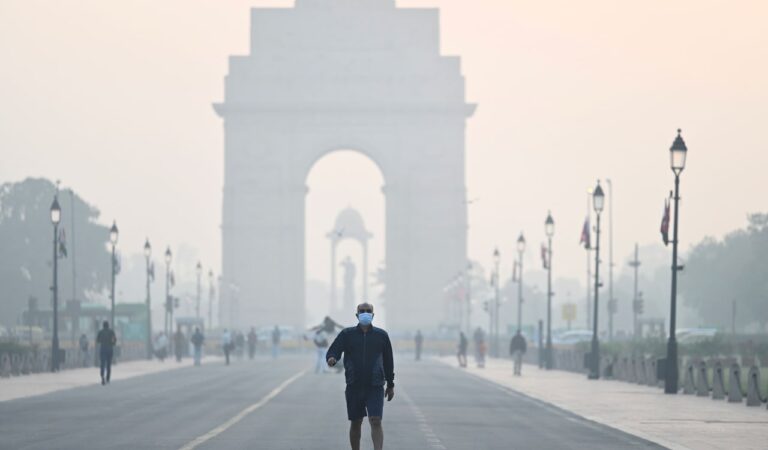
According to monitoring data, the AQI reached 393 at around 2 am on Friday before declining steadily in the early morning. At 6.11 am, the AQI stood at 273, nearly 120 points below its overnight peak.
Several monitoring stations across the city continued to report poor air quality. Ghoga recorded an AQI of 289, while Central Road Research Institute (CRRI) Mathura Road and North Campus registered 292 each. Other locations with elevated readings included ITO (285), Sirifort (280), Wazirpur (273), Bawana (266), Punjabi Bagh (260), Burari (259), Chandni Chowk (259) and Narela (239).
Delhi Technological University (DTU) recorded an AQI of 304, while Rohini registered 233 and Anand Vihar 239. Other monitoring stations included Karala (244), Nangloi (238), Tikri Kalan (164), Chhawla (243), National Institute of Health (NIH) Narela (253), Badarpur (218), Indira Gandhi International Airport (T3) (289), Burari Crossing (287) and Alipur (239).
Delhi’s air quality improved considerably on Thursday afternoon, with the AQI dropping to 121 at 5.01 pm, the lowest reading recorded during the preceding 24 hours. However, pollution levels began rising again in the evening, crossing the 300 mark around 8 pm before reaching 393 shortly after 2 am on Friday. The readings remained above 300 until after 5 am, according to AQI.in.
Data for the seven-day period ending November 26 showed that Delhi’s AQI peaked at 465 at 6 am on November 20. The lowest reading during this period was 170, recorded at noon on November 26. Early morning pollution levels remained particularly high on several days, frequently ranging between 350 and 450.
At 6.11 am on Friday, the PM10 concentration stood at 274 micrograms per cubic metre, against the World Health Organization’s recommended guideline of 45 micrograms per cubic metre.
Meanwhile, a report stated that Delhi ranked as the most polluted city among the 10 major National Capital Region (NCR) cities in terms of both PM2.5 and PM10 concentrations between October 1 and November 25. During the corresponding period last year, the national capital ranked third and fourth, respectively.