
Editorial: Hasina’s homecoming, a political gambit
Former Bangladesh Prime Minister Sheikh Hasina’s plan to end her exile and return home comes amid . Dhaka has been in the grip of violence, a reminder of Bangladesh’s continuing struggle with and India’s challenges with its eastern neighbour. Hasina, who ruled Bangladesh for over 15 years, was forced to flee the country in August 2024 following a against the Awami League regime. Her planned return on December 16 is loaded with a political message as the date coincides with Victory Day, which commemorates Bangladesh’s liberation from Pakistan in 1971 after a bloody struggle led by her father, late Sheikh Mujibur Rahman. It is a calculated political move to reclaim relevance in a country whose political landscape has changed dramatically since her ouster. By doing so, she invokes her father’s legacy and tries to reconnect her political fortunes with the country’s founding history. It would also create a symbolic challenge to the post-uprising political order, in which , the Islamist party that opposed Bangladesh’s independence in 1971, has emerged as the principal opposition in Parliament. Hasina’s departure followed a popular uprising triggered by student protests and intensified by the government’s deadly response. She was later sentenced to death in absentia by a Bangladeshi court for ordering the deadly crackdown on the uprising, in which hundreds of protesters were killed. Hasina rejected the verdict and said she is ready to fight the case upon her return.
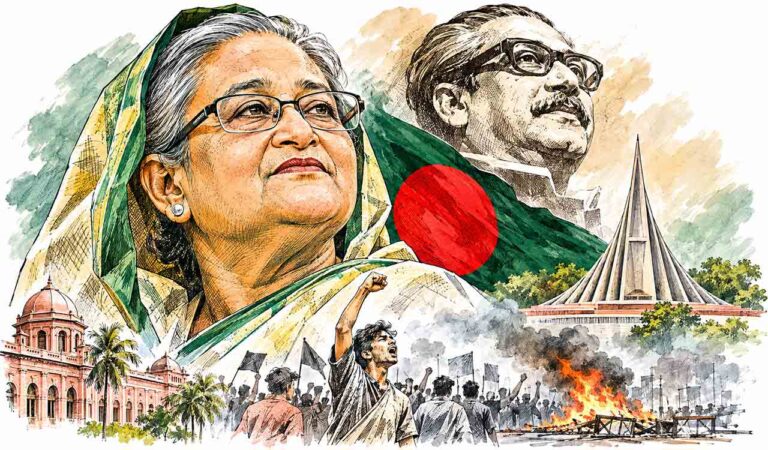
Hasina’s supporters view her move as an expression of political resilience tied to past economic growth and infrastructure gains. Critics, however, see it as a return to centralised rule and deep polarisation. Equally troubling is the present government’s vindictive attitude, led by Prime Minister Tarique Rahman. Defeating an authoritarian government does not automatically produce a pluralistic democracy. Rahman’s Bangladesh Nationalist Party (BNP) may have secured power in an election that kept the Awami League out of the electoral contest. Still, its democratic credentials will ultimately depend on how it treats the political opposition. Hasina’s announcement also places India in an unenviable position. New Delhi enjoyed an exceptionally close relationship with her government, particularly in matters of security and regional connectivity. Her presence in India since August 2024 has consequently become an irritant in relations with the Dhaka administration. India’s cannot be permanently tied to the political survival of one individual, however close the historical relationship may have been. The question of will therefore test New Delhi’s diplomatic judgement. India must balance its legal obligations and bilateral commitments against the consequences of appearing to shelter a former leader accused of grave abuses. At the same time, handing her over without adequate assurances of a fair trial could invite serious criticism. Bangladesh needs neither a return to the old order nor a new system of . Its democratic future requires accountability for past excesses and freedom of political association.