
Hyderabad-developed BaViS device detects early vision loss in babies with congenital glaucoma
Hyderabad: A specialised dome-shaped device developed by Hyderabad researchers has been successfully tested to accurately detect early vision loss in babies and toddlers suffering from primary congenital glaucoma (PCG), a serious eye condition that can lead to permanent blindness if not diagnosed early.
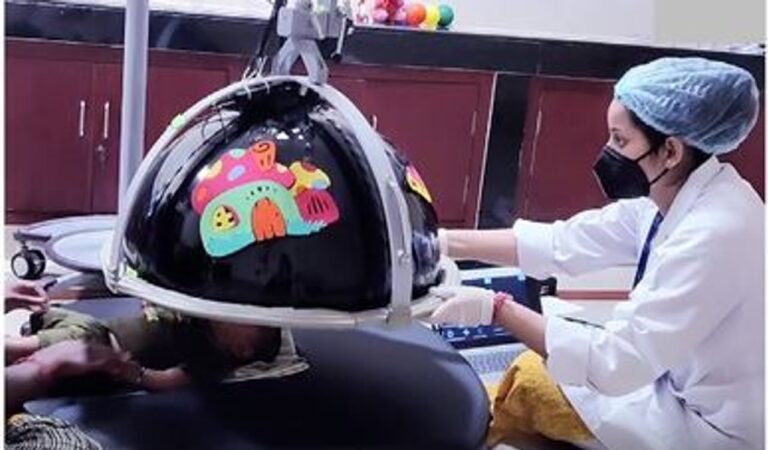
Developed at the Hyderabad-based L V Prasad Eye Institute (LVPEI) by scientist Dr PremNandhini Satgunam, the Baby Vision Screener (BaViS) tracks a baby’s natural eye movements towards flashing LED lights to measure peripheral, or side, vision. It overcomes a major hurdle in diagnosing infants who are too young to speak or follow instructions.
How BaViS works
During the test, a baby lies on its back in a dark room beneath a small dome fitted with LED lights. A central light first catches the baby’s attention, followed by individual lights flashing sequentially from the outer edge towards the centre along 12 directions. An examiner watches through an infrared camera and tracks the exact moment the baby’s eyes shift towards the light, mapping the field of vision.
Filling a diagnostic void
In PCG, a child’s side vision is damaged. While measuring side vision is routine in adults, there are no commercial automated machines for infants. Usually, eye specialists rely on simple techniques such as waving a toy or light from the side to see whether a baby’s eyes flick towards it.
Such techniques are imprecise and cannot track gradual vision loss. Eye-related medical equipment is usually established in laboratories and remains bulky and non-standardised.
In the LVPEI study, recently published in the Journal of Glaucoma, researchers tested 29 young PCG patients, including 14 infants and 15 young children. They obtained reliable vision maps for 20 of them after excluding eight due to fussiness or technical issues.
Half of the mapped children, 10 of 20, showed measurable narrowing of their visual field. Reliable responses were recorded in an infant as young as 2.3 months old. The findings also showed early signs linking greater optic nerve damage to narrower side vision, indicating that doctors can now spot and track vision loss in babies years earlier than before.