
Opinion: The true measure of GST
Dr CS Pitresh Kaushik, Dr Sushanta Kumar Mahapatra
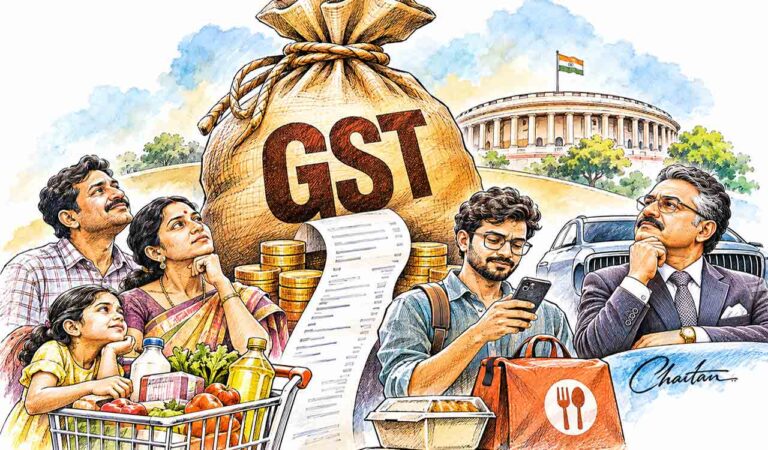
A family buying groceries, a young professional ordering dinner online and a wealthy household buying a luxury car all pay Goods and Services Tax (GST). Do they carry the same burden? Clearly not. The better question is whether GST takes a bigger bite out of some households’ purchasing power than others’.
It matters because is woven into the prices we pay, the choices we make and the way the government raises revenue.
Same tax, different weight
Take two households. One earns Rs 30,000 a month, the other Rs 3 lakh. Each buys a household appliance priced at Rs 10,000 before tax, attracting 18 per cent GST. Each pays Rs 1,800 in tax.
On paper, the tax is identical. In real life, it is not. For the first family, Rs 1,800 could mean putting off another essential purchase. For the second, it barely registers in the monthly budget.
The rate alone does not tell us who bears the greater burden. We must also look at income, consumption and what share of a household’s resources goes to taxable goods and services.
Unfair to the poor?
Indirect taxes are often called regressive because lower-income households spend a larger share of their income on consumption and have less room to save. But saying GST is necessarily regressive in India would be too simple.
Structure matters. Exemptions and , together with higher rates on certain luxury or demerit goods, can change how the burden is spread.
A fair tax system cannot make every household’s burden identical, but it can keep it reasonable and ensure the benefits of reform reach consumers
A September 2025 study in the Economic and Political Weekly, drawing on India’s 2022-23 Household Consumption Expenditure Survey, found GST to be progressive across rural and urban India on the distributional measures it examined. In other words, the standard rates do not tell the whole story. What households buy, and how each product is treated, matters too.
Still, an overall progressive result does not mean every household, or every price rise, is affected equally. The impact depends on what families buy, how much they consume and whether businesses pass tax changes on to customers.
When prices move
Picture a household that spends most of its income on food, transport, household supplies and basic services. Even a small rise in the price of things it buys every week can strain the budget. A richer household may spend more in rupee terms, but it has more room to adjust. It can save more, invest more or shift its spending elsewhere.
This is why tax incidence, the question of who finally bears a tax, matters as much as the rate in the law. Businesses collect and deposit GST, but consumers may end up paying some or all of its cost through higher prices. Sometimes suppliers absorb part of it through thinner margins.
The reverse is just as true. When GST rates fall, buyers do not automatically get the full benefit.
How much the price drops depends on competition, costs, pricing decisions and whether businesses actually pass on the savings.
Fair matters too
GST reforms have tried to simplify India’s indirect tax system, improve compliance and ease the load on consumers and businesses. A tax that is hard to understand raises compliance costs, invites disputes and leaves small enterprises uncertain.
But It also depends on whether similar products are treated alike, whether consumers can make sense of their bills, whether tax cuts reliably reach buyers and whether businesses receive legitimate refunds without a struggle.
There is a trade-off, too. Lower rates on essentials can protect household purchasing power, but governments must weigh the revenue they lose and their ability to pay for public services. Too many exemptions can also lead to classification disputes and make compliance harder. The aim, then, is not to cut every rate but to balance revenue needs, administrative ease, efficiency and fairness.
Towards a fair GST
Three priorities stand out.
First, policymakers should regularly study GST’s distributional impact using household consumption data, instead of leaning only on headline collection figures. The burden should be examined across income groups, rural and urban households, and categories of spending.
Second, tax changes must turn into real benefits for consumers. Clearer pricing, easy-to-use complaint mechanisms and effective monitoring can help people see what they are paying and whether advertised tax cuts show up in the price.
Third, success should be judged on more than A good tax system raises money efficiently, without avoidable compliance costs or undue pressure on households with little financial cushion.
Ultimately, the GST debate is not about whether one household pays 5 per cent, another 18 per cent and a third more on a particular purchase. It is about how taxation shapes our ability to spend, save and improve our standard of living.
A f cannot make every household’s burden identical because incomes, needs and spending patterns differ too widely. But it can ensure the burden is reasonable, the rules are predictable, and the gains from reform reach the consumer.
The true measure of GST is not just how much the government collects, but how efficiently and fairly it collects it.
(Dr CS Pitresh Kaushik teaches at School of Management Studies, Swami Rama Himalayan University, Dehradun. Dr Sushanta Kumar Mahapatra teaches Economics at the ICFAI School of Social Sciences, IFHE, Hyderabad)