
Opinion: Bigg Boss Telugu — whose show is it anyway?
By P Nagarjuna Rao
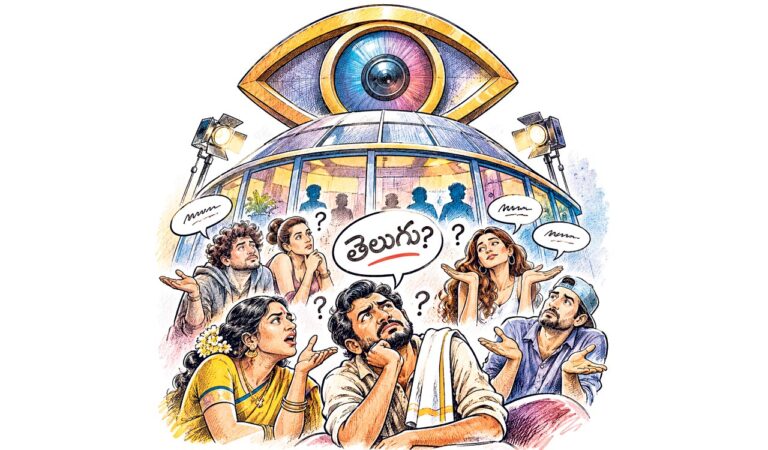
There is something increasingly curious about Bigg Boss Telugu. It is a show made for Telugu-speaking audiences, named after their language and built around a house where contestants are expected to communicate with one another. Yet, season after season, the programme seems remarkably willing to look beyond the Telugu-speaking talent pool when choosing its housemates. Why?
Bigg Boss is not the IPL. Cricket is an international sport in which talent has no mother tongue. If an Australian, South African or English cricketer can strengthen a team, he or she is bought for crores. The more, the merrier.
But Bigg Boss is a language-based reality show. Its USP is not batting averages or bowling speeds. It is personalities interacting, arguing, joking, scheming, forming alliances and entertaining viewers—all through a particular language. That distinction seems to have been forgotten by the makers of Telugu television’s most popular reality show, hosted by Nagarjuna.
When Telugu becomes optional
Look at the current season. The presence of contestants from Karnataka, Tamil Nadu, Bengal and Gujarat has once again raised questions about the programme’s .
Mukesh, Debjani, Varshini, Shiva and Neethu Nataraj are among the names that have brought the representation of non-native Telugu speakers into the discussion. While their backgrounds and levels of fluency may differ, their participation raises a larger question: how much importance do the makers attach to proficiency of Telugu when selecting contestants?
There is nothing wrong with contestants from other States entering the Telugu house. The issue is whether they can comfortably converse, argue, strategise and participate in the games in Telugu. The question should not be ‘Are you a Telugu person?’ but ‘Can you participate in a Telugu reality show in Telugu?’
This is hardly a new phenomenon. Mumaith Khan, despite appearing in two seasons, struggled to communicate in Telugu. Monal Gajjar, too, entered the house with limited command of the language, although she picked up some Telugu during her stint. The current controversy is therefore part of a recurring pattern. Why should non-Telugu-speaking contestants be given preference when thousands of native actors, comedians, singers, influencers and ordinary aspirants would jump at the opportunity?
Conversely, someone born outside the Telugu-speaking States but fluent in the language should have no difficulty qualifying. A contestant’s linguistic ability matters more than their place of birth.
The language rule
There was a time when Bigg Boss Telugu took its language requirement seriously. Contestants were repeatedly reminded to . Speaking English or other languages could invite warnings and even punishments. That discipline seems to have progressively disappeared. These days, contestants can switch between Telugu, English and Hindi with little apparent intervention from Bigg Boss.
Bigg Boss is a language-based reality show, yet contestants with limited proficiency in Telugu continue to enter the house. Is Telugu becoming optional in its own show?
Even the host’s occasional appreciation of contestants for attempting to speak Telugu, despite not knowing the language well, raises an interesting question: Should basic linguistic participation really be treated as an extraordinary achievement in a show dedicated to that language?
The other editions
The comparison with other regional editions is revealing. Bigg Boss Malayalam, hosted by Mohanlal, has generally maintained a predominantly Malayalam-speaking contestant pool. Its current eighth season, too, is largely drawn from Kerala’s entertainment industry, social media personalities and the commoner ecosystem.
Bigg Boss Tamil, hosted by Vijay Sethupathi, similarly relies overwhelmingly on Tamil-speaking contestants. It has accommodated participants with connections outside Tamil Nadu, including people from Karnataka and overseas, but the ability to communicate in Tamil remains central to the programme’s identity.
Bigg Boss Kannada, hosted by Kichcha Sudeep, has also welcomed non-Kannadigas, including actors from other States. However, contestants are expected to communicate in Kannada, and several have made a genuine effort to learn and speak the language. The point is not that these editions exclude outsiders. They do not. They simply give their respective languages greater importance.
Hindi: a different proposition
Bigg Boss Hindi, hosted by Salman Khan, is another matter altogether. Over the years, it has featured contestants and international personalities from across India and abroad, including foreigners with little or no initial knowledge of Hindi. Jade Goody, Pamela Anderson, Sunny Leone, Abdu Rozik and several other international personalities have been part of its diverse line-ups.
But the Hindi edition operates in a different commercial universe. It targets a pan-Indian audience, has a much larger celebrity pool and deliberately uses international participation to generate curiosity and publicity. Bigg Boss Telugu cannot simply borrow that casting philosophy without considering what makes its own edition distinctive.
Is TV diluting Telugu?
There is a larger cultural concern here. Telugu is already undergoing a transformation, with everyday conversations increasingly peppered with English and Hindi. Even native speakers sometimes adopt an artificial, of speaking.
Television has considerable influence over . Rather than merely reflecting changes in society, it can accelerate them. When a Telugu-language programme repeatedly showcases halting, heavily accented or grammatically awkward Telugu without insisting on improvement, it risks normalising a version of the language that is increasingly removed from its natural idiom.
Shouldn’t a popular Telugu programme be doing more to and its richness?
A fair chance
There is also the question of opportunity. Every slot occupied by someone who cannot comfortably communicate in Telugu potentially means one less opportunity for a Telugu-speaking aspirant. There are plenty of talented people waiting to showcase their personalities, entertain viewers and compete for the title.
Bigg Boss is not a linguistic quarantine zone. Diversity is welcome, and people from other States should certainly have opportunities. But the ability to participate in Telugu should be a basic consideration when selecting contestants. This is not linguistic chauvinism. It is about of the programme and the audience that sustains it.
The Telugu audience is not asking for less diversity. It is asking for its and its own talent pool to get a fair deal. After all, if the show is called Bigg Boss Telugu, shouldn’t Telugu be more than just the language appearing in its title?
(The author is a senior journalist)