
Can AI solve the Riemann hypothesis, a 167-year-old problem?
Levent Alpöge, a mathematician at Anthropic, says Claude played a part in putting a proof for the Riemann hypothesis. It is striking that Claude was able to take part in work in this area.
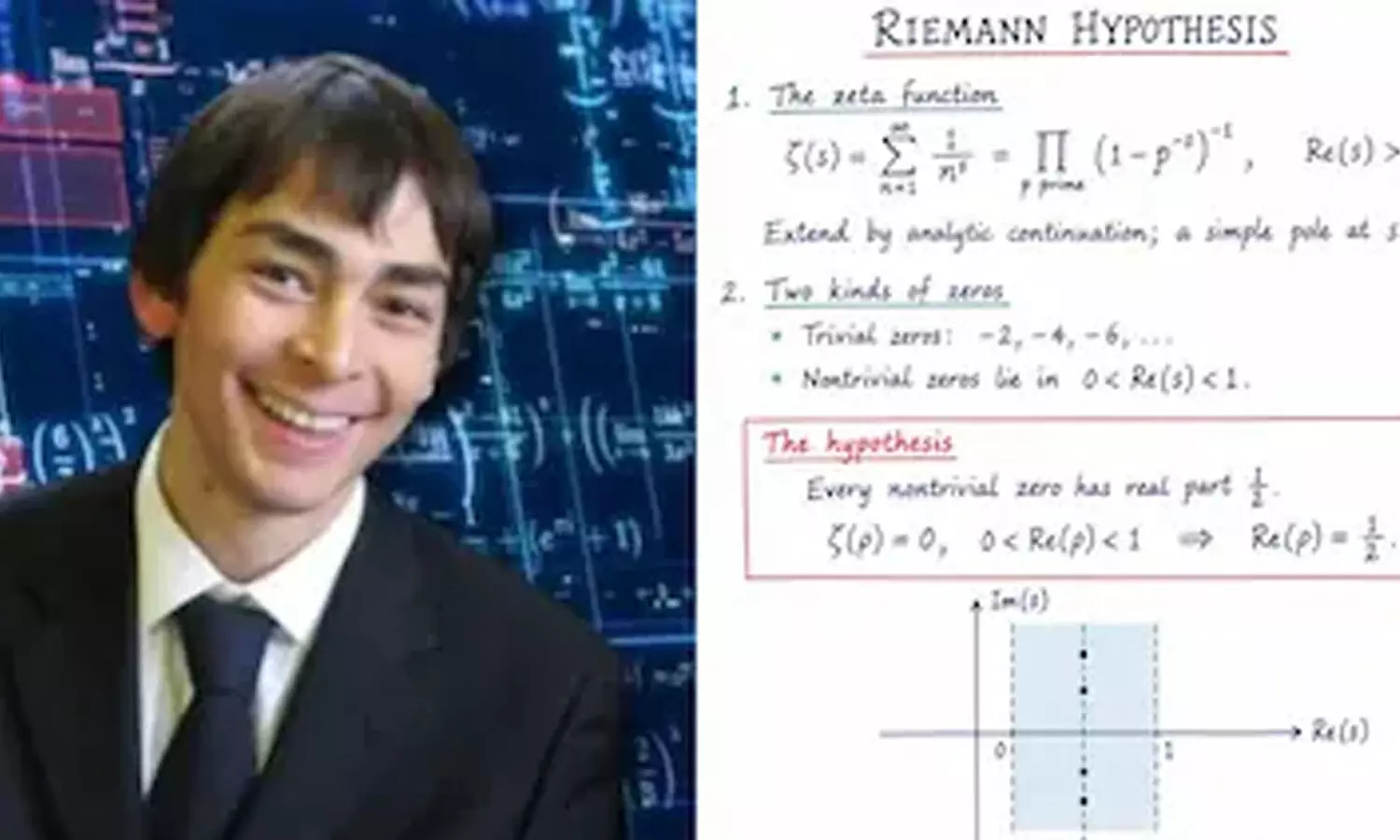
The Riemann hypothesis was first proposed by the German mathematician Bernhard Riemann in 1859. This conjecture is one of the seven “Millennium Prize Problems” listed by the Clay Mathematics Institute. Whoever succeeds in solving the Riemann hypothesis will receive a one-million-dollar prize.
Riemann thought that a hidden mathematical link might explain this distribution. Riemann also said that the key lies in a function—called the Riemann zeta function—at the points where the function equals zero.
Nevertheless, this claim has not yet been independently verified. If the proof withstands expert scrutiny, it could mark a milestone for both mathematics and artificial intelligence.
What is the Riemann hypothesis?
The Riemann hypothesis deals, in essence, with how prime numbers are distributed. Prime numbers are special because they are divisible only by one and by themselves. Examples include 2, 3, 5, 7, 11, and 13. These numbers do not seem to follow a pattern. The Riemann hypothesis tries to explain this pattern—or the lack of it—from a mathematical view.
Prime numbers follow rules. Yet prime numbers appear along the number line in a way. There is no pattern that tells mathematicians exactly where the next prime number will appear.
Riemann proposed that an underlying mathematical relationship could explain this distribution. The hypothesis centers on a function known as the “Riemann zeta function”—specifically, on the points where this function equals zero.
The conjecture posits that all its non-trivial zeros lie on a specific vertical line in the complex plane—referred to as the “critical line”—where the real part is equal to 1/2.
Proving this conjecture would provide mathematicians with a much deeper understanding of how prime numbers are distributed.
How did Claude contribute? Alpöge revealed that the problem had fascinated her since childhood. It would occupy a significant part of her mathematical career and that finding a solution could potentially take decades.
Describing the AI model’s contribution, Alpöge wrote: “Claude far surpassed me near the finish line. No—Claude soared, danced, and shone near that finish line.”
Furthermore, suggested that this approach could be extended to two problems: the Generalized Riemann Hypothesis and the Extended Riemann Hypothesis.
However, Alpöge acknowledged that the full argument is extremely extensive and Alpöge has not yet managed to grasp all of its parts.
“The beginning of something much larger in the scientific realm.”
The growing role of AI in mathematical research
This breakthrough occurs against a backdrop of various milestones in AI-assisted mathematical research.
OpenAI announced a potential solution to the Navier-Stokes problem and subsequently published hundreds of mathematical research results, which are currently at various stages of verification. Other advances include AI-assisted work on the KLS conjecture and the formal verification of Fermat’s Last Theorem, which was proven by the mathematician Andrew Wiles in 1995.
The importance of independent verification
Alpöge’s announcement is significant, but a mathematical claim of this magnitude requires more than just an argument generated by an AI.
Experts must look at the proof carefully, check the reasoning that underlies the proof and make sure that every mathematical step works. Tools such as Lean can help to check arguments that are written in a language, but the quality of formalization and its trustworthiness must also be examined closely.
If independent confirmation is obtained, this discovery could become a milestone. AI is increasingly helping researchers to investigate problems. Human expertise remains essential to decide whether the discovery is correct.