
How Order Types Such as Market, Limit and Stop-Loss Orders Work in the Share Market
When trading stocks, investors will need to consider what type of order to use. Most trading platforms will offer a range of order types to allow investors to set specifics for trading their stocks. Common types include market orders, limit orders and stop-loss orders. These will all work in a slightly different way and affect how much you could pay to trade your stocks. This article explains how market, limit and stop-loss orders work in the share market, along with their differences and the situations in which investors may use them.
What Is a Market Order?
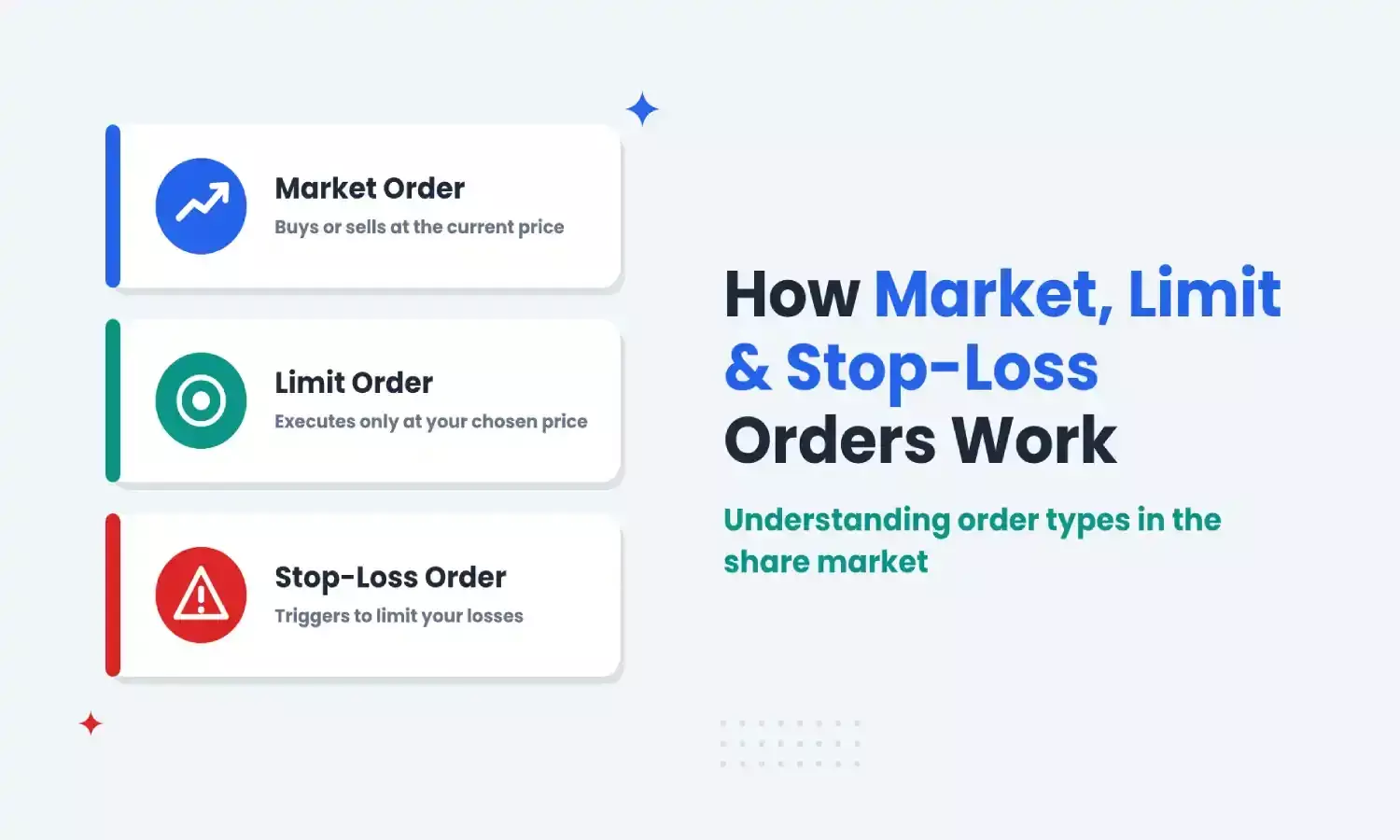
A market order is an instruction to buy or sell a share at the best available price in the market at the time the order reaches the exchange. The primary objective of this order type is execution rather than securing a specific price.
For example, suppose a share is trading at ₹500. An investor places a market order to buy 10 shares on the . The order is sent to the exchange and may be matched with available sell orders. If the available prices change while the order is being executed, the investor may receive the shares at slightly different prices.
Market orders may be considered when execution is more important than getting a specific price. However, investors should understand that the final traded price is not guaranteed.
What Is a Limit Order?
Limit orders allow you to set a maximum/minimum price to buy/sell your stocks at. Your order will only go through at a price equal to or better than your set limit.
Say a stock is trading at ₹500; however, you want to buy it at ₹490. You could place a buy limit order at ₹490. This means your order will only be executed if people are looking to sell at this price or lower.
If you own a stock that is trading at ₹500 and wish to sell it at ₹520, you can place a sell limit order. This will execute if there are people looking to buy at this price or higher.
What Is a Stop-Loss Order?
A stop-loss order is used to manage potential losses by setting a trigger price at which an order is placed. It is commonly used by investors and traders to define an exit level if the share price moves in an unfavourable direction.
Let’s say that you bought a stock for ₹500 and want to set a limit on how much you could lose. You can set a stop-loss trigger price at ₹480. Once the market hits this trigger price, your stop-loss will operate based on the type of order you set.
Stop-loss orders can help give you an exit strategy. However, your exact price may vary. This could be due to the moving quickly or there could be a price gap. Depending on the exchange and broker you may not have access to certain types of stop-loss orders.
Difference Between Market, Limit and Stop-Loss Orders
Although all three order types are used to buy or sell shares, they differ in how they handle price and execution.
|
Basis |
Market Order |
Limit Order |
Stop-Loss Order |
Main purpose |
Execute at the best available price |
Buy or sell at a specified price or better |
Activate an exit or trade order when a trigger price is reached |
Price control |
No specific execution price |
Investor specifies the limit price |
Investor specifies a trigger price and, for a stop-loss limit order, a limit price |
Execution |
Usually prioritises execution |
Only if the specified price or a better price is available |
Activated when the trigger condition is met; execution depends on the selected order type |
Main consideration |
Final price may vary |
Order may remain unexecuted |
Execution price may differ from the trigger price |
When Should Investors Use Different Order Types?
The choice of order type depends on the investor’s objective, market conditions and willingness to accept price changes.
- Market order: May be suitable when an investor wants to execute a trade without waiting for a particular price. It is important to consider liquidity and possible price fluctuations.
- Limit order: May be useful when an investor has a specific buying or selling price in mind and is willing to wait for the market to reach that level.
- Stop-loss order: May be considered when an investor wants to define an exit level in advance and manage potential losses.
Conclusion
Market, limit and stop-loss orders help investors manage how their share market transactions are placed and executed. A market order prioritises execution, while a limit order gives greater control over the transaction price. A stop-loss order helps define a trigger level for a potential exit, although the final execution price may vary. Investors comparing trading platforms can explore the 5paisa Alpha app to review its order placement facilities and other trading-related features. Understanding the available order types can help investors choose an approach that matches their trading objectives and risk considerations.