
US flights grounded after FAA communications outage
Washington: The Federal Aviation Administration (FAA) grounded all flights nationwide on Friday afternoon for only the second time since the September 11 attacks, citing “extraordinary circumstances” caused by communications problems at regional air traffic control centres.
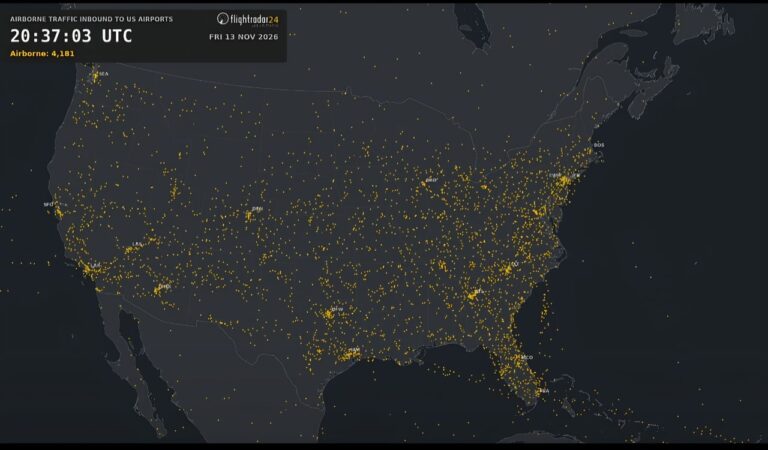
Secretary of Homeland Security Markwayne Mullin attributed the problem to a telecommunications outage and said there was no indication yet of a nefarious act. The disruption affected potentially thousands of planned flights until at least late Friday night, disrupting travel plans for passengers heading home, attending weddings or making other weekend plans.
“It’s frustrating. This certainly sounds like it’s going to be more than the usual run-of-the-mill delay. I look forward to finding out why,” said Jeff Dubner, a Washington, DC, attorney. His Alaska Airlines flight from Los Angeles to Washington, DC, was already half an hour late and taxiing to the runway when it came to a halt.
The nationwide ground stop was the first since January 2023, when a key FAA computer system malfunctioned, and the second since the aftermath of the September 11, 2001, attacks.
The restrictions were imposed “due to extraordinary circumstances and for reasons of safety,” according to an FAA notice. Transportation Secretary Sean Duffy said the agency was investigating a communications issue affecting the 22 regional air traffic control centres that direct planes between airports nationwide.
A few international flights took off from international aviation hubs on the East and West coasts on Friday evening.
No sign of nefarious act
Mullin told reporters at the White House that there was no indication yet that “this was a nefarious attack against us. It’s just a telecommunications outage as of right now.”
“Everybody’s safe. There’s no reason to be concerned about your loved ones if they’re flying,” Mullin said.
At least 600 flights had been diverted as a result of the FAA order to ground all air traffic nationwide. As of 5.50 pm Eastern Time, 496 flights had returned to the airports from which they originally took off, while 104 were sent to different airports, according to Cirium, an aviation analytics company.
Among the airports receiving many of the diverted flights were Chicago O’Hare International Airport, Denver International Airport, Dallas-Fort Worth International Airport and Ronald Reagan Washington National Airport.
Some 11,000 flights carrying more than 1.5 million passengers were scheduled to take off from airports in the US after 4 pm Eastern Time, raising the likelihood of more cancellations and diversions.
At Chicago O’Hare Airport on Friday afternoon, travellers passing through security learned about the ground stop when they looked at screens showing delays across the board.
Some called friends or family members and debated whether to stay overnight in Chicago or find another way to reach their destinations.
Amber McQuilkin, 27, sat on a bench, disappointed that she might miss a trip with friends to New York for the League of Legends world finals. Her friends had already arrived there, she said.
“There’s not really any information being passed to me,” said McQuilkin, a Seattle software engineer who took a week of vacation for the trip. “I contemplated just abandoning the flight and driving, but then the more I thought about it, the more I’m like, that would be miserable.”
Austin Curtis and his wife were reconsidering their trip from South Bend, Indiana, to a friend’s baby shower in Denver after being delayed during a layover in Chicago.
They had boarded a flight to Denver from O’Hare International Airport when they were told to get off the plane.
“We did see them taking luggage off our plane and others, so we’re assuming it’s going to be a pretty substantial delay,” Curtis said.
They were unsure whether to book a hotel room or continue waiting at the airport. With care already arranged for their two young children at home, they might stay in Chicago for the weekend, he said.
“We might just make the most of it,” Curtis said.
Despite the nationwide FAA ground stop, SpaceX launched its Starship rocket from Texas on its latest test flight on Friday afternoon.
Technology overhaul under way
There was no timeline for restarting flights. Mullin said investigators would examine whether there was any link to the FAA’s nationwide rollout of a new artificial intelligence system to help identify problems and reroute planes.
However, the system operates from one location near Washington, DC, and only sends recommendations to air traffic control centres.
The government has been working to overhaul the outdated technology used by air traffic controllers since Congress approved USD 12.5 billion for the project last year. Miles of old copper wires have been replaced with fibre optic lines, while old radio systems are gradually being replaced at airports across the country.
However, much work remains. Duffy has said another USD 30 billion will be needed to complete the work, and the White House has begun lobbying Congress to approve it.
The problem appeared similar to a regional air traffic control communications outage in September that disrupted hundreds of flights across the Northeast, but on a nationwide scale, aviation safety expert Steve Arroyo said. He said it might be linked to the outdated technology used by air traffic controllers.
“If you don’t have that ability, whether it’s because the old wires that they have are just run down or for whatever reason, you’ve got to stop airplanes on the ground,” said Arroyo, a former United Airlines pilot. “And not put them in the air where you’re going to risk not being able to communicate with them.”
Friday’s ground stop differed from the one after September 11 because planes were not being told to land immediately and pilots were likely able to communicate with ground controllers at airports, Arroyo said. (AP)