
Opinion: When elephants make a deal, middle powers still suffer
By Brig Advitya Madan
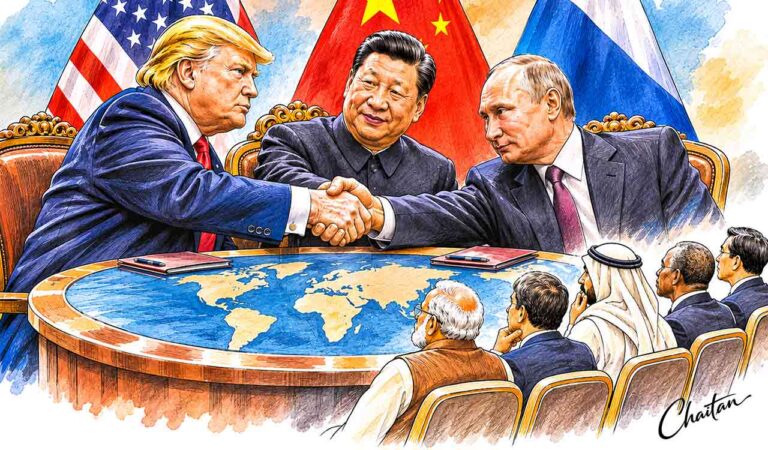
The greatest danger for middle powers may not be great-power confrontation, but great-power accommodation. When two elephants fight, the grass suffers, Singapore’s founding Prime Minister Lee Kuan Yew famously observed, referring to the US-China rivalry. But what happens when elephants stop fighting and begin doing business with each other? The grass may still suffer. The emerging geopolitical landscape suggests that countries caught between competing powers must prepare for both possibilities.
US President Donald Trump’s decision to facilitate to ease fuel prices ahead of the November 3 midterm elections illustrates this changing calculus. Washington has relaxed restrictions on Russian fuel transactions despite its earlier efforts to deprive Moscow of energy revenues following its invasion of Ukraine. The move demonstrates how domestic political and economic considerations can override strategic commitments, leaving Ukraine and European allies uncomfortable.
G2 Expression
The emergence of the expression adds another dimension. Washington and Beijing remain strategic competitors, but economic interdependence creates incentives for selective accommodation. Trade, agricultural purchases, aircraft sales and access to critical minerals have become bargaining instruments.
Trump’s pursuit of Chinese soybean purchases, Boeing aircraft orders and rare earth supplies, alongside indications of a willingness to moderate aspects of American policy towards Taiwan, illustrates this transactional approach. Such accommodation need not constitute a strategic partnership to affect other countries.
Russia, meanwhile, is not necessarily a permanent partner of either power. Its growing economic dependence on China coexists with Putin’s ability to engage Trump directly as a political equal. The three permanent members of the UN Security Council can also find common ground on questions concerning the international system, including its leadership, when their interests converge. Such temporary convergence can leave partners with fewer options than an outright confrontation. Yet a US-China accommodation is unlikely to be durable, given unresolved differences over Taiwan, technology and strategic influence.
It was against this backdrop that Canadian, addressing the World Economic Forum in Davos in January, urged middle powers to recognise their collective strength. His warning was stark: countries that fail to secure a place at the negotiating table risk finding themselves on the menu. Adherence to a rules-based international order can no longer be taken for granted as a guarantee of protection. Nor can submission to powerful countries ensure security. Middle powers must build coalitions, diversify economic relationships and reduce strategic vulnerabilities rather than negotiate individually from positions of dependence.
Nearly ten months later, the response to Carney’s appeal remains uneven. Many countries, however, were already diversifying trade and securing alternative supply chains. Europe’s response to Trump’s pressure over Greenland demonstrated that collective resistance could impose political costs. Denmark and Greenland received European backing.
From India to Europe and Asia, middle powers must safeguard their strategic autonomy through stronger coalitions, economic resilience and technological independence as great-power bargains reshape the global order
The agreement signed by the United States, on September 22 subsequently expanded American security involvement without transferring sovereignty. Trump moved away from the demand for ownership towards an enhanced security arrangement. The episode demonstrated both the possibilities and limits of coordinated resistance.
Asia Example
Asia offers another illustration. Japanese Prime Minister Sanae Takaichi has refused to retract her remarks suggesting that a Chinese attack on Taiwan could threaten Japan’s national security. Beijing’s diplomatic and economic pressure, including restrictions affecting critical minerals, has not produced the desired reversal. Japan’s position shows that economic exposure does not automatically translate into political compliance. However, not every middle power possesses comparable resilience or strategic leverage.
What constitutes a middle power? The category is not determined by size alone. It includes countries with sufficient economic weight, industrial and technological capabilities, regional influence, diplomatic networks or military strength to affect international outcomes, without being able to shape the independently.
Australia, Canada, Indonesia, Japan, Mexico, South Africa, South Korea, Türkiye, Brazil and India broadly fit this description. Smaller countries can also exercise disproportionate influence through control of critical technologies. The Netherlands and Taiwan, for instance, occupy important positions in the semiconductor ecosystem. Israel, Saudi Arabia and the UAE possess distinct military, financial or technological leverage.
These countries are far from homogeneous. Established supporters of the existing international order include Australia, Britain, Canada, Japan, South Korea and European countries. Russia, Iran and North Korea possess considerable military capabilities but face economic constraints and varying degrees of international isolation. Brazil, India, Indonesia, Mexico, Pakistan, South Africa and Türkiye seek greater strategic autonomy, although their interests and capacities differ.
Smaller but ambitious states such as Israel, Saudi Arabia, Taiwan and the UAE exercise influence beyond what their size alone might suggest. Canada’s abundant oil, gas and hydroelectric resources, for example, give it greater capacity to withstand external pressure than many other middle powers. Not all can afford comparable assertiveness.
The difficulty is that collective action remains easier to advocate than to organise. European resistance over Greenland was a relatively low-cost exercise in solidarity. Confronting would be altogether different. No coalition can confidently assume that it could compel Beijing to abandon military action through diplomatic pressure alone.
Europe’s interest in a stronger French nuclear umbrella and greater defence procurement from European suppliers reflects growing doubts about traditional security guarantees. Gulf countries’ interest in South Korean air-defence systems also illustrates how shortages of American interceptors can reshape strategic partnerships.
Makkah Pact
The signed by Pakistan, Saudi Arabia and Türkiye in August 2026 offers another example of countries seeking collective deterrence. Its provision that an armed attack against one signatory would be treated as an attack against all three is significant. Whether the arrangement becomes an effective security framework will depend on institutionalisation, military coordination and the willingness of members to honour their commitments. Agreements alone do not create credible collective power.
Artificial intelligence presents perhaps the starkest illustration of middle-power vulnerability. The United States and China are far ahead in the competition to develop and control this strategically consequential technology. Middle powers risk dependence on their platforms, computing infrastructure and technological ecosystems. Calls for responsible AI governance will carry limited weight unless these countries develop domestic capabilities, pool resources and secure meaningful participation in technology value chains.
For India, the challenge is not to choose between the American and Chinese camps or assume that a coalition of middle powers will automatically emerge. requires more than diplomatic flexibility. It rests on economic resilience, technological capacity, credible military strength and partnerships capable of withstanding shifting great-power calculations.
India has the scale and influence to help shape such coalitions, but also the vulnerabilities that make collective action necessary. In an international order where even great-power partnerships are increasingly transactional, the central question is not simply who fights the elephants, but who decides what happens when they make a deal.
(The author commanded 15 Punjab in Lebanon under United Nations Flag, commanded 27 Sector as DIG in Churachandpur and was Brigadier, Operational Logistics, in HQ Western Command. He is currently an analyst on geopolitics, international and defence affairs)