
Opinion: Play on local: Rethinking educational games for Indian classrooms
By Manish Narvade
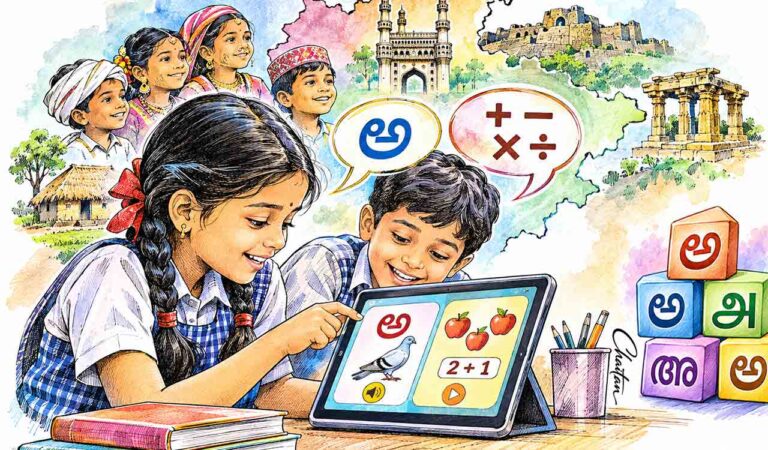
A child learning to read in Telugu may encounter a word that is pronounced differently across regions, while the same child learning mathematics must grasp underlying arithmetic concepts in a different linguistic environment. Designing an educational game for both these subjects requires more than translating instructions or adding points and rewards to digital games. It demands an understanding of how children learn, the language they speak, the dialect they use, the communities they belong to, and the institutions that support their education.
This remains a central challenge in integrating game-based learning (GBL) and gamification into foundational literacy and numeracy (FLN) in India. With and socio-cultural contexts, varied curricula and unequal access to digital infrastructure, India cannot assume that a single model of educational gaming will work equally well in every State. Besides, considerable regional and cultural diversity also exists within districts.
For instance, Hyderabadis are influenced by Dakhani, a linguistic variety shaped by Hindi, Urdu, and Telugu, while districts like Adilabad and Nizamabad have Marathi influence, and Mulug has Hindi influence. The challenge is not simply to make learning enjoyable, but to develop approaches that are pedagogically sound, culturally relevant and adaptable to children’s diverse learning needs.
Limits of Engagement
Research has shown that games can complement conventional teaching methods by making learners active participants rather than passive recipients of information. In learning, games can help children develop the ability to read, write, and work with numbers. Gamified applications have demonstrated effectiveness in improving student performance, with outcomes comparable to those of traditional pen-and-paper exercises in some settings.
Gamified applications have demonstrated effectiveness in improving student performance, with outcomes comparable to those of traditional pen-and-paper exercises in some settings. Their value lies not merely in making an activity entertaining, but also in encouraging repeated practice, providing feedback and sustaining attention. A child reluctant to practise reading may be more willing to attempt an exercise when progress is presented through stages and challenges.
Consider a game in which a schoolgirl from Telangana embarks on a journey to reach the historic Warangal Fort. Along the way, she deciphers clues, solves mathematical puzzles, and overcomes obstacles inspired by the region’s history. This approach makes learning more than a classroom activity—becoming the means of reaching a goal.
One Country, Many Contexts
India’s diversity makes this challenge particularly consequential. Educational gaming must accommodate differences in language, curriculum, classroom resources, teacher preparedness and children’s sociocultural experiences. These are not independent considerations; they influence one another and determine whether a game is accessible, meaningful and educationally effective.
Language presents another set of challenges. In , for instance, the pronunciation of a word may differ from its standard form. The standard Telugu veḷtāḍu (‘he goes’) may be pronounced eltāḍu in colloquial Telangana speech, illustrating how regional dialects shape spoken language. Similarly, a game developed around one linguistic context cannot simply be assumed to function appropriately in Hindi, Telugu, Tamil or Marathi-speaking classrooms.
An educational game must account for the relationship between spoken language and written text, as well as the linguistic experiences children bring from home
The difficulty extends beyond translation. Foundational literacy involves recognising sounds, connecting them with written symbols, understanding words and developing comprehension. An educational game must account for the relationship between spoken language and written text, including the linguistic experiences children bring from home.
A technically functional application may still fail pedagogically if its vocabulary, instructions or examples are unfamiliar to the intended learners. Developing a common repository of questions and responses across regions is therefore not merely a technological exercise; it requires linguistic validation and pedagogical judgement. For children from marginalised communities, this challenge also has a cultural dimension. Their experiences, local knowledge and everyday environments differ considerably.
Numeracy offers a somewhat different opportunity. Addition, subtraction and multiplication retain their underlying mathematical relationships across regions, making it possible to develop shared conceptual frameworks for numerical games. Literacy games require particularly careful attention to language, pronunciation, scripts and meaning, while numeracy games can draw more readily on shared mathematical concepts. Neither can be designed effectively without considering children’s developmental stages.
Behind Effective Games
Learning requirements differ from one learner to another. A Class 2 student, for instance, may not be expected to solve a division problem such as 144/12 or multiply three-digit numbers. Designing appropriate learning levels is therefore a complex task that requires the expertise of State Councils of Educational Research and Training (SCERTs) and experienced teachers.
These challenges make institutional collaboration indispensable. The central government can help establish common objectives, technical standards and an underlying architecture for educational technology. Such a framework can provide consistency, enable interoperability and reduce the need for every State to build an entirely separate system.
However, a common architecture cannot provide all the linguistic and pedagogical knowledge required for implementation. That responsibility necessarily involves State governments and their , which are better positioned to account for regional languages, curricula, learning contexts and administrative arrangements.
SCERTs and District Institutes of Education and Training (DIETs) can contribute to adapting content, developing learning materials and supporting teachers. Experienced teachers and headmasters can help identify whether questions are age-appropriate, instructions are understandable, and game mechanics reinforce the intended .
Their classroom experience is particularly valuable because it connects technical design with the realities of . Technology developers, in turn, must translate these pedagogical requirements into applications that function reliably across different devices and infrastructure conditions.
The process should be collaborative. If educational games are designed centrally and local teachers are asked to implement them only after development is complete, important contextual problems may be discovered too late. Conversely, if every State develops its own system without shared technical standards, opportunities for , reuse and consistent quality assurance may be lost.
Measuring Learning
The broader challenge is to distinguish an intervention’s appeal from its effectiveness. A game may generate enthusiasm, high participation and repeated use, yet provide little evidence that children are becoming better readers or more confident with numbers. Developers must identify the specific skill a game intends to strengthen and establish how improvement will be measured. Literacy activities should be assessed against relevant reading and writing outcomes, while numeracy games should be evaluated against the mathematical competencies they seek to develop.
Context also matters when interpreting results. A game that works in one sociocultural setting may require adaptation before it can be used elsewhere. Furthermore, gamification has been more frequently applied to STEM-related subjects than to areas associated with the humanities and social sciences in primary education. Developers must consider the distinctive demands of different subjects rather than assume that one model can be transferred everywhere.
India’s FLN challenge cannot be solved by making every classroom use the same game. Nor does linguistic and cultural diversity make educational gaming impractical. The task is to distinguish between what should remain common and what must be adapted.
(The author is Research and Communications Lead, VOPA)