
Opinion: Reclaiming Public University —autonomy, power and academic freedom
By Akhilesh Kumar
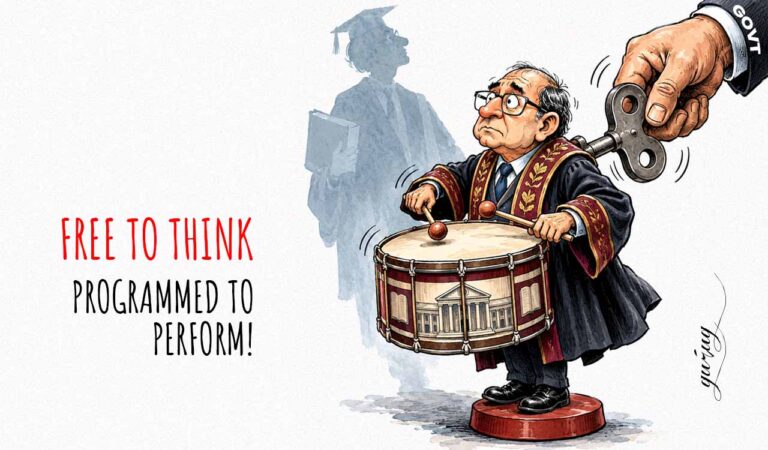
A university is not merely a place where degrees are awarded and students are prepared for employment. It is a social institution where inherited assumptions can be questioned, dominant ideas challenged, and different experiences brought into conversation. Its purpose is not simply to produce skilled workers but also to cultivate independent thinkers and democratic citizens.
Yet, when universities come under increasing political influence, their capacity to perform this function begins to weaken. The question is no longer simply whether universities are functioning, but whether they remain free to think. The Free to Think 2026 report by Scholars at Risk classified academic freedom in , citing increased government involvement in university governance, appointments, and campus expression. Examining developments between July 2025 and June 2026, the report raises serious concerns about the relationship between political authority and academic independence.
University autonomy is fundamentally about the freedom to produce, question, and disseminate knowledge. It determines whether academic institutions can make decisions based on scholarly considerations rather than political convenience.
Appointments to senior positions, including those of vice chancellors and professors, shape institutional priorities, recruitment, and the campus environment. When selection processes lack transparency or academic independence becomes secondary to political considerations, institutional credibility suffers.
The centralisation of decision-making can further weaken the participation of faculty members, academic bodies, and students in shaping university policies. When decisions affecting curricula, research priorities, and campus life are made without meaningful consultation, universities risk becoming extensions of external authority rather than autonomous intellectual communities. Public funding and regulatory oversight are necessary, but they must not become instruments of political control.
Politics of Knowledge and Dissent
Universities have never existed outside society. Curricula reflect choices about which histories to remember, whose contributions to recognise, and which intellectual traditions to prioritise. The question is not whether universities should engage with national or cultural questions, but whether these can be examined critically.
When particular ideological interpretations receive institutional preference while competing perspectives are marginalised, academic freedom narrows. restrictions on academic events, and pressure surrounding research can influence not only what is taught but also what teachers and students feel safe discussing.
A university’s success should be measured not merely by rankings or placements but by its ability to produce independent thinkers, challenge social hierarchies, and sustain democratic debate
Academic freedom does not disappear only when a scholar is dismissed or a student is punished. It also weakens when researchers avoid critical questions, teachers hesitate to introduce critical readings, and students remain silent for fear of institutional consequences.
A university that celebrates in official statements but treats legitimate criticism as indiscipline undermines its own purpose. Students must be able to question administrators, challenge government policies, and organise peacefully without automatically being regarded as threats to institutional order.
Inclusion Without Belonging
The crisis of university autonomy also has a social dimension. Public universities have historically expanded educational opportunities for communities excluded from privileged educational spaces. Yet admission alone cannot guarantee equality.
For students from Dalit, Adivasi, minority, working-class and other marginalised backgrounds, entering a university may represent a significant break with generations of educational exclusion. However, physical access does not necessarily translate into intellectual recognition or social belonging.
requires examining how knowledge is produced, whose scholarship is recognised and which histories are preserved. Autonomy and inclusion are therefore interconnected. Without academic freedom, marginalised scholars may struggle to challenge established hierarchies.
Without inclusion, autonomy can become a privilege enjoyed primarily by those who already possess social and institutional power. A genuinely public university must protect both the freedom to question and the right to be heard.
A university is also a space of socialisation where students encounter differences beyond their immediate social worlds. However, when student associations, public meetings, peaceful demonstrations and campus discussions face excessive restrictions, this social function weakens. transforms the campus from a space of democratic engagement into an increasingly controlled administrative environment.
Peaceful dissent cannot be equated with violence, and criticism cannot automatically be treated as disruption. The greater danger is that students may graduate having learnt how to comply with authority but not how to question it.
Whose University Is It?
Restoring university autonomy requires more than declarations in favour of academic freedom. Recruitment and appointments must follow transparent procedures. Academic bodies must retain meaningful decision-making powers, and faculty members must be able to pursue research without ideological interference.
Students must have protected avenues for peaceful protest, association and expression. Universities must strengthen grievance-redressal mechanisms, protect scholars against arbitrary disciplinary action and ensure institutional rules are applied consistently.
must not become an institutional privilege reserved for administrators. It is a shared condition of intellectual life, protecting teachers, researchers and students alike. Governments have a legitimate role in funding and regulating higher education, but that role must preserve the independence necessary for universities to question public power.
Ultimately, the crisis of public universities is not only about governance, funding or It concerns the kind of society higher education is expected to create. When appointments become opaque, scholarship becomes vulnerable to ideological pressure, dissent invites punishment, and inclusion remains symbolic, the university loses its democratic character.
The question “Whose university is it?” therefore demands a clear answer. A public university must not belong exclusively to the government of the day, its administration or any particular ideological tradition. It must serve society, including those whose voices and experiences have historically been excluded.
A university must remain a place where students can learn and unlearn, where authority can be questioned, and where difference enriches intellectual life. Its success should be measured not merely by rankings or placements but by its ability to produce independent thinkers, challenge social hierarchies, and sustain democratic debate.
The freedom of a university is ultimately measured by how it When that freedom disappears, the loss extends beyond the campus: democracy itself becomes poorer.
(The author is a PhD Research Scholar at Jamia Millia Islamia, New Delhi, and an independent writer)