
Opinion: Don’t ‘fix’ young people — understanding India’s youth mental health crisis
By Ankita Sharma, Souryabrata Mohapatra
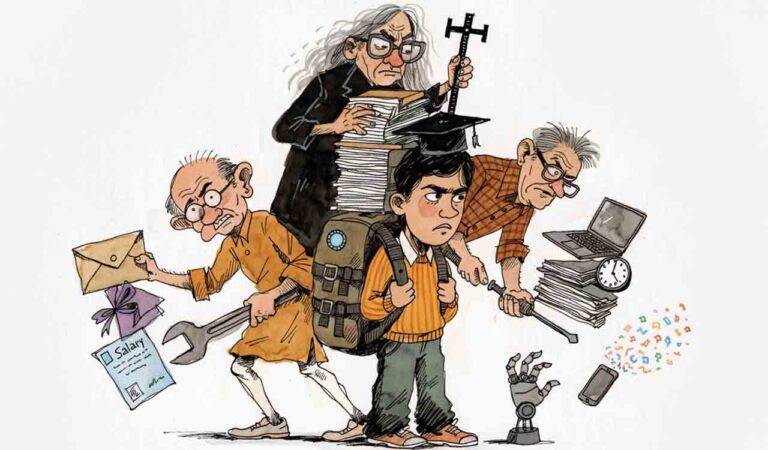
As the world prepares to mark World Mental Health Day on October 10, India faces a difficult question: are we really understanding what is happening to our young people?
The warning signs are everywhere: in classrooms, coaching centres, universities, homes and workplaces. When a young student takes their own life or a young professional reaches a breaking point, public attention briefly turns to , , workplace stress or family expectations. But these explanations often focus on the final trigger rather than the accumulated pressures beneath it.
India is home to one of the world’s largest youth populations. What happens to the emotional and psychological well-being of this generation will shape not only individual lives but also the social and economic fabric of the country. Yet the conversation remains too often reduced to a simple phrase: the mental health crisis of digital youth. The reality is considerably more complicated.
Hyperconnectivity, Disconnection
Young people today have unprecedented access to information, communities and opportunities. Yet greater connectivity has not necessarily produced greater emotional connection.
Growing up with continuous digital access means navigating an endless stream of information, opinions and choices. The challenge is no longer simply accessing information; it is determining what is true. Misinformation, deepfakes, AI-generated content and unverified claims require constant vigilance. For young minds already dealing with academic and career pressures, this continuous cognitive demand can become exhausting.
India’s youth mental health crisis cannot be reduced to exams, social media or workplace stress. Behind these triggers lie layers of academic pressure, family expectations, career uncertainty, digital overload and a rapidly changing world
There is another paradox closer to home. In India, family networks have traditionally served as an important emotional safety net. But physical proximity does not automatically guarantee emotional presence. Parents may be absorbed in work messages, grandparents in short-video feeds and young people in their own social media worlds. The phenomenon of phubbing, ignoring people physically present because of one’s phone, can turn a connected household into an emotionally distant one.
Even family WhatsApp groups, intended to maintain connection, can become sources of information overload, health scares, ideological disagreements and social expectations. The result is a strange contradiction: we may be more digitally connected than ever while feeling increasingly disengaged.
Personal Pressure
For young Indians, these pressures do not exist in isolation. Academic expectations, , family scrutiny and changing relationships increasingly overlap.
In a collectivist society, examination results, university admissions, jobs, salaries and relationships are often discussed not merely as personal matters but as matters of family reputation and expectation. A poor academic result can therefore feel like more than a temporary setback. It can become a perceived failure to meet an entire network of expectations.
The transition from education to employment adds another layer. The traditional promise that hard work will necessarily deliver long-term stability has become less certain. Artificial intelligence is transforming occupations and entry-level work, forcing young people to ask not only what career they want, but whether that career will exist in its current form.
At the same time, young people are growing up against a backdrop of climate disasters, geopolitical conflict, economic instability and technological disruption. The result is what might be called a continuous background noise of uncertainty.
Previous generations could plan their futures largely around personal circumstances. Today’s young people increasingly have to ask a larger question: Will the world itself remain stable enough to accommodate the future I am planning?
The Danger of Blaming
When a young person breaks down, the public response can quickly become individualistic: they could not handle stress, they lacked resilience, they were too sensitive, or they overreacted.
Such explanations miss the accumulated nature of distress.
The immediate event may be an examination result, a relationship breakdown, workplace conflict or job uncertainty. But the event itself may simply be the final weight placed on an already overloaded structure. What appears from outside to be an isolated reaction can be connected to months or years of loneliness, uncertainty, cultural expectations and emotional exhaustion.
This is why terms such as burnout, emotional exhaustion and even emerging behaviours such as “bed rotting”, remaining in bed for prolonged periods while scrolling, or disengaging from daily life deserve to be understood in context rather than dismissed as laziness or weakness.
The academic phase of youth can become particularly difficult when self-worth is closely tied to . Later, the career phase presents a different challenge: young professionals are expected to demonstrate ambition while simultaneously navigating an unstable labour market and protecting their mental well-being. Choosing can still be interpreted as a lack of ambition or resilience.
From Surviving to Feeling Valued
Yet it would be a mistake to portray today’s youth only as a generation in crisis. There is another side to this story: .
Young people are challenging long-standing taboos around therapy, emotional vulnerability, burnout and neurodiversity. They are asking schools and workplaces to recognise that people are more than their grades, salaries or productivity. They are also using their unprecedented connectivity to organise around social justice, climate accountability and human rights.
The challenge, therefore, is not to “fix” young people. It is important to understand the environment in which they are trying to grow.
Schools and universities need spaces where does not become a judgment on personal worth. Families need to rediscover the importance of listening without immediately judging, comparing or advising. Employers need to recognise that sustainable productivity cannot be separated from human dignity. And public conversations about youth distress must move beyond searching for a single culprit.
The deeper crisis is not simply that young people are stressed. It is that many are trying to construct an identity, relationships and a future in a world whose rules appear to be changing constantly.
The question before us is therefore not merely how to make young people more resilient. It is whether we are willing to create environments in which resilience is not constantly demanded of them.
If we want today’s young people to build tomorrow’s India, they must feel more than productive. They must feel safe, heard and valued.
(The authors are Full Professor of Psychology and Assistant Professor of Economics at IIT Jodhpur, respectively. Views expressed are personal and do not necessarily reflect those of the institution)