
Rewind: Pranahita–Chevella and Kaleshwaram — Rhetoric vs Reality
By Chandri Raghava Reddy
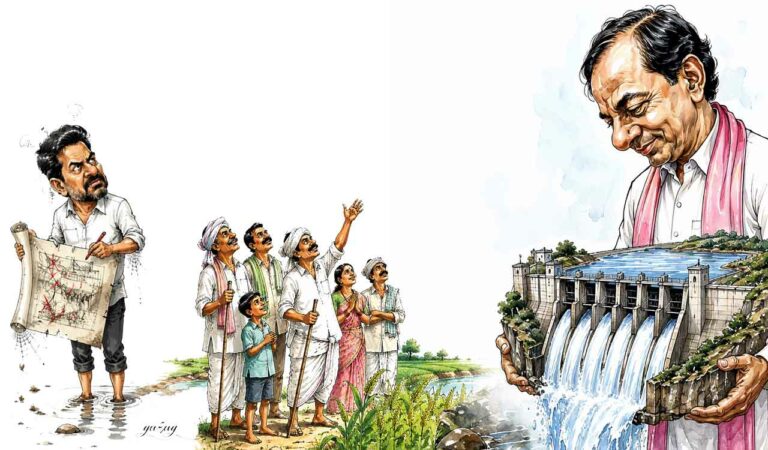
Artificial intelligence, for all its analytical power, is often driven by rhetoric. It can reproduce official statements, polished reports, and visionary promises with ease. But unless probed critically, AI risks echoing the surface language of politics rather than exposing the truth beneath. My dialogue with AI on the Yellampally reservoir and the Pranahita–Chevella project illustrates this danger.
At first, AI repeated the Congress government’s claim of irrigating 16–20 lakh acres, leaning on the 2010 detailed project report (DPR) as if it were a concrete plan. Only through persistent questioning and critical guidance did the gaps become clear: no reservoir capacities mentioned, no detailed cost estimates were provided, no land acquisition, no funds.
The Congress Vision
In 2010, the Congress government submitted a DPR for the irrigation scheme, promising to lift 160 TMC of water from the Pranahita River into the Yellampally reservoir and irrigate 16–20 lakh acres across Telangana’s drought-prone districts. On paper, it sounded transformative. The DPR spoke of canals stretching over 1,055 kilometres, tunnels cutting through ridges, and vague references to “balancing reservoirs along the canal alignment” and a “terminal reservoir near Chevella.”
However, beneath the grand language, the plan remained largely schematic. While some balancing reservoirs downstream of were named, their storage capacities and the specific ayacut to be served by each were not clearly defined. Precise pumping station sites were not finalised, detailed cost estimates for each lift stage were missing, land acquisition plans were incomplete, and fund allocation beyond DPR preparation and limited package advances was not secured for full execution.
The promise of irrigating 16–20 lakh acres therefore remained a statement of intent rather than a workable blueprint. It was politically visionary, but it delivered no completed intermediate reservoirs, no functioning lift chain, and no irrigation benefit to the farmers who were told the project would transform their lands.
Exposing the Gaps
This truth becomes clear only when one moves beyond the surface of the DPR. In my conversation, the AI initially relied on the official language available on the websites, repeating the promises as though they were technically grounded. In fact, it mistook information from the DPR 2010, which was revised later, after 2014, as the original.
I then challenged AI to look more critically. I pointed out that the Congress plan, while naming certain balancing reservoirs, still relied heavily on generic engineering phrases such as “balancing reservoirs” and “intermediate storages” without clear storage capacities, specific ayacut under each reservoir, fixed pumping-station sites, or detailed stage-wise cost estimates.
I also pointed out that land acquisition remained incomplete, that only limited funds had been released (mainly package advances and partial works), and that canal excavation was partial at best. From the perspective of the drought-prone farmers who were promised relief, none of this translated into water on their fields.
By insisting that AI should “call a spade a spade,” I prompted it to recognise that the plan, whatever its stated engineering intent, functioned more as a political promise than as a project that delivered irrigation. This process of questioning was essential: it exposed the difference between rhetoric and reality — between a grand announcement that produced no water for the drought-prone farmers and a later redesign that moved actual infrastructure onto the ground.
From Promise to Execution
The contrast with what followed after 2014 is striking. The BRS government, under Chief Minister K Chandrashekar Rao, redesigned the project into the Kaleshwaram Lift Irrigation Scheme (KLIS). Unlike the earlier Congress DPR, was action oriented. It shifted the source to Medigadda barrage on the Godavari, introduced a chain of barrages — Medigadda, Annaram, Sundilla — and named balancing reservoirs such as Mallannasagar and Kondapochamma with defined capacities.
Pumping stations were precisely located, canal alignments were mapped, costs were estimated at over Rs 80,000 crore, and land acquisition was carried out. Contracts were awarded, construction undertaken, and pumping stations and barrages built. For the farmers in the target districts, this difference was decisive: the earlier plan left them with announcements; the redesigned project put physical infrastructure on the ground.
What the Congress government left largely as rhetoric and limited partial works, the BRS government turned into large-scale execution. The difference is not just technical; it is political. The Congress offered a vision that remained largely schematic and delivered no irrigation benefit, while the BRS delivered specificity, funding, and construction on a scale the earlier plan never achieved.
The story of Pranahita–Chevella versus is not only about irrigation engineering. It is about the politics of promises in India. Grand announcements often precede detailed planning, and promises are made in the hope of electoral gain. Farmers, desperate for relief, are told that salvation is imminent. But when reservoirs remain largely on paper, pumping stations are not built, detailed costs and land acquisition stay incomplete, and no water reaches the fields, these promises remain just words.
The Congress plan for Pranahita–Chevella was precisely such a case: visionary in scale, yet it delivered no completed intermediate reservoirs, no functioning lift chain, and no irrigation benefit to the farmers who were promised relief. The BRS redesign into KLIS, by contrast, demonstrates how political will combined with engineering detail can turn rhetoric into large-scale construction. Whatever one thinks of BRS’ motives, the fact remains that it delivered specificity, funding and where the earlier plan offered mainly intent and limited partial works.
Calling a Spade a Spade
What makes this analysis particularly valuable is the process by which it was reached. Initially, AI repeated the official narrative. I then pressed AI to confront the missing pieces by highlighting the absence of named reservoirs, cost estimates, land acquisition, and funding. In doing so, I encouraged AI to move beyond surface level claims and critically reassess the project. This collaborative process shows how questioning and dialogue can expose the difference between political rhetoric and engineering reality.
Ultimately, the story of Telangana’s irrigation politics is one of versus delivery. The Congress offered a politically appealing vision, but for the farmers in the drought-prone districts it resulted in no completed intermediate reservoirs, no functioning lift chain, and no water reaching their fields. The BRS, on the other hand, delivered specificity, funding, and construction. The contrast is stark: one was a promise to gain votes, the other an implementable project. And it is through critical questioning that this distinction becomes clear.
(The author is Professor, Department of Sociology, University of Hyderabad)